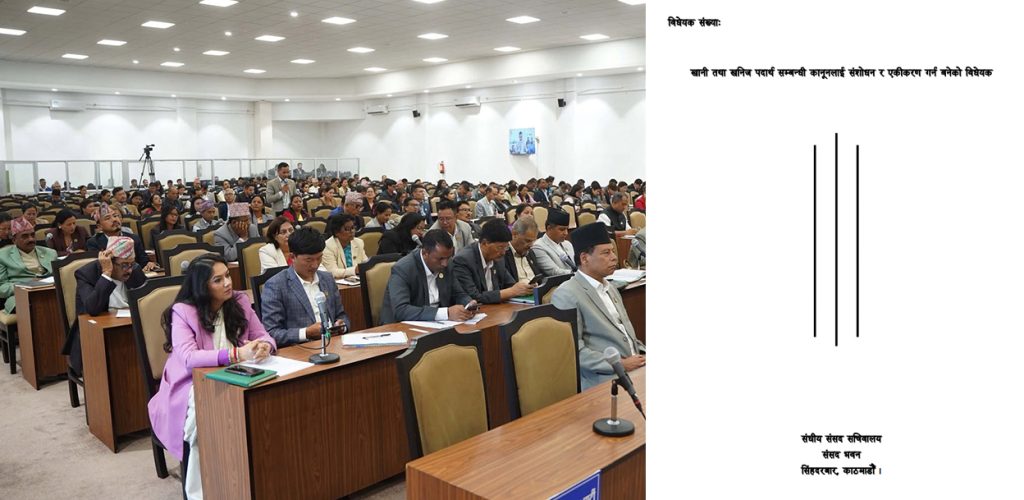
Kathmandu. The parliamentarians have proposed to put legal provisions so that the interests of the future generations should be taken into account when mining minerals. By proposing amendments to the ‘Mines and Minerals Bill 2083’, the parliamentarians sought legal provisions to take into account the interests of future generations.
Members of the House of Representatives, Basana Thapa, Jayapati Rokaya and Reena Upreti (K.C.) have proposed to put provisions related to protection and management of minerals in section (3) of the proposed bill.
“The Nepal government will protect, manage and utilize the natural state of minerals on the surface or underground of any type of land owned by private, community, government or public within Nepal in a way that will benefit the citizens and future generations,” they proposed to write like this.
They propose that the principle of inter-generational justice, environmental sustainability, public interest, transparency and accountability should be written in the law while protecting, managing and using minerals.
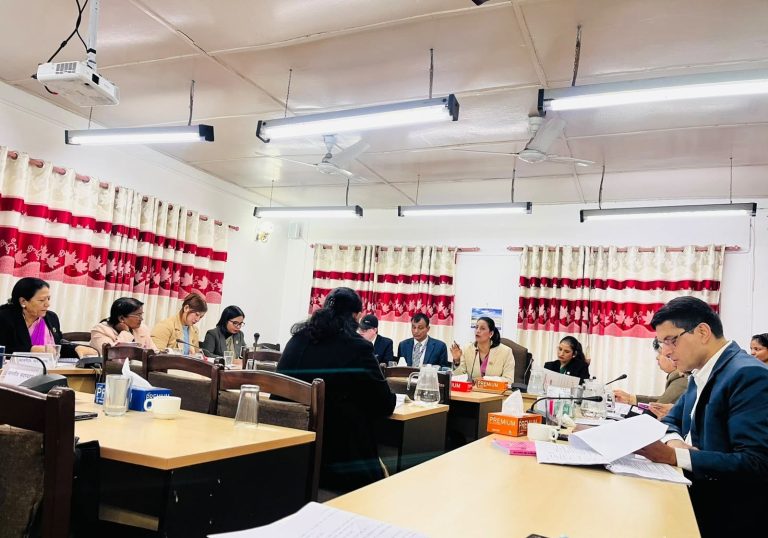
Along with this, the parliamentary subject committee is proceeding with the discussion on the amendments made to this bill. On Monday, the Industry and Commerce and Labor and Consumer Welfare Committee under the House of Representatives is discussing with experts on the Mining and Minerals Bill, 2083. Then the amendment will be discussed with the MPs.
On this bill, the MPs have proposed amendments in 35 groups.
This bill was introduced by Industry, Commerce and Supply Minister Gauri Kumari. On the bill registered in the House of Representatives on July 14, the parliamentarians have filed amendment proposals in 35 groups.
The government has introduced the Mines and Minerals Bill to clarify the rights and responsibilities related to mines and minerals in line with the federal government system.
63 clauses are proposed in this bill, which aims to make the conservation, exploration and extraction of mines and minerals systematic, scientific and sustainable.
Currently, the Mines and Minerals Act 2042 is in force. The bill, which was brought to decentralize the rights in accordance with the time and in accordance with the federal democratic republican governance system by repealing it, has special provisions related to general construction minerals, minerals of strategic and tactical importance and radioactive minerals.
The Constitution of Nepal has divided the powers of the union, state and local levels in matters related to mining and minerals.
According to the Ministry of Industry, the prevailing Mines and Minerals Act, 2042 is a law prior to the implementation of the Federal Government System and is insufficient to cover the needs of the current constitutional system, federal structure, modern mineral administration, environmental responsibility, strategic mineral management and investment promotion.
According to the ministry, the bill has been introduced to make scientific management of minerals and mineral sector, protection of mines and mineral materials, exploration and extraction process more systematic, transparent and easy.
It is mentioned in the bill that the Mining and Minerals Bill has been formulated to regulate strategic, strategic and radioactive minerals, to provide a legal basis for geological research and seismological work and to clarify the coordination and jurisdiction between the federation, state and local levels and to amend and unify the laws related to mining and minerals.