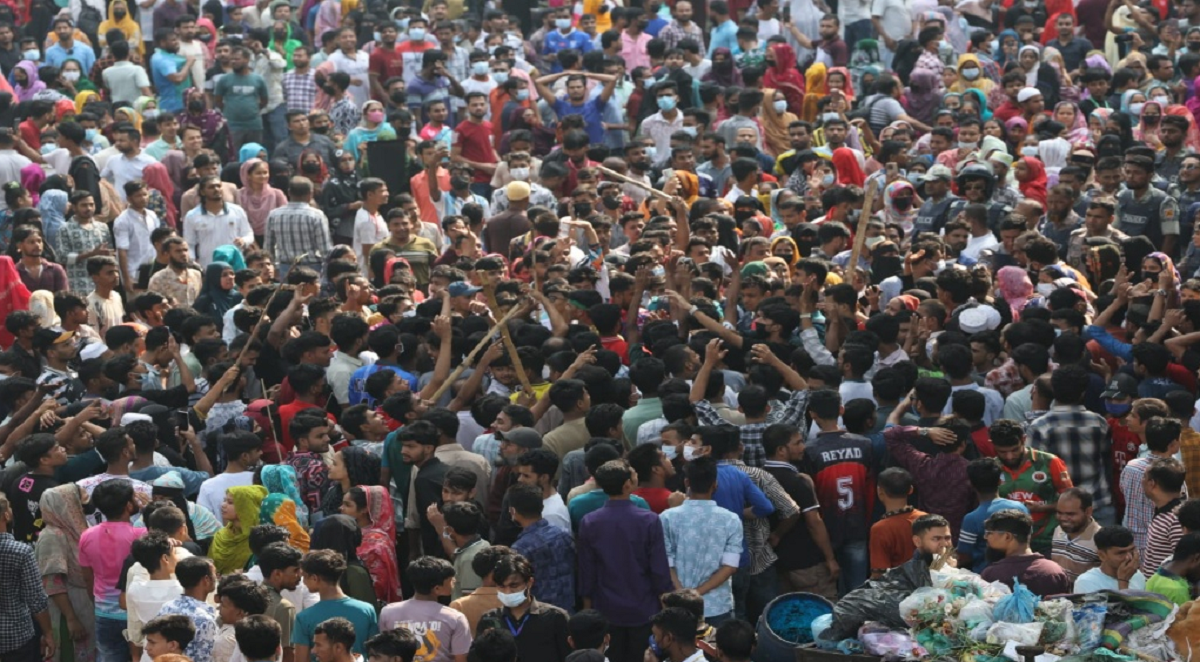
Kathmandu. Garment workers in Bangladesh have taken to the streets demanding an increase in the minimum monthly wage. The production of about 150 industries in major industrial areas of the country has been affected as the labor movement intensified in industrial areas including Ghazipur, Savar and Ashulia.
Yesterday Monday, the workers of ABM Fashion and Jamuna Garment in Konabari area of Gazipur gathered outside the industry refusing to go to work. After they demonstrated by blocking the Konabari-Kashimpur road, the police asked them to open the road. When the workers got angry, the police fired tear gas and sound grenades. After that, the protestors dispersed and the situation returned to normal, said Mohammad Amjad Hussain, Superintendent of Police of Gazipur Industrial Police-2. Police and Border Security Force (BGB) have been mobilized to prevent further tension in the industrial area.
Due to labor agitation, 13 industries in Ghazipur have been closed indefinitely and other industries have also declared temporary holidays. Far East Knitting and Dyeing Industries, Ecotex Limited, Ehsan Composites, various industries under Apex Holding and Mojauddin Textiles are going to be closed.
Likewise, dozens of industries have also been closed in Savar and Ashulia industrial areas. Some industries have been closed indefinitely as per Section 1399100 of the Bangladesh Labor Act, while other industries have given leave to workers due to disruption of work. According to the Bangladesh Garment Manufacturers and Exporters Association (BGMEA), the production of 121 industries in Savar, Ashulia and Ghazipur regions alone was affected on Sunday. As of Monday, the number of industries that have stopped production has reached 148, according to various media.
The main reason for the protest is the difference between the industrialists and the workers regarding the increase in the minimum monthly wages of the workers. At present, the minimum monthly wage of garment workers is 12,500 taka. The labor representatives have demanded that it should be increased to 30,000 to 32,000 taka. But the industrialists have prepared to offer a salary of around 14,500 to 15,500 taka.
In order to reach agreement on this matter, the government has set up a minimum wage board and proceeded with the discussion. A third meeting of the board was scheduled for Monday morning, where industry representatives were scheduled to present their proposals. The government has recommended new wages by the end of November and is preparing to implement them from December 1.
The workers have said that the current wages are not enough to cover the rising costs of housing, food, health and transportation. According to them, a significant increase in the minimum wage is necessary for a dignified living. On the other hand, the industrialists have been arguing that wages should be determined only by taking into account the competition in the international market, the export situation and the economic capacity of the industry.
Bangladesh’s garment industry is the mainstay of the country’s economy and foreign exchange earnings. Being the world’s second largest exporter of ready-made garments after China, Bangladesh has been exporting ready-made garments worth more than US$ 40 billion annually. About 4 million workers are directly involved in this sector.