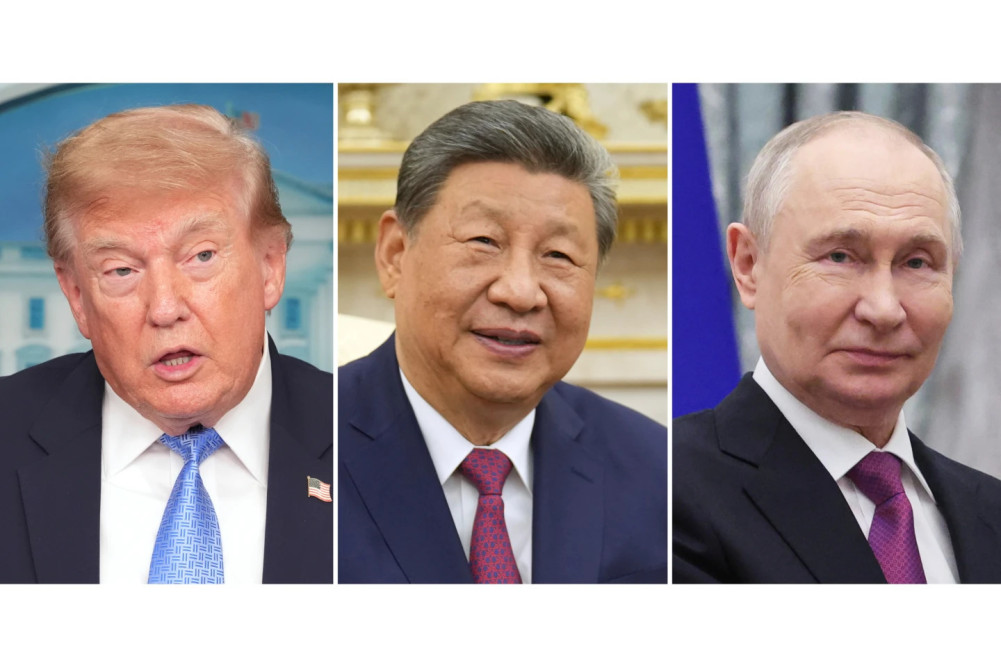
Washington. Three of the world’s most powerful leaders, US President Donald Trump, Chinese President Xi Jinping and Russian President Vladimir Putin, will sit on the sidelines of the APEC summit in Shenzhen, China on Thursday to discuss global issues ranging from the war in Ukraine and Iran to nuclear weapons and artificial intelligence (AI).
This is the kind of talk that political and economists have analyzed that can overshadow the agendas of the main conference. The White House of the US President and the Kremlin of the Russian President have confirmed this meeting. Based on military power, these countries are the three largest countries in the world. Among these, the US and Russia are still fighting a war on different fronts.
For that reason, the meeting of the heads of the three countries is considered to be symbolic. However, the possibility of any big or decisive agreement coming out of this rare meeting is extremely low.
According to two people who have information about the plan, no definite agenda or framework for the meeting has been prepared yet. All these three leaders are appearing on this platform with their own different objectives.
Putin’s goal will be to reach an agreement to end the war in Ukraine. However, the US and China do not want to keep the agenda in this conference. Instead, the leader of the Republican Party, who was badly defeated by the Democratic Party in the recent parliamentary elections, wants to make a tripartite agreement on the control of nuclear weapons.
The “New Start” agreement between the world’s two largest nuclear powers, Russia and the United States, has expired in February 2026. Since then, no new contract has been signed.
Trump’s goal is to get China to sign this agreement as well. However, China is not willing to sign a trilateral agreement with the US-Russia, which has more than 5,000 nuclear warheads.
Although China has been increasing its nuclear stockpile rapidly in recent years, it is estimated that it only has around 500 nuclear warheads. China, which considers its reserves to be small compared to two countries with huge reserves, is not planning to agree to control them.
Trump is known for his impromptu actions and meetings. On the other hand, C usually sits in the negotiation only after adequate preparation. This time, the agenda of the talks has not been decided even to the final stage and China is organizing these talks. Therefore, Beijing is equally cautious about the risk that this dialogue on its own soil could become counterproductive.
Fear of a new ‘Yalta’ conference
This meeting gave a glimpse of the ‘Yalta Conference’ of 1945. At that time, the United States, Britain and the Soviet Union discussed the plan of action after the Second World War, keeping other countries out.
During the discussion, it was agreed to formalize the various spheres of influence of the powerful countries, to set the foundation of the United Nations and to ensure the veto power of the permanent Security Council countries. Because of this agreement, after the Second World War, small countries were forced to accept the agreements imposed by the big powers.
Ukraine and European countries are afraid that this conference could become a new form of Yalta. Ukrainian President Volodymyr Zelensky has expressed his suspicion that this could weaken the role of Europe and Ukraine. “We really do not want to see this meeting turn into ‘Yalta 2, 3, 4’ of redistributing spheres of influence,” he said last month.
On the other hand, Russian nationalists have been excited by the ‘new look of Yalta’ comment. Because it could open the door to an agreement to end the four-year-old conflict in Ukraine in a way favorable to Moscow. Likewise, it will bring back the legacy of Russia that was lost after the Soviet era, even if only in symbolic form.
Alexander Dugin, a Russian nationalist thinker, said that the mere holding of this meeting will elevate Russia to the level of a superpower along with China and America. Speaking to state-run radio Sputnik this week, he said, “It shows who is important in the world.” That is us, China and Western countries. This is very symbolic. This meeting is confirming the multipolar world which the western countries have been rejecting before.
For China, the scene is a bit uncomfortable, because it was not invited to the 1945 meeting. At that time, China was busy fighting Japan’s expansionist policy.
The People’s Republic, i.e. modern China, had not yet been built. Since Mao founded the People’s Republic of China in 1949, he has always tried to present himself as an advocate for small countries.
Instead of participating in a club dominated only by limited superpowers, China considers it in its interest to maintain equality and equidistant relations with all the small and large countries of the world.
For China, which has been advocating a multi-polar world system and the strong presence of developing countries in it, it is a step against its own beliefs to make an agreement with two big powers by leaving out many countries in the world.
According to Chinese professors who spoke to Reuters, Beijing cannot accept Trump’s proposal for nuclear talks. Similarly, he has to avoid making big decisions by meeting only the heads of state of the two countries. China wants the meeting to be limited to an informal or limited-scope meeting rather than a platform for major deals.
Because, he does not interfere at all in the political disputes and internal affairs of other countries of the world. Instead, it uses large international forums to raise important issues.
Despite all these discomforts, Xi is organizing this meeting on Thursday. Relations between Beijing and Moscow have been deepening in recent years through the exchange of oil and gas trade and military knowledge. Despite this, they have adopted different approaches to this possible tripartite meeting.
According to a person familiar with the preparations for the meeting and a European diplomat, while Moscow has sought to discuss the Ukraine war, Beijing has strongly resisted putting the issue on the agenda.
On Friday, a US official said that Trump is unlikely to raise the issue of the Ukraine war and that the trilateral talks are not the appropriate forum for that. The US itself is mediating the Russia-Ukraine war and wants to take credit for ending the entire war. In this conversation, Trump wants to discuss the issue of ending the Iran war.
Speaking to reporters on Monday, Putin’s spokesman Dmitry Peskov said, “Suggestions are being exchanged regarding the possible agenda.” However, this meeting will certainly be interesting. And, it will naturally attract the attention of people all over the world.
This is what Trump wants. Only recently, the Democratic Party won the majority in both houses in the US parliamentary elections. It will be difficult for Trump to implement his policies after the new US lawmakers are sworn in in January. Even before that, he may be trying to achieve some major political successes in foreign policy.
A new deal on nuclear weapons or help to end the war with Iran could add to his political legacy. Kurt Tong, managing partner of Asia Group Consultancy and a former senior State Department official, said, “President Trump will try to use this visit to re-establish his leadership ability, demonstrate his statesmanship and mainly show his influence on the international stage.” Reuters