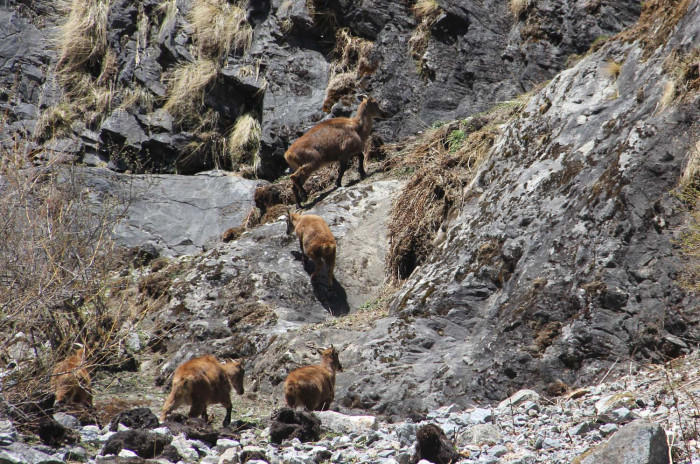
Gandaki Stray dogs have become a challenge in the conservation of rare wildlife found in the Annapurna Conservation Area. Wild dogs attack and prey on wild animals such as musk deer and naur. Dr. Ravin Kadaria, head of the Annapurna Conservation Area Project, said that despite efforts to control and manage stray dogs, the attack of stray dogs on wildlife has not stopped.
According to him, last year 2082 and 83, four musk deer died due to the attack of stray dogs in Humdema, Manang. In the year 2081-82, one musk deer in Humde and in the year 2080-81 three musk deer in Mustang, one fox, one red deer in Ghandruk in Kaski and one naur in Manang were hunted by stray dogs.
“Wildlife in the Annapurna conservation area has become a prey to stray dogs every year”, said Dr. Kadaria, head of the project, “Last year only 355 dogs were sterilized for dog control.” He says that domesticated dogs with violent nature and left unattended attack wild animals.
Locals say that stray dogs also attack domestic animals. In the Himalayan and high mountain areas, stray dogs are more likely to attack children in Chauri. Dr. Kadaria, the head of the project, said that such dogs also cause trouble to the tourists visiting the conservation area. He said that an awareness campaign will also be conducted in the community to prevent dogs from being abandoned.
Along with the attack of stray dogs, wild animals die in this area due to illegal poaching, vehicle collisions etc. According to the project office statistics, 25 wild animals were poached in the last three years and seven wild animals died due to vehicle collisions.
“Most of the wild animals are hunted by setting traps and using homemade guns”, said project leader Dr. Kadaria, “Security patrols have been increased to control poachers, and drone surveillance has also been done.” The Annapurna Conservation Area is considered important in terms of biodiversity, covering 87 wards of 15 local levels in Kaski, Lamjung, Manang, Myagdi and Mustang.
This area is famous for animals like snow leopard, musk deer, naur, Himalayan thar and mountain flora. The head of the project, Dr. Kadaria, said that various types of wild mammals, rare birds and reptiles can be found here.