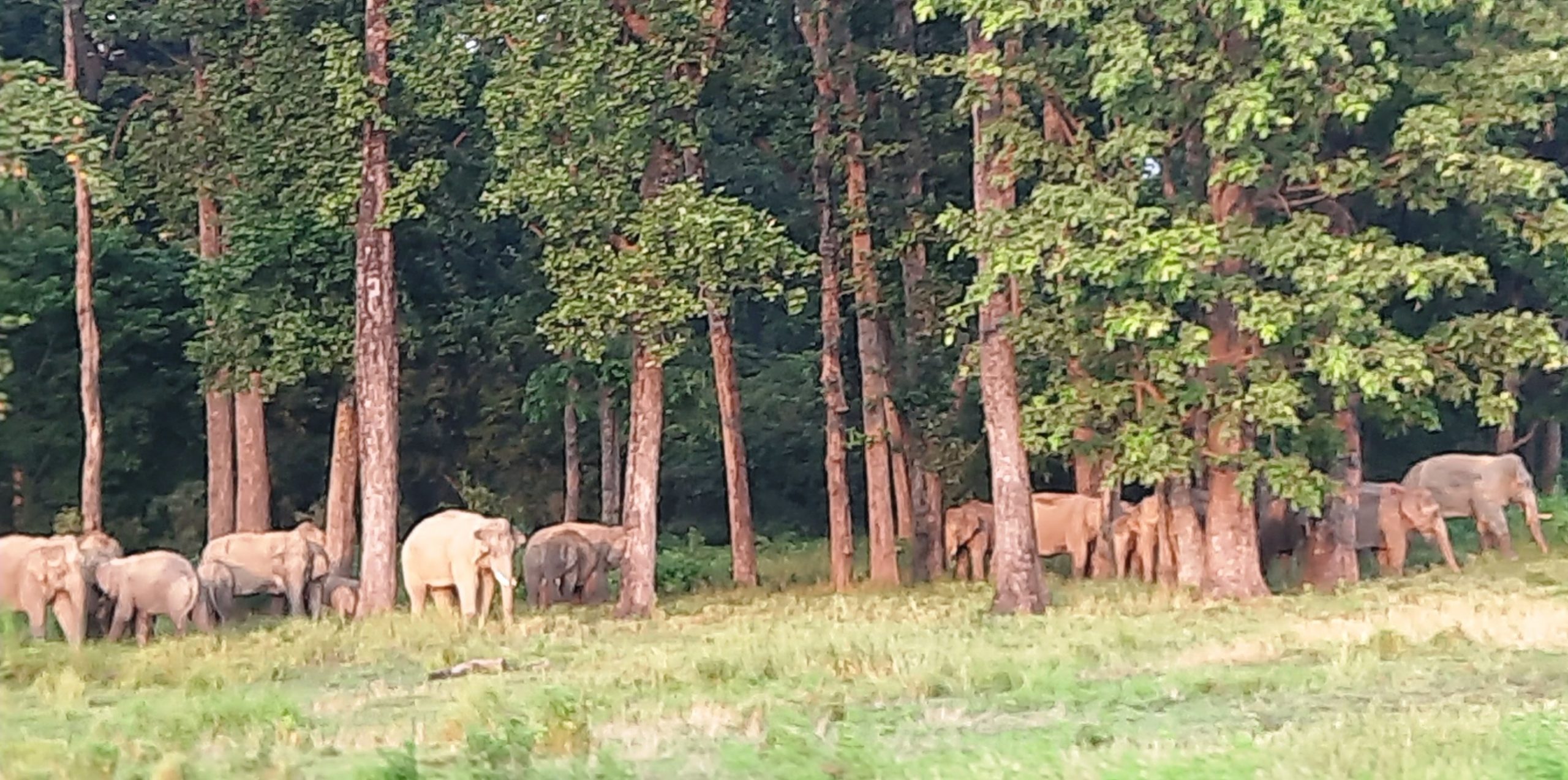
Jhapa. After the herd of elephants that entered Nepal from India three days ago reached Buddhashanti area through Bahundangi, there has been increased concern for human security along with crops.
The farmers who are preparing to cut and store the paddy are worried that elephants will destroy the crops at any time.
According to Tulsimaya Shrestha, a resident of Mechinagar-4, wild elephants visit this area almost every day. She said that due to the elephants that usually come at night, the farmers have problems in protecting the crops.
“Even today, we are looking for fields and preparing to harvest paddy and tying bundles to store it. There is uncertainty as to when the elephants will come and destroy the paddy,” said Shrestha, “since the elephants come every day, we cannot stay safely even at night.”
This morning, a motorcyclist was injured in an attack by an elephant in Bihani Tol located in Buddhashanti rural municipality-2. Local 56-year-old Dilli Bahadur Poudel was injured when an elephant came out of the three-story community forest at 5:10 in the morning. He was taken to B&C Hospital in Birtamod for treatment.
District Administration Office Jhapa has also increased its activity to reduce possible elephant attacks and damage. Chief District Officer Shravan Kumar Pokharel along with the chiefs of all the four security agencies in the district and the employees of the Division Forest Office conducted an on-site monitoring of Prasad Gowda located in Mechinagar Municipality-4 which is considered as the main gateway of elephants.
They discussed with the local residents and got information about the movement of elephants and possible damage prevention measures.
Meanwhile, Chief District Officer Pokharel said that human-elephant coexistence should be maintained by managing the movement of elephants.
“We have discussed elephant control issues with the concerned parties time and time again. Now we have come to the field to get information about the situation on the ground,” said Pokharel, “We need to create a suitable environment for human-elephant coexistence. It is necessary for all parties to be serious about managing the movement of elephants, reducing crop and human damage and changing the behavior of the locals.”
He emphasized on maintaining uniformity and coordination between the administration, security agencies, division forest office, community forest, local people’s representatives and local residents.
Keeping in mind the movement and risk of elephant herds, the local level has also started adopting security measures. Ward President of Mechinagar-4 Arjun Kumar Karki said that the ward office has provided flashlights and sirens to the security agencies for the safety of the locals as elephants often walk at night.
He informed that the farmers have also started to change the farming system to reduce the damage of crops caused by elephants.
He says that along with crops that can be damaged by elephants such as rice and maize, farmers are attracted towards crops that are relatively less preferred by elephants such as mustard and betel nut.
The problem of human-elephant conflict has increased due to the shrinking of the elephant’s natural corridor and the forest area being affected. In order to reduce human and physical damage, it is necessary to change the habits and behavior of the locals.