Rasuwa The arrival of domestic and foreign tourists has started to increase again in Gosainkunda, the famous pilgrimage site of Rasuwa, which is full of religious faith, natural beauty and biological diversity. The tourism business, which had slowed down after the flood in the Bhotekoshi river on August 10, damaged the roads and footpaths, has gradually started to return to normal as the movement has eased.
Kaisang Nurpu Tamang, chairman of Gosainkunda Rural Municipality, said that the flood-affected tourism area has started to function again. According to him, with the increase in the number of tourists, hoteliers, guides, transport workers and other small businesses have started getting relief.
After the flood, the tourism activity was almost at a standstill for some time. “Now that the road has become easier, internal and external tourists have started coming,” said President Tamang. He informed that the rural municipality is coordinating the necessary coordination for the maintenance of footpaths and the safety and convenience of tourists.
Ganesh Prasad Tiwari, information officer and conservation officer of Langtang National Park, said that after the flood, the traffic that was blocked after the flood has become easier, and the arrival of tourists in Gosainkund area has started to become regular. He informed that the park is conducting programs to protect the natural environment and biodiversity of this area.
Babulal Tamang, president of civil society Rasuwa, said that the number of pilgrims and hikers coming to Gosainkund has started to increase as the condition of roads and footpaths is improving. According to him, tourism activities were affected for some time after the flood damaged the roads.
According to Santosh Ghale, a local hotelier, the number of domestic tourists and young people coming to Gosainkund is increasing recently. He said that earlier there was a lot of pilgrim traffic only on the occasion of Janaipurnima and Gangadshahra, but now there are tourists who come for trekking and sightseeing all year round.
According to businessman Ghale, tourism in this region will contribute to the national economy along with the livelihood of the locals if attention is paid to the sustainable upgrading of hiking trails, communication facilities and basic infrastructure development.
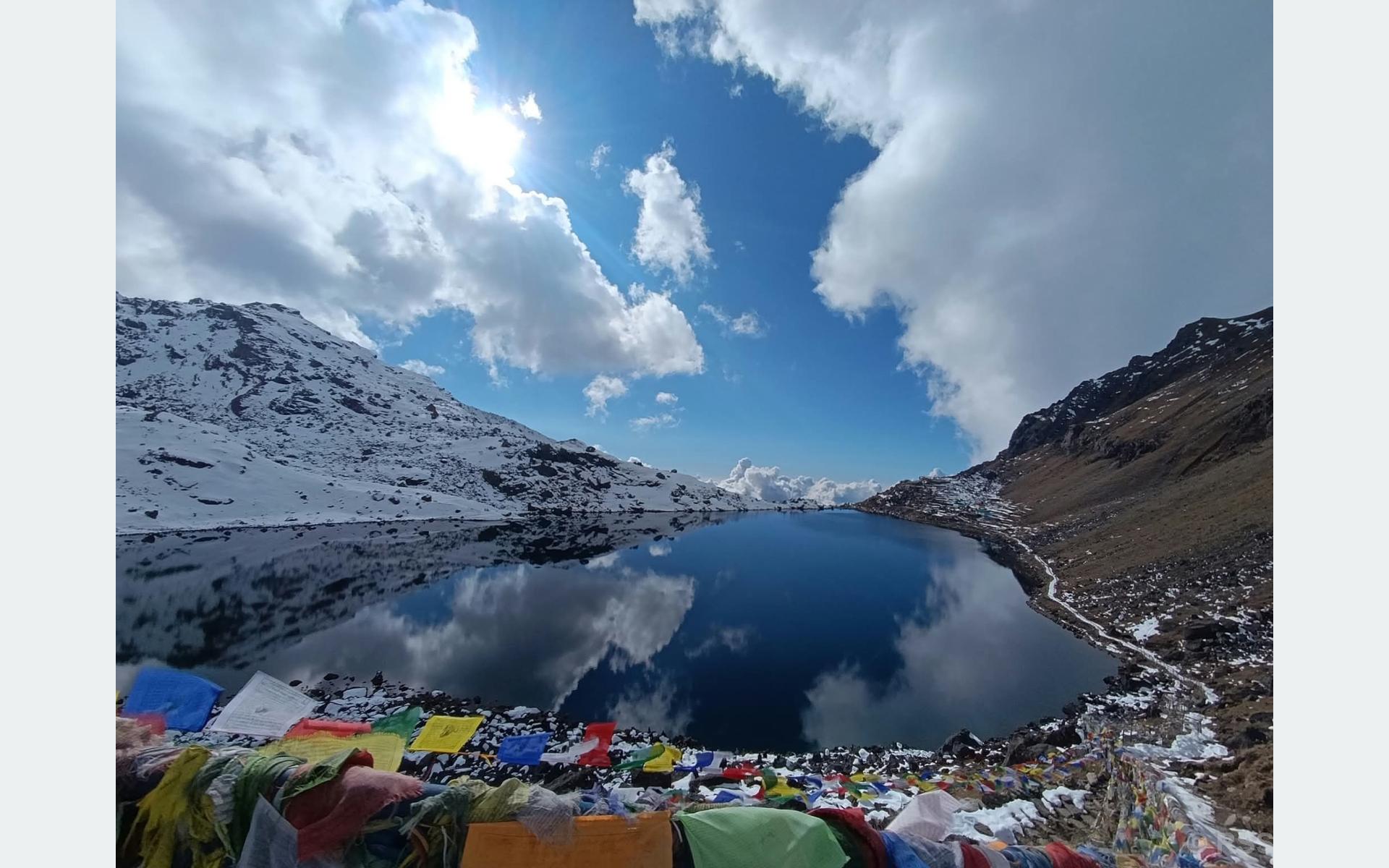
Located in the Langtang National Park area, Gosaikund is located in Gosaikund Rural Municipality-6 at an altitude of 4,380 meters above sea level. Spread over an area of about 13.80 hectares, the length of this tank is 625.55 meters, width 302 meters and depth 26 meters. It is said that there is about 14 lakh 72 thousand cubic meters of water in the tank.
The religious importance of Gosaikund, the center of common faith of Hindus and Buddhists, has been there since ancient times. According to Hindu scriptures, it is believed that after consuming the kalkoot poison released from the churning of the sea, Lord Shiva struck a trident and drew water out of it to calm his thirst, and the pool was made from that water. Based on the belief that the water came out from the Trishul strike, this area is also connected with Trishuldhara.
Gosainkunda is known by different names in the local community. The Tamang community says ‘Gyo’ or ‘Chhokar’, the Sherpa community says ‘Ghyo’, the Tibetan community says ‘Cho’ and the Newar community says ‘Shilu’.
There are Bhairavkund, Saraswatikund, Suryakund, Chandrakund, Dudhkund and Ganeshkund and other cisterns around Gosaikund. The historical Amarsingh Cave and the original culture of the local Tamang community are also attractions for tourists.
Taking into account the ecological importance of the Gosaikund area, it has been listed in the Ramsar list on 5th Asoj 2064 (23rd September 2007). Wild animals such as snow leopard, red hare, musk deer and Himalayan deer and red deer, goldfish and other mountain flora are found here.
Gosaikund is known as a major religious and tourist destination in Nepal. The area also connects the Helambu, Langtang and Tamang heritage routes.
Especially on the occasion of Gangadshahra in May-June and Janaipurnima in July-August, a big fair is held here. The priest of Rasuwa, Tank Prasad Dhakal, said that special religious rituals are also held on Balachaturdashi.