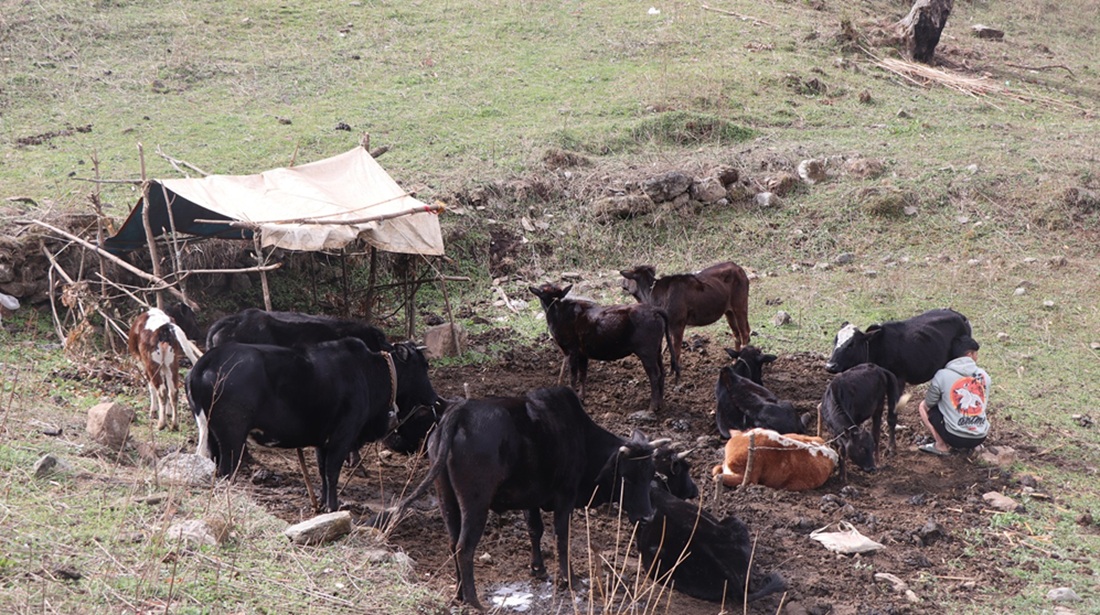
Myagdi. It has been five years since Yamprasad Pun of Dhawalagiri Rural Municipality-3 Muna of Myagdi stopped raising cows. Pun, who reared cows for nearly three decades, has now started rearing buffaloes instead of cows.
“It is easier to keep one buffalo that gives a lot of milk than to keep 10 cows that give little milk”, he said while narrating the experience of rearing cows in the past, “After the introduction of mining minitiller plows, the importance of bulls also decreased, the practice of keeping cows disappeared.”
Pun’s experience shows how the tradition of rearing local breeds of cattle in Dhawalagiri region is declining. At one time it was customary to keep cattle in households, but now it is difficult to find local breeds of cattle in this area.
Man Bahadur Chapai of Dhawalagiri rural municipality-7 Takam has started having problems in collecting cow’s milk and wheat required for religious and cultural activities. He says that since cow’s milk and wheat are needed for worship and religious activities, there is a situation where the cowherds should be informed in advance.
“Today, it is difficult to get cow’s milk and wheat, which are required for religious activities”, he said. In Gurja, Lulang, Muna, Mudi and Malkwang, although the number of mobile herds has decreased, the tradition of keeping cows has not completely disappeared.
The local breeds of cattle, which have religious, cultural, biological and ecological importance, are facing a crisis due to modern agricultural technology, commercial animal husbandry and lack of manpower. With the aim of reducing production costs and increasing income, the importance of Raithane cattle is decreasing as farmers are attracted towards raising cattle of advanced and Varnashankar breeds.
Indralal Paudel of Dhawalagiri Rural Municipality-7 says that the increase in the breeding of advanced breeds of cattle that give more milk and the use of tractors and mini-tiller plows to till the farmlands are displacing local breeds of cattle. “After the introduction of mini tillers and tractors, the number of local breeds of cows has decreased”, he said, “The government has also emphasized on breeding cattle that give more milk, so the breeding of advanced and variegated breeds has increased.”
At one time Dhawalagiri Rural Municipality was known as the resource center of Halgoru. Farmers from Beni municipality, Parbat, Syangja and Kaski used to come here to buy bulls due to the lack of modern equipment for plowing the fields. Farmers were earning by selling bulls. Tamprasad Chantyal of Dhawalagiri Rural Municipality-1 Gurja says that now both the demand and sale of cows have decreased.
Cattle decreased
The livestock statistics of Dhawalagiri Rural Municipality also confirm the decline of local breeds of cattle. During eight years, the number of cows in the village has decreased by 2,345.
According to the survey report conducted in the year 2074, there were six thousand 756 cows in Dhawalagiri. At present there are 4,411 cows in the rural municipality, said Chandrakala Dahal, Head of Animal Services Branch. According to him, because the new generation is attracted to foreign employment and has to work hard in animal husbandry, the attraction towards local breeds of cattle and cattle has decreased.
“Although there is a possibility of livelihood, self-employment and income generation in animal husbandry, a lot of effort is required”, she said.
Local cows as biological assets
According to the records of the Ministry of Agriculture, Livestock, Forestry and Environment, out of the eight species of cows found in Nepal, cows reared in hilly districts including Myagdi are known as hilly breeds. It is mentioned that these cows entered Nepal from Bhutan, Sikkim and Darjeeling.
Generally, the color of mountain cow, weighing between 200 to 300 kg, is black, red, brown and tan. Such cows are considered to be adapted to the local climate and environment, said Subhash Regmi, Head of the Planning Branch of the Veterinary Hospital and Animal Services Expert Center.
According to him, the carotene found in cow’s milk is important for human health. “Consumption of cow’s milk has been mentioned in various scientific studies to provide various health benefits and help prevent disease”, said Regmi, “cow’s milk, curd, ghee, cow dung and wheat have been used in Ayurveda along with their religious significance.”
Religious and cultural significance
Cow is mentioned as the national animal in sub-section (3) of Article 9 of the Constitution of Nepal. Cows are associated with religious and cultural beliefs by Hindus. Cows are important in various religious rituals from birth to death.
Mahanth Himalaya Baba of Sri Lakshmihari Temple located in Beni Municipality-1 said that cow should be protected not only by connecting it with religion and culture but also as a biological asset. “Cows should not be understood only in connection with religion and culture”, he said, “Vedic cow breeds with biological characteristics are the biological assets of Nepal.” The state and society should pay special attention to save it.
According to him, cow dung and wheat obtained from local breed of cows are being used in agriculture as well as in traditional Ayurvedic practice.
Hindus have a tradition of worshiping the cow as Lakshmi and taking protection of the cow as a pious act. Since cow’s milk, curd, ghee, dung and wheat are used in religious rituals, the protection of local breeds of cows is also connected with religious and cultural continuity.
Resham Punamar, vice chairman of Dhawalagiri Rural Municipality, said that for the protection of Raithane cattle adapted to the local climate, breeding management, encouraging farmers and increasing public awareness about the importance of local breeds have been started.
According to him, by making the local cattle rearing, which is associated with the identity of Dhawalagiri, professional and organized, it can be used as a basis for improvement of livelihood and increase in income. Rasas