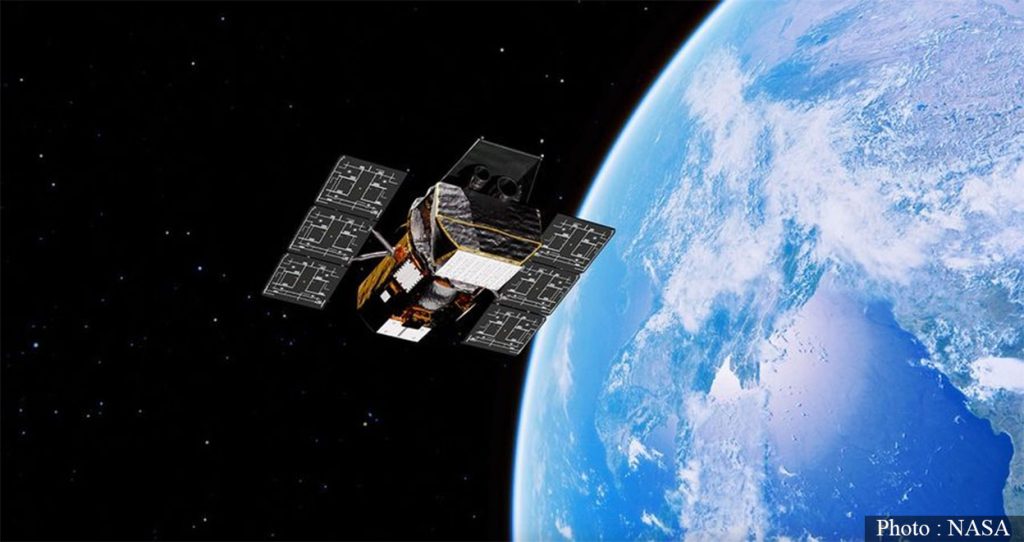
Kathmandu. The space telescope of the American space agency NASA (National Aeronautics and Space Administration) weighing about 1.5 tons is going to re-enter the Earth’s atmosphere after about 22 years.
Although most of it is expected to burn up in the atmosphere, some remnants may reach the earth’s surface, according to NASA scientists. It is estimated that NASA’s ‘Neil Gerrell’s Swift Observatory’ space telescope will enter the Earth’s atmosphere today on November 4.
Indian cities including Mumbai, Hyderabad, Bengaluru and Chennai are within the latitudinal limits of the potential re-entry zone, so there is a theoretical possibility that its remnants may fall in those areas as well.
Launched on November 20, 2004, the initial name of this space observatory was ‘Swift Gamma-Ray Burst Explorer’. This spacecraft, which was initially intended to operate for two years, stayed in space for about 22 years and studied various phenomena in the universe.
According to NASA, the spacecraft’s potential re-entry zone extends from 20.6 degrees south latitude to 20.6 degrees north latitude. Since India is also in this region, it is considered to be in the risk zone.
According to Brad Senko, the chief scientist of the space mission, Africa, Australia, India, Southeast Asia and some parts of Central and South America fall into the potential risk zone. Looking at the geographical location of India, cities like Mumbai, Hyderabad, Bengaluru and Chennai are in the risk zone, according to NDTV.
However, if these cities fall within the possible latitudinal zone, it is not certain that the remnants of the spacecraft will fall there. The actual re-entry location depends on the spacecraft’s orbital position and velocity at the time of re-entry into the atmosphere. Therefore, NASA has not designated any specific city as a risky landing site.
More likely to fall into the sea
According to scientists, most of the spacecraft will burn up due to the high temperature generated when it enters the atmosphere. However, some strong and large pieces of equipment can reach the surface of the earth.
Jonathan McDowell, an astrophysicist at the University of Durham, said that he was surprised that more than 100 kilograms of the spaceship weighing about 1,500 kilograms remained after re-entry into the atmosphere.
According to Brad Tucker, an astrophysicist at the Australian National University, about 70 percent of the Earth’s surface is covered by oceans. Therefore, statistically, there is a higher probability that the remnants of the spacecraft will fall into the sea.
Scientists have said that there is a very low chance of injury to a person or major damage to physical structures. India also has a system to monitor objects returned from space and other structures in space.
The Indian Space Research Organization (ISRO) has been monitoring satellites, rocket remnants and other space objects through the multi-object monitoring radar at Sriharikota. However, no official information has been released yet whether ISRO is also monitoring the re-entry of the Swift space observatory or not.
22 years of scientific journey
The main purpose of the SWIFT space observatory was to study high-energy events in the universe, including gamma-ray bursts. It has collected important facts about supernova, black hole and other astronomical phenomena.
According to NASA, during its tenure, this space observatory observed more than 2,000 gamma-ray bursts and more than 1,400 supernovae.
This space observatory, which was sent for two years, has made a significant contribution to astronomy by working for about 20 years more than the scheduled period. Its last scientific observation was on October 20, 2026. Now, after its capacity is gradually decreasing, it has reached the stage of re-entering the Earth’s atmosphere. NASA and the US Space Force are monitoring its re-entry conditions.