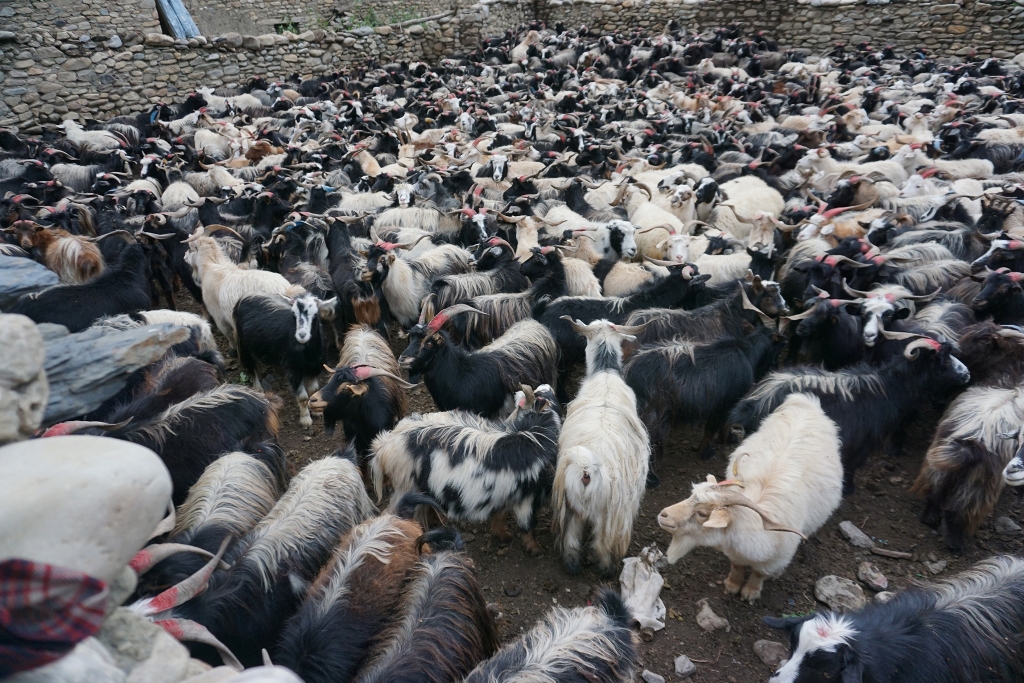
Mustang. One thousand 591 sheep have been slaughtered from Mustang for Tihar.
The lambs were taken from Upper Mustang and Dolpa to Bensi to be sold for Tihar. According to the Agriculture and Livestock Development Office located here, till Wednesday morning, the traders of the sheep that were slaughtered in Mustang from Dolpa and Jomsom from Upper Mustang have purchased and said that they have been slaughtered.
According to Dr Lalmani Aryal, Head of Agriculture and Livestock Development Office, the traders slaughtered 1,385 goats and 206 sheep from Mustangs targeting the Tihar festival.
One thousand 150 goats and 136 sheep were slaughtered for Tihar from the horse breeders and traders of Mustang. Similarly, Head of Agriculture and Animal Development, Dr. Aryal informed that 3300 sheep including 235 sheep and 70 sheep brought to Mustang from Upper Dolpa.
Head of Agriculture and Livestock Development, Dr. Aryal, said that traders from Kathmandu, Pokhara, Baglung and Myagdi bought and sold sheep from Upper Mustang and Dolpa to Jomsom for Tihar.
The health of Jomsom weeded sheep from Mustang and Dolpa must be confirmed by the concerned veterinarian to be taken from one district to another district.
The head of the office, Dr. Aryal, mentioned that the veterinary examination of the lambs that had been slaughtered for Tihar had been done. Earlier, more than 15,000 sheep were released from Mustang targeting the Dasai festival. Out of which more than 500 lambs were bought from Tibet and brought into Nepal through Korlanaka.
On this year’s Dasai, Jomsom was brought to Jomsom by foot from Dolpa, Mugu and Jumla in Karnali province. The head of the office, Dr. Aryal, informed that only 10 percent of sheep shed from Mustangs for Tihar than Dasain festival.
Chief Dr. Aryal says that local traders from outside the district and within the district took it to Pokhara Kathmandu for sale, while for Tihar, Jomsom felled sheep were taken to Pokhara/Kathmandu by traders from outside the district.
Traders have made a good profit from the lambs that were sold in the market this year targeting Dasai festival. Due to the fact that less mutton falls from Mustang and the culture of eating mutton grown in the cold climate of the Himalayan region during Dussein, the business of mutton has flourished in Dussein.
The farmers of Mustang have been following sheep farming and yakchauri farming as their main business. The number of animal husbandry has started to increase since the federal, state and local bodies started conducting subsidy programs under various headings for the promotion of animal husbandry in the Himalayan region.
Dr. Aryal, head of the office, said that since the three levels of government began to arrange subsidies and concessions in animal insurance, cattle improvement, and feed management, the attraction of farmers towards animal husbandry is increasing.
The meat of lamb reared in the cold climate of the high Himalayan region is tasty and nutritious. In Khark, Patan and Buki of high lakes, mutton eats wild herbs such as yarsagumba, niramsi, jatamsi, panchaule, one garlic and jimbu, so the meat of mutton is considered tasty and health promoting.
Farmers of Gharpazhong, Waragung, Loghekar and Lomanthang Rural Municipality of Mustang are rearing sheep professionally. In recent times, due to climate change, unauthorized grass growing in the Himalayan areas, drying up of water sources and the risk of wild animals such as snow leopards, animal husbandry business is becoming a challenge.