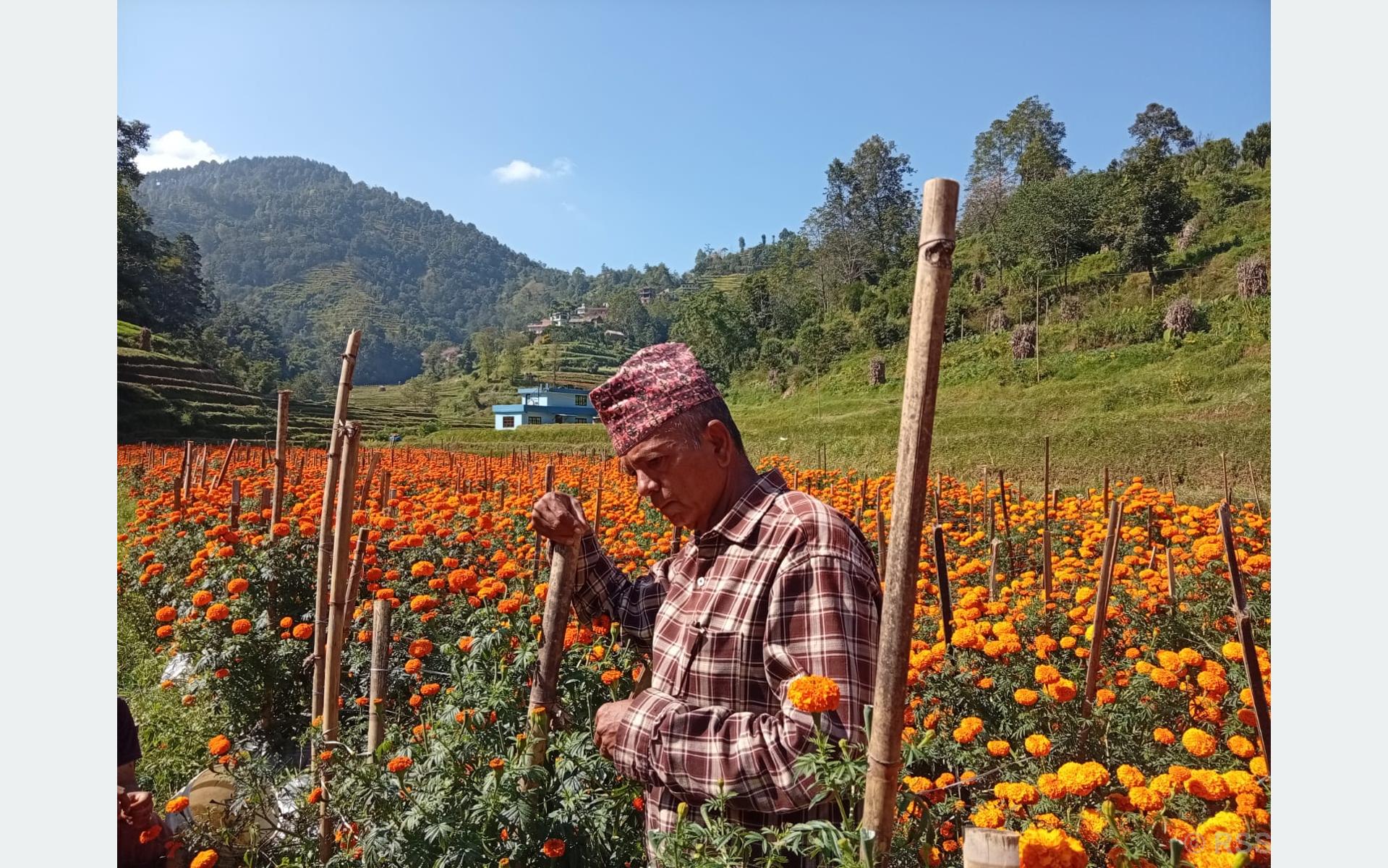
Kavre. As Tihar is approaching, hundred-petal flowers have started blooming in the field of Madhav Ghimire of Banepa Municipality-12 Basdol. As the demand for flowers for the festival approaches, 59-year-old Ghimire is busy preparing for flower care and sale. After spending 17 years abroad, he started flower farming with five plants and now it has expanded to 14 plants.
Ghimire, who returned to his country nine years ago, did not do any work for the first two to three years. However, having spent a long time working, it was not easy for him to stay idle at home. With the thought that he should do something in his own place, he chose agricultural business. Full support and assistance was also received from the family.
Ghimire, who started agricultural business five years ago, did golbhenda and cucumber farming for the first two years. Having gained experience in vegetable farming, he later saw the possibility of flower farming. He said that since there is a demand for 100-petal flowers during festivals like Dasain and Tihar, he has started flower cultivation with an area of 5 plants in accordance with the idea of producing them commercially.
The first year of production and sales experience gave him more courage to move forward in this business. At the beginning, the cultivation was done in a limited area and now it has been expanded to 14 plantations. He has planted hybrid hundred-petaled flowers of Japanese and Thai varieties.
Planting of plants for floriculture starts from July. Ghimire said that the flowers will be ready for sale in about three months after planting. Since the consumption of flowers is more during Dasain and Tihar, they have been managing the farm targeting the same time.
He does not leave the fields empty after the flowering season. After the sale time of the hundred-petal flower is over, other greens and vegetables are planted. His practice is to use the land throughout the year rather than depending only on one crop.
Ghimire’s flower farming has given employment not only to him but also to other people. 10 workers are involved in farming. Their help has been taken in the work of planting flowers, pruning, caressing and picking. He said that with the expansion of commercial farming, the need for workers has also increased.
Ghimire, who produced about 6,000 kilos of flowers last year, earned about Rs. 1.8 million before deducting expenses from sales. He said that the production of flowers was good this year as well. But in his experience, income is not guaranteed if the product is good. As market demand and price determine the farmer’s income, he is now waiting for the right time to sell flowers.
He thinks that the sale and price of flowers may be affected as Tihar is a bit late this year. He said that although the production is good, without selling all the flowers immediately, he is waiting for the market conditions with the hope that the prices will increase before Tihar. He expects the price of flowers to reach around Rs 250 per kg this year.
“The production has been good. Now it is a matter of tomorrow what price the market will give. We have not sold the flowers in haste. We hope that the price will be good at the time of Tihar”, said farmer Ghimire. According to him, production is one aspect for farmers, while selling the produced goods at a reasonable price is another challenge.
Even if the production of flowers is good, the market demand and price cannot be determined in advance. In his experience, there is a risk that the prices may fluctuate as the products of many farmers reach the market at the same time during the festival. He said that if the market for the flowers produced by the farmers can be ensured, it will be easier to make the business more organized.
He is dissatisfied with the fact that flowers are being imported from abroad while they are being produced in the country. He said that if the flowers produced by Nepali farmers can be given priority, the market of indigenous products will expand and farmers will get more incentives. Ghimire is expected to increase the demand and consumption of indigenous flowers, especially during Tihar, and the flowers produced by local farmers will get a market.
“Sometimes I am satisfied, sometimes I am also dissatisfied. The concerned bodies should pay enough attention to the farmers of Nepal. It would have been a lot of relief for the farmers if flowers produced in the country were given priority and not imported from abroad”, he said.
Ghimire, who returned after spending a long time abroad, is now engaged in agricultural business in his own village. For them, flower farming has not only become a means of income, it has also become an opportunity to use their desire to work and experience in their own soil. He has kept the farm busy throughout the year by producing sayapatri during the flowering season and greens and vegetables at other times.
Ghimire, who has been continuing the agricultural business, now gives equal importance to the market conditions along with the production. He believes that it will be easier for the farmers to survive in this area if the flowers produced by hard work can get a reasonable price. He has experience that if an environment for production and marketing can be created in the country, flower farming can increase the income of the farmers as well as create jobs at the local level.