

Oil Abhibh. According to the latest Israeli election results, Prime Minister Benjamin Netanyahu’s coalition has lost its majority. However, as the opposition is also divided, there has been serious confusion in the formation of the new government.
According to the results announced on Friday morning, Netanyahu’s coalition won 53 seats in Tuesday’s election, while the main opposition coalition won 48 seats.
Similarly, Arab-led parties secured the remaining 19 seats in historic performances. Now the parties will have to find a way of hard bargaining and a new coalition to get at least 61 seats needed to form a government in the 120-member Parliament (Knesset).
Netanyahu, Israel’s longest-serving prime minister, is still in office. To dislodge him, the opposition would have to partner with Arab-led parties, which run counter to their established political line. Especially the right-wing parties in the opposition coalition are strongly opposed to this collaboration.
Avigdor Lieberman, the right-wing leader of the opposition coalition, has made it clear that there will be no partnership with Arab-led parties. Lieberman, who once cooperated with Netanyahu, said that his party “Israel Betenu” will not cooperate with Arab parties. This party in the opposition camp has 7 seats.
He has termed the Arab parties as ‘supporters of terrorism’. However, it is almost impossible to overthrow Netanyahu without this partnership. During the election campaign, both Netanyahu and his opponents vowed not to cooperate with Arab parties, making the coming days extremely challenging for the parties.
Israel came to a standstill because Friday was the Jewish day of rest (Sabbath). Israeli citizens, meanwhile, have mixed reactions to the potential alliance. Some have said that traditional caution should be exercised towards Arab parties. Some have argued that the time has come to include them for national unity in the country.
After the election results are verified on Wednesday, they will be formally submitted to President Isaac Herzog. After that, the President will hand over the responsibility to someone to form the new government.
The leader of the party who gets the most votes or the leader who has the ability to get a majority in the parliament will get this responsibility. According to the current results, Netanyahu’s Likud Party has become the first party with 27 seats, while Eisenkot’s Yasser Party is in second place with 21 seats.
In Israel, the president does not directly appoint the prime minister. One of the many candidates is appointed as the Prime Minister’s candidate. That candidate is elected as Prime Minister only after getting a majority from the Parliament. If one fails to reach the majority, the other is given a chance.
Netanyahu will remain as acting prime minister until a new prime minister is elected by the parliament. If no one can get a majority after repeated attempts, a new election will be announced under his leadership.
Hours before the final results, Netanyahu and his Likud party made serious accusations that Arab-led parties had influenced the election with foreign aid. Opponents have accused Netanyahu of trying to defame citizens of Arab origin, who make up about 21 percent of the total population.
Chief of Israel’s Election Commission and Supreme Court Justice Noam Sohlberg has asked the security agency to investigate the matter after receiving a complaint about “serious suspicions” of foreign interference.
Israeli media reported that Qatar may be involved in this. However, Qatar has denied this allegation. Ekthari alleges that Netanyahu is trying to discredit the Arab parties and influence the possible alliance between the opposition and the Arabs by creating comments about stealing votes.
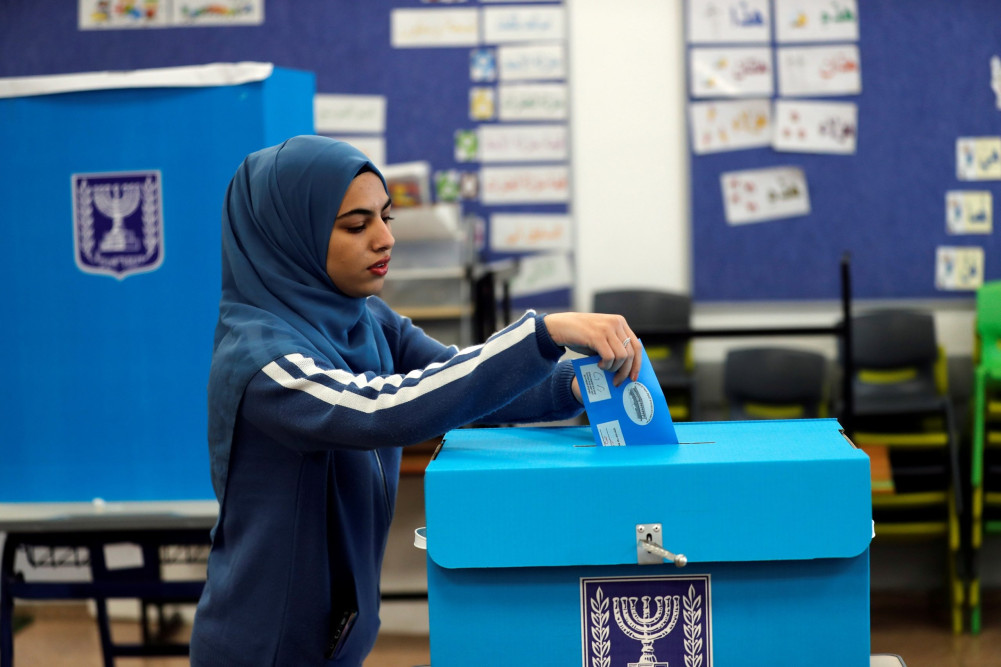
About 21 percent of citizens of Arab origin living in Israel voted with great enthusiasm this time. Nearly 80 percent of the Arab population voted, the highest in Israel’s electoral history.
The opposition has been saying that they sent a strong message against the violence in Gaza Strip and the West Bank through voting. The United Nations has repeatedly passed it as a resolution and stated that Israel and Palestine should live on the basis of coexistence. However, it has not been implemented in practice.
The majority of the Jewish population of Israel is against it. Both Netanyahu and Eisenkot are against it because the coalition represents the Jews. However, Eisenkot opposes the oppression of Palestinians in Gaza and the West Bank. He said that the expansion (encroachment) of Israeli settlements in those areas under the leadership of the Netanyahu government should also be stopped.
The ‘Joint List’, which received the most votes among the Arab parties, has put forward a centrist proposal that can support Eisenquot from outside the government. Because, their first priority is to get rid of Netanyahu, who is seen as intolerant towards the Arab population, at any cost. This proposal will pave the way for Eizenkot to be Prime Minister by removing Netanyahu for the time being. But in the future, the Eizenkot government will have to depend on the support of the Arab parties.
The new parliament is expected to be sworn in by November 10. There is still a possibility that the opposition parties will cooperate with the Arab parties to win the position of Speaker of the Parliament before the formation of the new government. Arab party leaders have condemned the October 7, 2023 Hamas attack on Israel, but have refused to declare Hamas a terrorist organization. Their understanding is that declaring Hamas a terrorist organization will further strengthen Israel’s continued campaign of violence in the Gaza Strip.
Meanwhile, hundreds of Israelis have rallied calling on Eisenhower and other opposition parties to join hands with Arab-led parties. Mirisklair, a resident of Jaff, said, “I think that we should join hands and cooperate with the Arab parties that live legally in Israel.” Isa Jaber Abu-Ghosh, the former mayor of an Arab village outside Jerusalem, said, “Israel always claims itself as the only democracy in West Asia.” But if its politics remains divided between Jews and Arabs, then it cannot be considered a real democracy.
When Netanyahu leaves power, he will face ongoing corruption charges and an official investigation into the October 7, 2023 security breach. Because he is in power, he is getting immunity from such investigation. Ap



