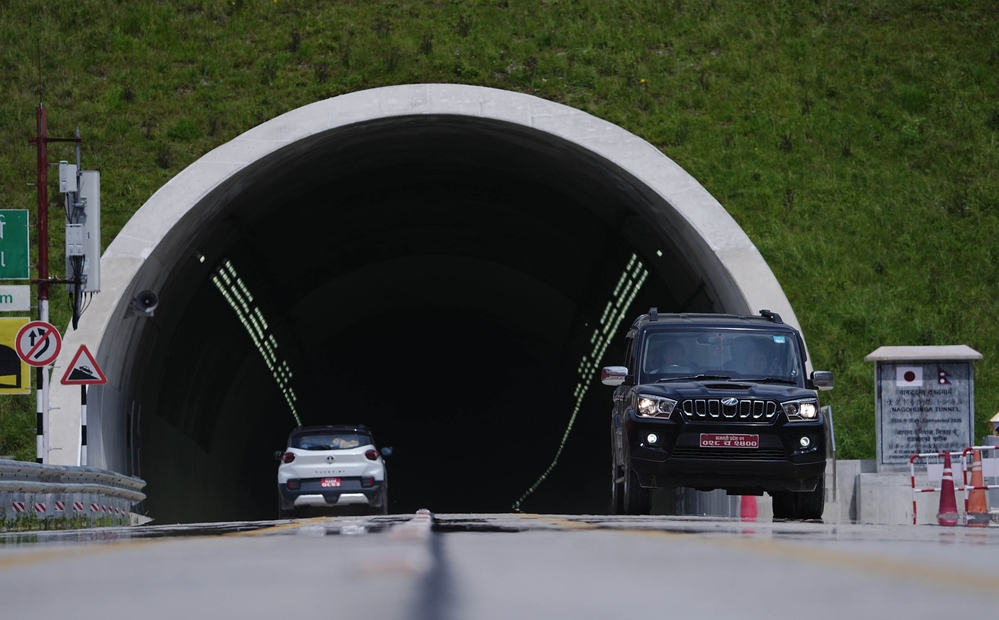
Kathmandu. Vehicles passing through Nagadhunga-Sisnekhola tunnel have to pay toll from Sunday. The road board has decided to collect the fee according to the decision of the executive committee on 12 October and the notification published in the gazette on 26 Chait 2082.
According to the Road Board’s decision, cars and vans will have to pay a fee of Rs 65 when entering Kathmandu and Rs 60 when leaving. Mini bus-trucks and trippers are charged Rs 150 when entering Kathmandu and Rs 80 when leaving. Buses and trucks will have to pay a fee of 260 rupees when entering Kathmandu through the tunnel and 200 rupees when exiting through this route. Big trucks and heavy vehicles (lorries) will have to pay a toll fee of 600 rupees when entering the valley through the tunnel and 250 rupees when exiting the valley.
After 80 months of construction, the Nagadhunga-Sisnekhola tunnel was put into operation on July 11. Ambulance, fire brigade and security agency vehicles were allowed to enter the first lot. In the second lot, entry was opened for small and 9-seater vehicles on August 8. In the third phase, the entry permit was to be opened for small micro buses and mini buses leaving Kathmandu. At this time, on August 17, the tunnel was opened for all vehicles free of charge after the road was flooded in Nagadhunga Oralo and traffic was stopped. According to which vehicles have been allowed to run free of charge till Saturday, October 14.
The director of the Nagadhunga tunnel construction project, Courtesy Nepal, said that the tunnel was opened for all vehicles after the road collapsed while the vehicles were being opened as a test run in stages. “Because of this, a test was conducted with emergency management for some time,” he said, “Now the Road Board is preparing to collect the toll as decided by Nepal.” He said that the toll fee is now accepted in cash and can also be paid through QR. “This is an arrangement made for the time being, later arrangements will be made for automatic cards that can be used to pay fees,” he said.
Speed limits are set for vehicles inside the tunnel. Must drive at a speed of 40 km per hour. When coming from Dhading to Kathmandu without a tunnel, it would take 15 minutes for small vehicles and 35 minutes for large vehicles when there was traffic on the Nagadhunga hill. It is said that the project will reach from Sisnekhola in Dhading to Kisipdi in Balambu in 7 minutes through the tunnel.
15 jet fans have been installed inside the tunnel for ventilation purposes. The distance of the main tunnel is 2.688 km and the emergency tunnel is 2.557 km. 7 cross passages have been constructed at a distance of 375 meters from the main tunnel and the emergency tunnel. Pedestrians, two-wheelers, three-wheelers and non-motorized vehicles will not be allowed to enter the tunnel. Vehicles carrying diesel, petrol, gas and highly flammable substances and explosives are also prohibited in the tunnel. USIN-ART JV has been entrusted with the operation of the tunnel. USIN is a Chinese company and ART is a Nepalese company. The tunnel will be open 24 hours a day. 64 manpower will be mobilized for toll collection.
There will be only 146 employees in the tunnel. The service provider company will have to manage and operate the tunnel for five years. The company will have to maintain the tunnel maintenance, traffic management, emergency rescue, toll collection, maintenance of the overall tunnel and access road connecting both Kathmandu and Dhading. The amount raised every day should be deposited in the account of Toll Road Board Nepal. After the tunnel was opened for some time for all vehicles, there have been complaints of increased pollution inside the tunnel.
Similarly, there is a risk of accidents when driving a vehicle inside the tunnel by crossing the lane, and for this, the traffic police have been taking action against such vehicles by looking at the CC cameras. “These complaints have also come to the project office, it has been found that more smoke is coming out from large cargo vehicles,” Director Nepal said, “We have requested the Transport Management Department to check the pollution to solve this.”
The construction of the tunnel started when the then Prime Minister KP Sharma Oli laid the foundation stone on 4 October 2076 at Tutipakha located in Chandragiri Municipality-2. According to the Ministry of Infrastructure, although its construction was started with the goal of completion within 42 months, it was completed only late due to the covid epidemic and local obstacles. The construction contract was taken by the Japanese company Hazma Endo Corporation. Hazma handed over the construction of the tunnel to Nagadhunga tunnel construction project in May 2083. According to the contract, if there is any problem in the tunnel within one year, Hazma will have to repair it.
How much is the fee for which vehicle?
Cars and vans: 65 rupees when entering Kathmandu and 60 rupees when leaving
Mini Bus-Truck and Tripper: 115 rupees when entering Kathmandu and 80 rupees when leaving
Bus, truck: 260 rupees when entering Kathmandu and 200 rupees when leaving
Big trucks and heavy vehicles (lorries): 600 rupees when entering Kathmandu and 250 rupees when leaving