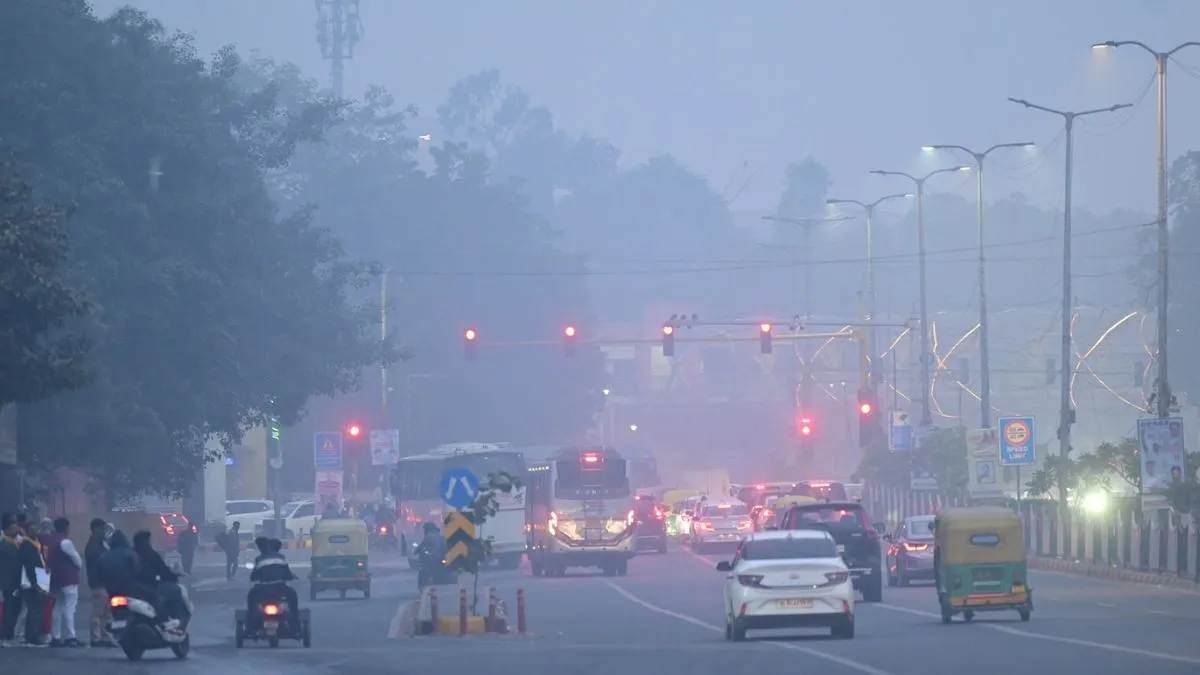
New Delhi. In order to control the increasing air pollution in the capital of India, New Delhi, the authorities have imposed stricter restrictions since Sunday. Under the new system, parking fees for vehicles have been doubled and government and private office employees have been instructed to work from home.
Officials have said that the main objective of the new measures implemented for pollution control is to reduce emissions from vehicles. According to the new system, vehicles that do not meet the prescribed emission standards will be banned from entering the capital. In the same way, a ban has been imposed on demolition work and construction activities in open areas with immediate effect.
In a statement issued by Chief Minister Rekha Gupta’s office, it is said that Delhi’s ‘Winter Action Plan’ has been implemented from November 1. It is mentioned in the plan that strict pollution control measures, effective implementation and round-the-clock monitoring have been arranged.
In the statement, the residents of Delhi are requested to follow the government instructions and cooperate in making the air of the capital clean and healthy. The Delhi government has been adopting various measures to control pollution since last one month. Under this, burning of garbage has been banned and roadside shops that prepare food using coal and firewood have been banned.
However, similar measures implemented in previous years have not been very successful in controlling the thick smog and pollution that blankets the capital from November to January. During this period, when the temperature drops, the pollutant particles accumulate near the surface of the ground.
The major sources of air pollution in Delhi are vehicular smoke, coal-fired power plants, industrial activities, dust from construction, and burning of farm residues after importing crops to neighboring states.
According to the Ministry of Environment of India, vehicles contribute 23 percent to pollution in Delhi during winter. Similarly, 20 percent of the pollution is caused by burning agricultural residues and other organic matter, and around 9 percent is caused by industries including coal-fired power plants.
The amount of fine particles called PM-2.5 found in air pollution reaches more than 300 micrograms per cubic meter in the main months of winter. These particles are considered very harmful to human health as they can reach the inner part of the lungs. This amount is about 20 times more than the daily limit recommended by the World Health Organization.
Last year, the amount of PM-2.5 in Delhi reached 846 micrograms per cubic meter. This is 56 times more than the standard set by the World Health Organization.
In the measurement done on Sunday, the amount of PM-2.5 was 201 micrograms per cubic meter. This is more than 13 times the safe limit. It is estimated that the level of pollution may have decreased due to occasional rains in the last few days.
According to a study published in the journal ‘The Lancet Planetary Health’ in 2024, 3.8 million people died due to air pollution in India from 2009 to 2019.