

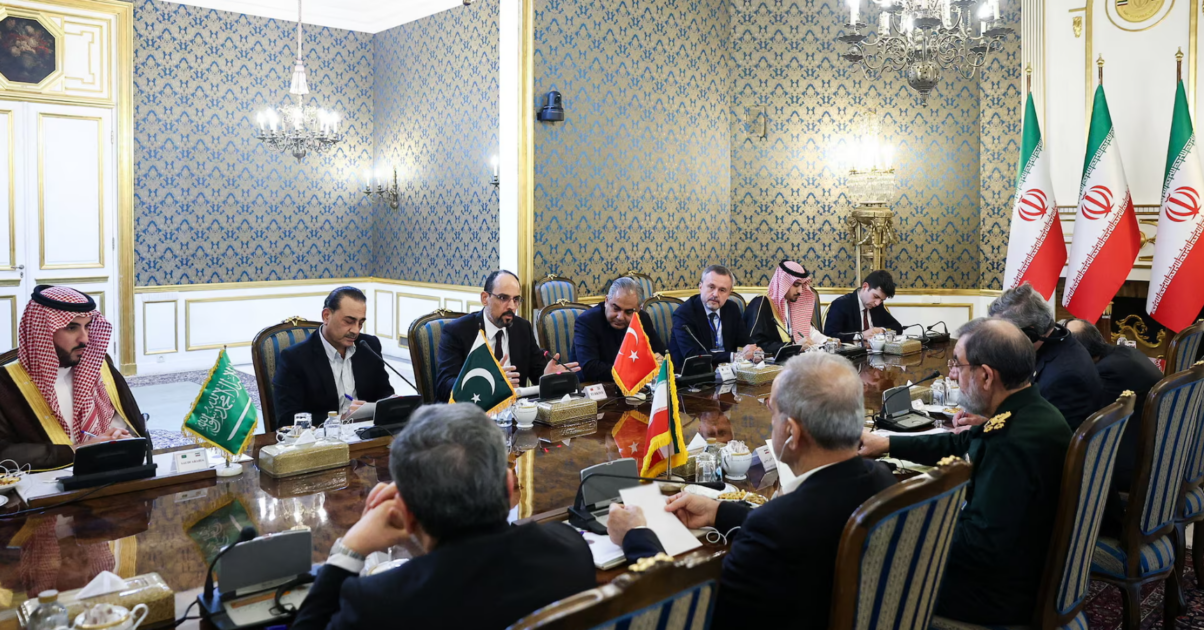
Kathmandu. High officials from Saudi Arabia, Turkey and Pakistan held important talks with the Iranian leadership on Monday as the risk of another major war in West Asia is rising. Iran has described the talks as “very good” amid fears that the eight-month-old war could flare up again.
This is the first time that high-ranking officials from the three countries have jointly visited Iran since the defense alliance was announced in Saudi Arabia’s holy city of Mecca last August. According to the Saudi Foreign Ministry, the visit is aimed at reducing tensions between the parties to the regional crisis.
Saudi Arabia’s Defense Minister Prince Khalid bin Salman, Pakistan’s army chief General Asim Munir and Turkey’s intelligence chief Ibrahim Kalin participated in the talks. They held separate and joint meetings with Iranian President Masoud Pezhekian, Foreign Minister Abbas Arakhchi and Supreme National Security Council chief Mohsin Rezaei.
Although no concrete agreement was made public after the meeting, the participating parties agreed to continue the talks, according to Iranian state media. Rezai, head of Iran’s national security, stated that the discussion was positive and stressed that the countries in the region should take responsibility for regional security. According to him, there were also serious discussions about the Israeli occupation of southern Lebanon, southern Syria, Gaza and the West Bank.
This diplomatic initiative is seen as important at a time when regional tensions are rising. United Nations Secretary General Antonio Guterres has also said that it is imperative not to increase tensions in West Asia. He emphasized that a major military attack on Iran and Iran’s attack on Gulf countries should be stopped.
Saudi security analyst Hesham Alghanam described the talks as the last chance before the crisis spirals out of control. The visit of the Saudi defense minister himself to Tehran is also seen as a sign that Riyadh attaches high political importance to talks with Iran.
Meanwhile, Iran-backed Houthi rebels have continued to attack the Saudi capital, Riyadh. The Saudi-led coalition said it shot down three drones in the southern region, including Riyadh, after the Houthis claimed to have attacked Riyadh International Airport on Sunday. The Egyptian parliament has approved President Abdel Fattah al-Sisi to provide defensive military assistance to Saudi Arabia if needed.
US President Donald Trump has warned that more military action may be taken against Iran. Similarly, Israeli Prime Minister Benjamin Netanyahu has claimed that he has intelligence that Iran and its allies could launch an attack to disrupt the election.
In this situation, Qatar and Pakistan are playing the role of mediator to reduce the tension between the US and Iran. Although recent talks between regional powers are expected to help reduce tensions, the risk of war in West Asia is not immediately over.