

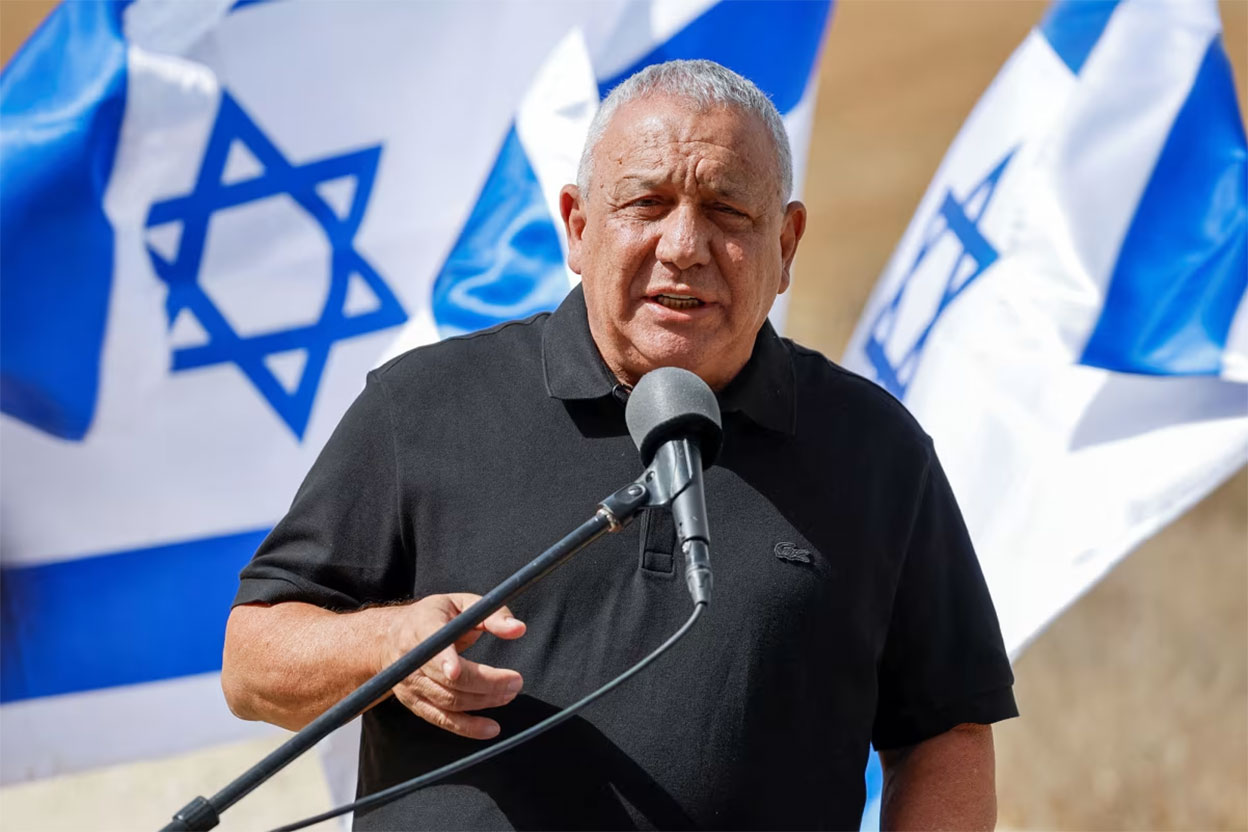
Kathmandu. Gadi Eisenkot has emerged as the main opposition leader who will challenge the current Prime Minister Benjamin Netanyahu in the general election to be held in Israel on October 27, i.e. today. Eisenkot, who spent a long time in the Israeli army, has recently been active in politics.
He is being presented as an influential candidate among voters looking for an alternative to Netanyahu. He has led the moderate party ‘Yashar’.
Eisencott’s greatest political advantage is the fact that he is not like Netanyahu. In this election, which is considered important for Israel’s political future, it is analyzed that he can get the support of voters who are looking for an alternative to Netanyahu. Earlier, polls showed Eisenkot ahead of Netanyahu by four seats.
His family background has also come into the limelight during Eisencott’s political journey. Yinon Magal, a television presenter who is considered to be a supporter of Netanyahu, made a controversial comment targeting Eisencott and linking it to his ethnic background. He described Eisencott as a man of “Moroccan descent” under the control of the Ashkenazi Jewish elite.
The comments resurfaced a long-standing debate about the inequality between Jews of European origin and Jewish communities of Middle Eastern and North African origin. Magal later claimed that his comment was not meant to mock ethnic backgrounds, but to refer to people operating behind the scenes. Netanyahu also criticized the comment.
Who is Eisencott?
The 66-year-old Eisenkot is the son of immigrants who came to Israel from Morocco. The second of nine children, he is the father of five children. He lost his son in the Gaza war.
His background is different from that of Netanyahu. While Netanyahu grew up in an elite environment in Jerusalem, considered the center of political influence and power, Eisencott spent most of his life in the military.
Eisenkot, who joined the Golani Brigade of the Israeli army in 1978, held the responsibility of the chief of the Israeli army from 2015 to 2019 after nearly four decades of military service. During that period, he worked under Netanyahu’s government.
In 2016, the incident of Israeli soldier Elor Azari, who shot and killed a wounded Palestinian attacker, sparked a debate about the discipline and ethics of the Israeli army.
Despite pressure from right-wing politicians, Eisencott supported a military investigation and legal action in the incident. He said that it is necessary to maintain the discipline and morals of the army.
In 2022, he entered politics with former military chief Benny Gantz. After the Hamas-led attack on October 7, 2023, they joined Netanyahu’s Emergency War Cabinet. But both leaders left the cabinet in June 2024 saying that there was no clear post-war strategy.
The war also caused deep damage to Eisencott’s family. In December 2023, his 25-year-old younger son Gal died during military operations in Gaza. Two of his nephews also lost their lives in the war.
What is the result of the poll?
According to various opinion polls published before the election, Yashar Party of Eisenkot can win 20 to 23 seats out of 120 seats in the Parliament. In some polls, his party is four seats ahead of Netanyahu’s Likud party.
It is also claimed that Eisencott is behind Netanyahu in the question of who is considered suitable as the prime minister. But the lead seen in the survey alone does not ensure the formation of the government. There are a total of 120 seats in the Knesset, Israel’s parliament. The support of at least 61 MPs is required to form a government.
Voters in Israel do not directly vote for a single candidate, but for a political party. The seats in the parliament are distributed based on the proportion of votes received by the parties. Due to this arrangement, in the event that one party does not get a clear majority, a coalition between various parties is necessary to form the government.
The leader of the party that wins the most seats in the election is not automatically given the responsibility of forming the government. The parliamentarian who is likely to get a majority before the president is given the responsibility of forming the government.
Netanyahu’s coalition includes right-wing and extreme right-wing and ultra-conservative Jewish parties. On the other hand, polls have shown that there is no possibility of getting a clear majority in the anti-Netanyahu coalition. In such a situation, there is a risk of political deadlock after the election. For Eisencott, it will be a challenge to bring the left-wing, centrist and right-wing parties into a single coalition. In some situations, the support of the Arab parties may also be necessary.
What is the difference between Netanyahu and Eisencott’s policies?
Eisencott presented himself as a ‘warrior, leader and supporter of unity’ in his election campaign. His party’s name is ‘Yasher’, which means ‘straight’ in Hebrew.
Among his major election agendas are the establishment of an independent state commission to investigate security failures during the October 7, 2023 attack and the introduction of mandatory military service or national service for all citizens. Netanyahu has been resisting the creation of an independent commission of inquiry into the October 7 incident.
Similarly, some parties in the current coalition are demanding that the ultra-Orthodox Jewish community be exempted from military service. Eisencott is in favor of all citizens participating in military or national service. But in terms of security policy, Eisencott is not much different from Netanyahu. He has widely supported Israel’s military operations in Gaza, Lebanon and Iran.
While in the Israeli army, Eisencott’s name was associated with the ‘Dahiya principle’. This doctrine emphasizes the strategy of creating deterrence through the use of extensive military force, including civilian infrastructure, to prevent future attacks by armed groups. He is also believed to be a supporter of covert and limited military operations that weaken the enemy’s military capabilities without expanding the war completely.
On Iran, both he and Netanyahu are in favor of preventing Iran from acquiring nuclear weapons and weakening the Tehran-backed armed network. But Eisencott criticized Netanyahu for lacking a clear strategy in the latest conflict. According to him, it is necessary to combine military achievements with diplomatic efforts.
He also criticized Netanyahu regarding the war in Gaza. He accused Prime Minister Netanyahu of endangering the lives of Israeli hostages by prolonging the war due to political interests. This difference was one of the reasons for leaving the War Cabinet.
Eisencott is a leader from Israel’s security apparatus. Therefore, it is not certain that his policy on the Palestinian issue will bring about a radical change in Israel’s current strategic direction.
Policy changes may also be limited as he may need the support of right-wing parties to form the government. There is little chance of a major improvement in the condition of the Palestinians if the government changes in Israel.
Regarding Gaza, he has expressed his commitment to end the rule of Hamas within 18 months. For that, he has put forward the option of implementing the cease-fire plan of US President Donald Trump or conducting what he called a ‘constructive’ military campaign.
Netanyahu has also been presenting the goal of ending the rule of Hamas. But according to Eisencott’s reasoning, Hamas’ rule cannot end as long as Netanyahu remains in power. Before entering politics, Eisencott had warned that Israel could turn into a binational state due to continued Israeli control over the Palestinians in the West Bank. He considered such a situation as a serious challenge for the concept of building a Jewish state in Israel.
But after October 7, 2023, he has not supported the two-state solution. In a recent interview, he commented that the advocates of the two-state solution were “deluded”. However, he has not presented a clear blueprint of what kind of political system should be in place of it.
Eisencott has been opposing the formal annexation of the West Bank and the expansion of illegal settlements. He called the plan to build an Israeli settlement in the disputed E-1 area of the West Bank a “mistake” because of the price Israel has to pay at the international level.
Similarly, he has promised to be strict on the violence caused by the residents of the Jewish ghetto. He termed such violence as ‘Jewish terrorism’ and accused the government of obstructing the work of the security agencies.
Eisencott and Netanyahu’s relationship with Trump
US President Donald Trump has made clear his support for Netanyahu. On October 18, he said he had “full and unconditional support” for Netanyahu. He called Netanyahu a “great warrior prime minister” and hinted that other people might be the wrong choice for the United States under the leadership of Israel.
According to Israeli sources, Eisencott and other opposition leaders asked the US administration not to interfere in the election. For that, it is said that the help of mediators such as Miriam Adelson, the main donor of the Republican Party, has been taken. But Trump did not stop supporting Netanyahu.
Trump and Netanyahu have been in political cooperation for a long time. The decision to move the US embassy to Jerusalem in 2017, the decision to withdraw the US from the Iran nuclear deal in 2018, the Abraham deal in 2020 and the attacks on Iran in 2025-2026 have been seen as cooperation between them.
However, recently there have been reports of dissatisfaction within the Trump administration saying that Israeli attacks on Lebanon and Gaza have affected regional peace efforts.
Itamar Ben-Gavir and Bezalel Smotrich, Netanyahu’s right-wing allies, are likely not to be in the government if an Eisencott-led government is formed. In such a situation, it has been analyzed that it may be easier for the Trump administration to advance regional diplomacy.
Especially the new government can create a different environment in the American effort to normalize Israel’s relations with Saudi Arabia. Saudi Arabia has been demanding credible progress towards the establishment of a Palestinian state. The government, which does not depend on the support of far-right parties, can find a relatively easy environment to carry out diplomatic initiatives on this issue.
But even if Eisencote wins the election, he will have to gather the necessary parliamentary support to form the government. Therefore, the future political direction of Israel will depend on the ability of coalition building along with the election results. With help from CNN