

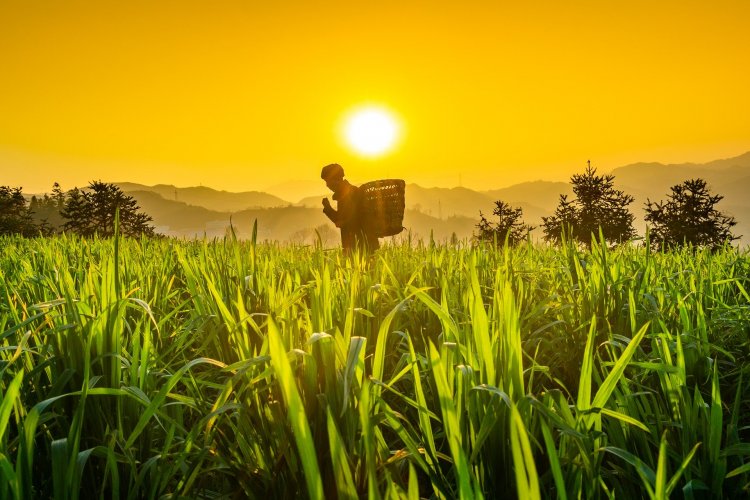
Surlahi. Mohammad Akbar Ansari of Hariwan Municipality-4, Sasapur has become an example that if you can do agricultural work in an advanced way, you can earn better income in your own land than going abroad for employment. Ansari, who went to Qatar and Saudi Arabia for foreign employment, is now farming commercial sheep in his own village.
He has been farming Golvenda commercially for the last eight years and is also earning a lot of income. This year too, he has planted golbhenda in an area of seven bighas. Ansari’s experience is not just a story of subsistence farming. He claims that he has earned a lot of income from commercial farming.
According to him, in the year 10 bighas, he got more than Rs. He said that he has made a profit of more than Rs. 50 lakhs and has been able to add more floors to the house and land. Ansari’s story is also an answer to an important question. If agricultural knowledge, market, technology, investment and management are properly managed, they can earn respectable income from agriculture in Nepal.
Another farmer, Neelkanth Devkota of Bagmati Municipality-11, has grown commercial sugarcane in an area of 25 bighas. Apart from the one he owns, he is cultivating almost 20 bighas of land on rent. He says that farming can be done easily with the use of technology. He said that he is getting a good income from it, but his experience is that there is a shortage of chemical fertilizers and seeds.
The agricultural work in Sarlahi and its experience have illustrated the agricultural problems of Nepal. On the one hand, few farmers have achieved success like Ansari of Hariwan and Devkota of Bagmati. Farmer Mukesh Mahato of Barathawa Municipality-5, Hattidanda complains that due to heavy rains and cheap market prices, he is finding it difficult to even raise the cost of green vegetable cultivation. He says that since green vegetables cannot be stored and kept, they have to sell them at a price that does not raise investment even when the price falls.
He is saddened that the price of vegetables produced compared to the cost of seeds, fertilizers, pesticides, irrigation, labour, transportation and other expenses is not available to the farmers. Sometimes when the price of vegetables goes up, the consumers are hit by high prices, and sometimes when the prices fall, the farmers have to find loans to pick the vegetables produced from the farm and bring them to the market.
The wholesale vegetable market area of Lalbandi is full of farmers and traders every day from dawn. From here, millions of vegetables are transported to different cities every day. According to the details, the farmers have been selling various vegetables including cabbage, bodi, beans, cauliflower, cabbage, gourd, gourd, bitter gourd, cucumber, khorsani.
Vegetable farming has become an important source of income for the farmers of Lalbandi, Hariwan, Bagmati, Ishwarpur, Barhathwa and Chandranagar areas. Farmers say that if the automatic price system is implemented to ensure the investment made by the farmers, the farmers’ produce will get a better price. Mukhchandra Mahato, a farmer of Hariwan Municipality-4, says that due to fruits and vegetables entering Nepal through the open border from the neighboring country India, the local production is always affected. He complains that it is unfortunate that the material produced by the farmers gets the price at the middleman’s price rather than the cost.
Although the farmer takes the biggest risk and produces the agricultural produce, he does not have the power to determine the price in the market. Farmers spend years producing, but the price is not determined based on its cost. Farmers should always sell sugarcane cheaply and buy sugar expensively. The cost of farming is increasing every year. Malkhad is not given by the government, it has to be bought expensively from the black market. The experience of the farmers here shows that they had to incur huge losses due to having to sell on credit for years.
Agricultural reform means not only increasing production but also stabilizing the income of farmers. For this, along with the production of agricultural produce, moisture storage, processing, market information, insurance, cooperatives and price policy should also be developed. Food security cannot be considered only as storage of grain in warehouses. Food security can only be ensured if the farmers who produce grain, the land where it is produced and the system that transports the product to the market are safe.
Farmers are becoming displaced due to the fact that farming has been made a less prestigious profession in recent times. Due to the uncertainty of income from agriculture, this profession has become a subject of low prestige. This may have happened because the production cost of the crop is high and the profit is low. The problem faced by the farmers in the availability and cost of basic essential and technical tools such as fertilizers, seeds and irrigation has also become an important reason. Due to the losses incurred due to unstable market prices and the fragmentation of agricultural land, the attitude towards this profession is changing.
It is clear that because the young generation understands agriculture more as traditional labor than as a modern business, their distaste for agriculture is increasing. “Good agriculture, mediocre business and poor job” was a very popular statement in this Nepali society until a few decades ago, but now this statement has practically disappeared.
Why was he encouraged to leave his ancestral profession for the same profession in a foreign land? Why are young people ready to go to Korea, Japan, Israel to work in the agricultural sector because this profession is inferior in their country? Why don’t the parents here have any regret when they see their children working in the farm animal cage after reaching abroad? The question has become complicated now. The only difference is that the children plowed abroad with tractors that should be plowed here. Connected to technology. Here too, with the gradual development of technology in agriculture and animal husbandry, there is a need for concerted efforts to prevent the migration of young people abroad.
Experts are of the opinion that due to insufficient coordination between social perception, investment in the agricultural sector, research, technology and market management, the outlook towards agriculture is overshadowed. Agriculture is linked to the lifestyle, culture and economy of Nepali society, but in this country, which is said to be agrarian, farming has been portrayed as a profession of the weak and poor. Experts say that the agriculture sector is being neglected because of not trying to transfer the agricultural profession from generation to generation and not being able to move it from traditional to professional.