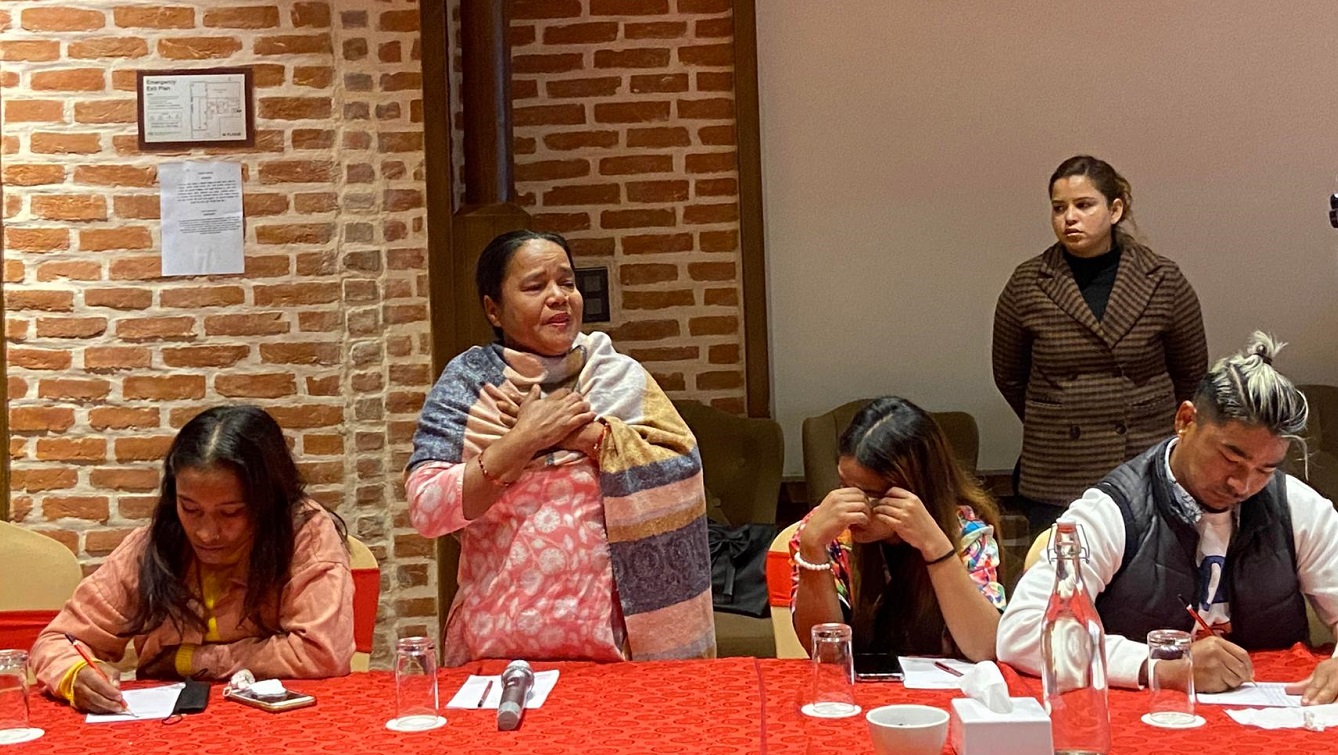
Kathmandu. Pampha tailor did not inquire about her husband’s affairs when she got married. Sewing skills and a husband were enough to make a living. However, after the death of her husband, the question of identity and citizenship arose in her life.
Born in Nepal, Pampha is struggling with the pain of being stateless in her own country. His pain is not limited to himself. She is even more worried when her children and grandchildren have to become stateless. She says, ‘We are going to be uncivilized for three generations.’
According to Pamfa, she was married to a young man who was wandering in Maiti village. The eldest of 10 children, his family was in the grip of poverty. The young man, who was good at sewing clothes, thought that he could support the family, so his parents married him off. “They married the boy because he was good at sewing, he would take care of him,” Pamfa said, “My mother-in-law did not ask where the house was, nor did I ask.” After that, her married life passed by sewing and working.
It has been more than two decades since the death of Pampha’s husband, who came to Kathmandu 35 years ago for employment. He had to suffer the problem of not having citizenship even more at that time, when it was not possible to make citizenship and birth certificate of his children. Now, as the grandchildren do not have birth certificates, they are also deprived of going to school.
After all, I am also a citizen of this country. My birthplace is this country. Why is my citizenship not made? I couldn’t understand,’ she said emotionally.
Pampha is worried that there will be a situation where the grandchildren will be without citizenship. That’s why she is fighting for the citizenship identity of her children and grandchildren. According to him, he was born in the year 2025. He wishes that the next generation should not have to suffer the pain that he had to suffer due to his lack of citizenship.
“Since two sons do not have citizenship, they are neither employed nor educated. We are also deprived of the opportunity to open a bank account,” she said. He says that his sons, who earn a living by working, have to lose their jobs because they do not have citizenship.
She said that due to lack of citizenship, the family had to lose their livelihood as well as being deprived of various facilities provided by the state.
It is not that they did not try to create citizenship from Maaiti side. However, after the local body returned her married daughter’s citizenship, she returned to Kathmandu disappointed.
After my husband passed away, I went to Maiti to get citizenship. However, he sent it back saying to make it from his husband. I don’t know the whereabouts of my husband. Where should I go now?’ she said.
When will our citizenship become?
Sanjay Rai, who spent his life as a street child, is stateless even when he reaches adolescence. He has not been able to obtain citizenship due to the lack of identity of his relatives. Having become a taekwondo player, he also got a job as a coach at a school. However, due to lack of citizenship, there is a problem in getting salary, he said.
The Tiktok account he is operating is also in the name of someone else. He complained that the five lakh rupees in the said account were also kept by others. He said that he was also forced to get the SIM card of the mobile phone he was using in someone else’s name.
“What is more ironic than not being able to open a bank account without citizenship?” He questioned.
At the same time, with the help of the organization, he asked the members of the House of Representatives, “Parliamentarians, when will our citizenship be made?”
Like Sanjay, Anju Guru is stateless. She spent her childhood in the streets of Pashupati area. Anju’s husband, who got married as a teenager, is also a street person. Both husband and wife do not have citizenship.
If I had citizenship, I would have got a job. The future was bright. We are living in darkness now. There is no identity, no respect,’ she said.
Also, according to a recent survey conducted by the organization on street children, 93 percent of 150 street children do not know about birth registration. The conclusion of the survey is that most people understand birth registration as a means of obtaining citizenship and employment rather than a fundamental right.
In the survey, it is mentioned that 65 percent of parents have no documents, fathers are not identified and disappeared and 35 percent are related to marital status. Similarly, the survey showed that 45 percent do not have any identity cards or documents, so they are deprived of access to formal employment and government facilities.
The organization has also classified cases where births could not be registered. According to which, there are three cases of couples living together, 25 cases of polygamy, 45 cases where both parents do not have documents, 65 cases where the father does not have documents, 27 cases where the mother does not have documents, 45 cases where the father is missing and five cases related to the identity of the foreign national father.
Law, Justice and Human Rights Committee Member of Parliament Madhusudan Choulagai said that since the right to citizenship is a fundamental right, no citizen should be deprived of it. He is of the opinion that temporary identity cards should be arranged for citizens to live easily when the documents are not verified and the identity of the parents is not revealed.
For this, he expressed his commitment to take the initiative to prepare a procedure to facilitate the citizenship distribution process after necessary discussion in the committee. You should get natural rights like citizenship. There is a law. We will take initiatives in the committee to make it simpler,” said MP Chaulagai.
Kavita Shah, a human rights activist and resource executive of the organization, said that although there is a legal system for obtaining citizenship and birth certificate, the practical implementation is complicated, so the common people cannot get the service easily. “The law is good, although the practical aspect is weak, many young generations are forced to become uncivilized,” she said.