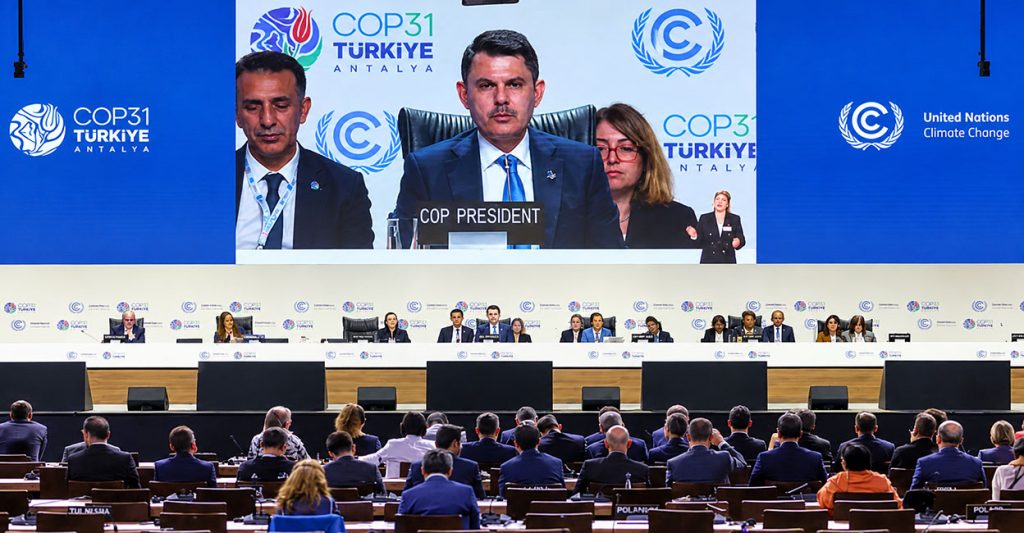
Kathmandu. The United Nations Conference on Climate Change (COP-31) ended without reaching a concrete common conclusion. The European Union (EU), Britain and some developing countries have rejected the proposed agreement after fossil fuels, which are the main cause of the climate crisis, were not mentioned in the final agreement document.
The ‘Antalya Pact’ proposed as the main conclusion of the conference held under the joint chairmanship of Turkey and Australia in Antalya, Turkey, did not include the topic of exiting from fossil fuels. Disagreements broke out in the final stage of the conference over this issue.
The conference was scheduled to end on Friday, but it was extended until Sunday afternoon as no agreement could be reached. The main document could not be passed in this time, which was the longest in the history of the climate conference.
Speaking on behalf of the European Union, Ireland’s Environment Minister Darragh O’Brien said the proposed document failed to address the needs of the current climate crisis.
This proposed decision could not meet the needs of the present time. “We cannot support a decision that does not address the facts shown by science and further widens the gap between global commitments and necessary action,” he said, adding, “This does not even mention fossil fuels.”
He made it clear that the EU would not support the proposed agreement saying that efforts to make fossil fuels look greener cannot be accepted.
After the EU’s objection, Panama, Marshall Islands and Norway also expressed dissatisfaction with the proposed document. Representatives of small island nations and less developed countries also demanded that the transition from fossil fuels should be included in the agreement.
The Antalya Pact included encouraging countries to electrify their economies, rich countries providing financial assistance to poor countries to deal with the effects of climate change, and reducing the risk of exceeding the 1.5 degree Celsius temperature increase limit set by the Paris Agreement.
However, the document did not include the commitment to phase out fossil fuels demanded by more than 130 countries. Provisions regarding Carbon Capture and Storage (CCS) technology were also included in the document. Some countries have criticized that this technology can continue the use of fossil fuels.
Saudi Arabia defended the provision of CCS technology. Although the African Group, China and Pakistan expressed dissatisfaction with some provisions of the agreement, they did not oppose the entire document.
Pakistan is of the opinion that even if there is disagreement on some issues of the agreement, the remaining issues should not be abandoned and climate action should not be taken as an option to choose an issue that is convenient for them.
Ghana also criticized the negotiation process and held the opinion that it should not withdraw from multilateral cooperation.
Although the main document of the conference could not be passed, it was decided on issues such as ‘just transition’ to support workers during the transition from high carbon emitting industries to low carbon economy.
The chairman of the conference, Turkish Environment Minister Murat Kurum, admitted that there was no agreement on the main document. He said that he did not try to impose documents on any party and said that the decision was not passed because there was no agreement.
“We tried our best. Finally, we have not imposed this document on anyone. We have not even given an ultimatum to accept or reject it,” he said. “It is clear that there are opposing parties in this document. Therefore, no agreement could be reached and the decision was not passed.
Chris Bowen, Australia’s climate change minister and co-chairman of the conference, also said that his side has done its best in the negotiations. However, he said that consensus could not be reached between the positions of different countries.
Simon Steele, Executive Secretary of the United Nations Convention on Climate Change, admitted that the expected consensus was not reached at the conference, but said that there was progress and concrete decisions on other issues.
Former Irish President and former United Nations Climate Envoy Mary Robinson, who participated in the conference, expressed disappointment that there was a lack of leadership and readiness in the negotiations.
There is no readiness to address these issues. It is very disappointing for me,” she said.
The participants expressed dissatisfaction with the slow pace of the conference at a time when heat waves, droughts, floods and other extreme weather events are increasing worldwide due to the climate crisis. In the context of climate-related disasters in various regions of the world, including the glacial disaster in Nepal, it was criticized that the conference could not produce the expected results.
United Nations Secretary General Antonio Guterres also expressed disappointment that the conference could not reach a common conclusion.
I am deeply disappointed that the overall conclusion was not reached. “I share the disappointment of all those who expected governments to move according to the needs of the hour demanded by the climate crisis,” he said.
However, he said that even if no consensus was reached in the talks, there is no ambiguity in the scientific facts related to climate change.