

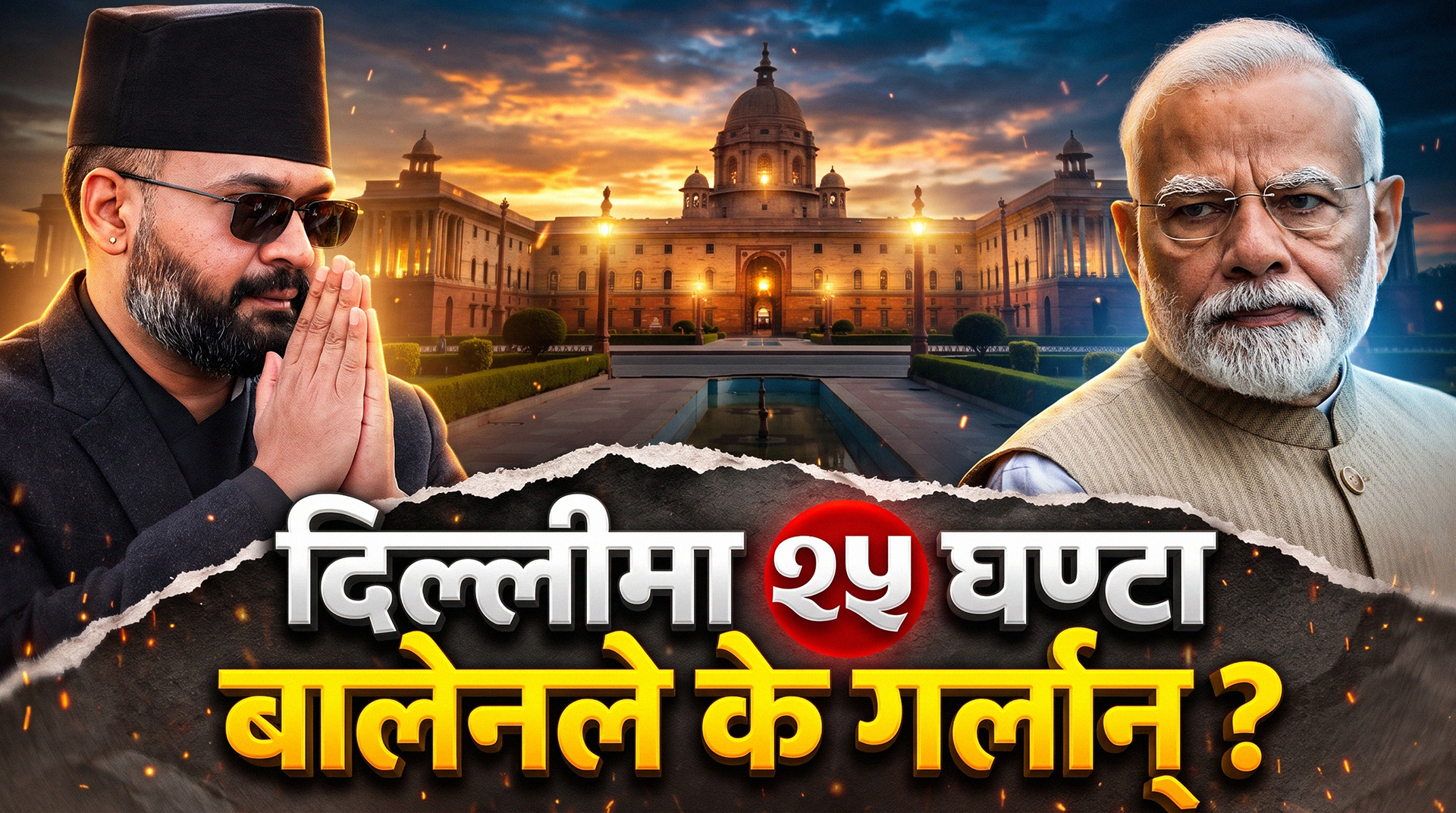
Kathmandu. Prime Minister Balendra Shah’s imminent visit to India has now become a matter of special interest in Nepali political and diplomatic circles. This visit is not only a formal meeting between the Prime Ministers of the two countries, but also a test of how Nepal’s changing political leadership wants to advance its relations with India.
Prime Minister Shah seems to prefer a short, limited and results-oriented visit, different from the traditional diplomatic style. He is scheduled to stay in Delhi for about 25 hours during the visit scheduled for November 22 and 23. Issues including economic cooperation, air routes, infrastructure, border disputes, post-disaster reconstruction and regional politics are likely to be prioritized in the meeting with Indian Prime Minister Narendra Modi. But the most important question is not what Balen demands from India, but what kind of relationship Nepal wants to establish with India according to its national interest.
1. Short visit, big diplomatic message
The first characteristic of Balendra Shah’s tour of India is its period and style. In the past, Prime Ministers of Nepal used to stay for three to four days during their visits to India, hold various political and business meetings and also include programs outside Delhi. But Balen seems to prefer tours based on limited time and a fixed agenda. It conveys an important message – the Prime Minister of Nepal is willing to expand ties with India, but wants to give more importance to results than formalities and frills.
However, a short visit is not a diplomatic success in itself. How many agreements and understandings are executed in 25 hours will determine its true value. So Balen’s visit should be judged not by time, but by achievement.
2. Meeting with Modi: Building trust and balancing national interests
The meeting between Balen and Modi will be the most important political aspect of the visit. In a personal dialogue with Modi, Balen can convey the message that Nepal’s new political leadership wants to cooperate with India, but will not compromise Nepal’s sovereignty, national self-respect and national interest.
India has special interests in Nepal related to security, trade, energy, water resources and connectivity. India is also the most important trading partner for Nepal, a major transit route and a major market for energy trade. Therefore, the relationship between the two countries should not be based on sentimental expressions, but on the principle of mutual dependence and mutual benefit. Balen should be able to convince Modi that Nepal is not anti-India, but a country that is clear in its interests and independent in its decisions.
3. Border Disputes: A Real Test of Diplomatic Stance
The most sensitive issue of Nepal-India relations is the border dispute. Disputes in areas like Kalapani, Lipulek, Limpiyadhura and Susta have not been resolved for decades. It is said that Prime Minister Balendra Shah showed interest in collecting historical evidence and documents related to the border dispute even after becoming the Prime Minister. This time in his meeting with Modi, it will be important for Nepal’s national interest to raise this issue. But raising a border dispute and making concrete progress towards a solution are two different things. There is a need for Nepal to activate a high-level dialogue mechanism by clearly presenting its historical map, evidence and diplomatic claims.
Balen should at least seek agreement on a timeline for resuming formal negotiations and the establishment of institutional mechanisms to resolve the border dispute. It would be wrong not to raise national issues for fear of spoiling relations with India. Likewise, making provocative statements for domestic popularity is not diplomacy. The balance of determination and dialogue is the right path for Nepal.
4. Reconstruction after the Bhotekoshi floods: An opportunity to turn cooperation into results
The devastating floods in Bhotekoshi and Rasuwa areas have caused great damage to Nepal’s border infrastructure, people’s lives and economic activities. In such a situation, it is natural to ask India for financial and technical support for reconstruction. It is said that Nepal is expecting big financial support for reconstruction. However, the final official details about the demand of two billion rupees and the possible agreement on it have not been made public.
When Balen asks for help from India, it should not be limited to relief materials but seek help in long-term reconstruction, roads, bridges, hydropower structures, settlement protection and disaster management. If the post-disaster reconstruction can be linked with Nepal’s infrastructure development and the economic revival of the border region, this visit can become an important achievement.
5. New Collaborations in Sports: Another Door of Possibilities
It seems that Balendra Shah is trying to advance the sports sector as a new dimension of Nepal-India relations. There is a public statement that the topic of sports cooperation was raised even in the meeting with the Indian Foreign Secretary Vikram Misri. India is at the forefront in the development of sports infrastructure, training, technology and professional competition. Nepal can benefit from Indian experience and resources in cricket, football, athletics and other sports.
In particular, cooperation can be done in player exchange, joint training, production of coaches, construction of sports infrastructure and organization of international competitions. Sports should be seen not only as a field of entertainment, but as a means of developing the capacity of the young generation, promoting tourism and expanding relations between the citizens of the two countries.
6. Gautam Budh Airport and Air Gateway: Key to Economic Development
Air access may be the agenda item of most practical and strategic importance on Balen’s visit to India. One of the main reasons why Gautam Buddha International Airport is not operating at full capacity is the lack of access to more international air routes through Indian skies.
Nepal has been requesting India for a long time to provide more air access routes from Mahendranagar and Bhairahawa areas. If an agreement can be reached this time, the usefulness of Gautam Budh Airport will increase. Lumbini will have a positive impact on religious tourism, international tourist arrivals, hotel business and local economy.
7. Regional and International Geopolitics: How does Nepal determine its position?
A visit to India can also exchange views on regional and international situations. Especially the tensions in West Asia, Iran-US relations, energy supply, the price of petroleum products and its impact on the South Asian economy are important topics. India’s energy security and Nepal’s fuel supply system are interconnected.
Therefore, it is natural for the two countries to discuss the economic challenges that international tensions can create. But rather than becoming a supporter of the strategic interests of a powerful nation, Nepal should keep its independent foreign policy, the principle of non-alignment and national economic interests at the center. It is Nepal’s diplomatic need to expand relations with India and balance relations with other countries including China.
8. Financial support and a clear message from Nepal to Modi
Nepal is looking forward to greater economic cooperation, concessional loans and partnership in development projects with India. A financial assistance package worth about two billion US dollars is also being discussed.
But the amount of aid is not the only thing that matters. It is important that which projects are built, how many jobs are created, how much Nepal’s production capacity increases and how much the economy benefits in the long run. Balen should be able to articulate to Modi his vision of a stable government, commitment to development and an investment-friendly environment in Nepal. India needs to create an environment to increase investment in Nepal’s infrastructure, energy, tourism, agriculture, information technology and manufacturing industries.
Conclusion: Balen’s exam will be held after returning to Nepal, not in India
Prime Minister Balendra Shah’s visit to India can be seen as the first major test of the new political leadership’s diplomatic skills. Short tours, limited delegations and results-oriented agendas indicate his distinct style. But more important than style is achievement. Ultimately, the success of Balen’s visit to India will depend not on how long he talks to Modi, but on what signs of change the Nepali people see in their lives after returning to Nepal. Will the 25-hour stay in Delhi change the future of Nepal or will it continue the old promise? The answer will be given by the achievements of the tour.



