

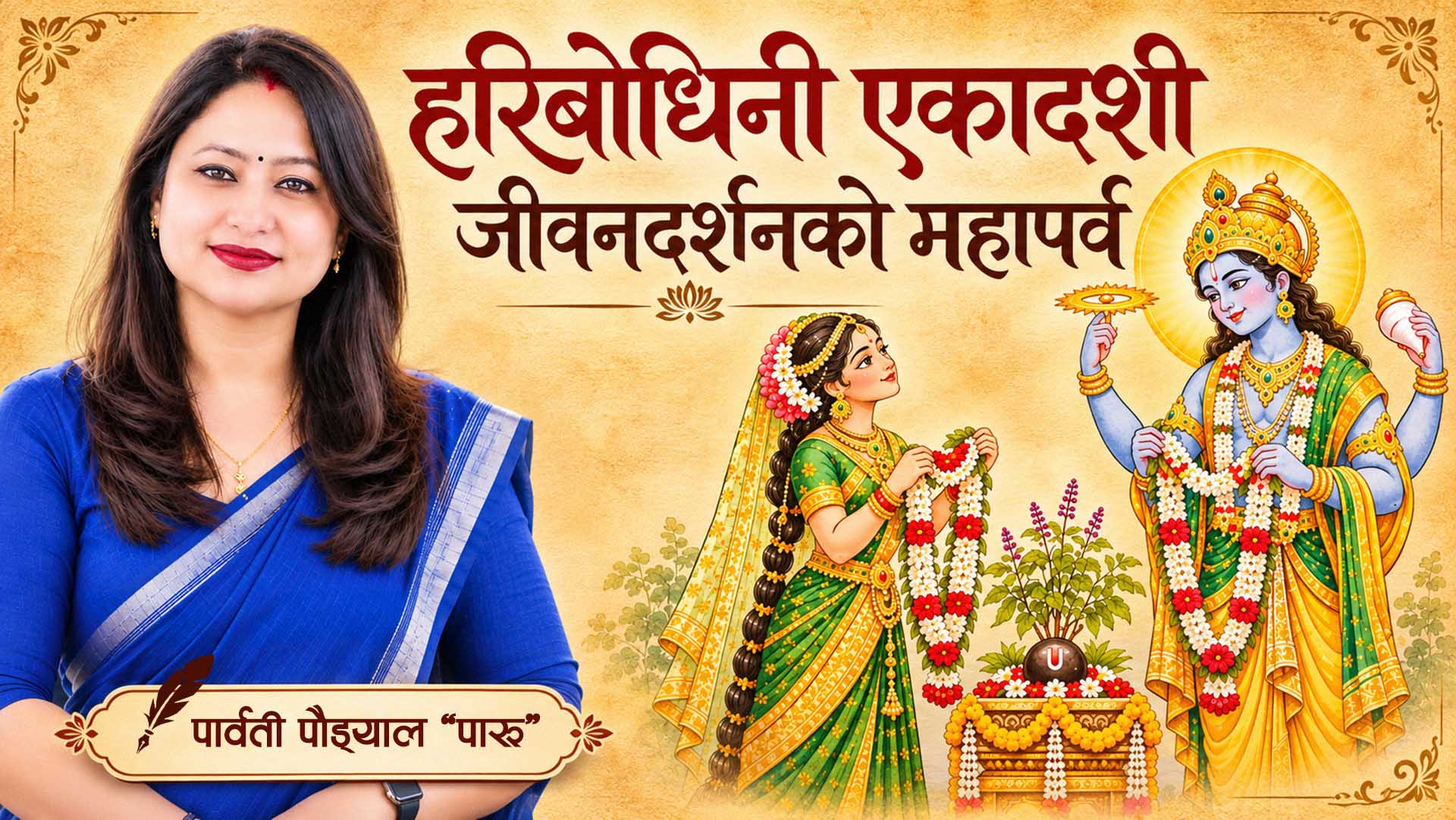
Haribodhini Ekadashi is a unique festival of Nepali Sanatan culture. It is not only a date for religious rituals, but also a cultural occasion to reawaken faith, self-realization, gratitude towards nature and social relations. Ekadashi of Kartik Shukla Paksha is known as Haribodhini, Devotthan, Vivah or Thuli Ekadashi. According to Sanatan belief, Lord Vishnu, who has been in yogic sleep in Kshir Sagar since Ashad Shukla Ekadashi, is awake on this day. It is religiously believed that this marks the end of Chaturmas and the beginning of manglik work including marriage.
However, I think that God’s awakening cannot be understood by limiting it only to religious narratives. Its symbolic message is also connected with the awakening of conscience, compassion, sense of duty and human sensibilities that are latent in humans. Lighting a lamp in Tulsi’s monastery is a sacred act, lighting the light of conscience in one’s inner self is equally important. While celebrating the awakening of God, people themselves are falling asleep to their responsibilities, so the spiritual essence of the festival remains incomplete.
Another special attraction of Haribodhini Ekadashi is the Tulsi wedding. On this day, it is a tradition to decorate Tulsi Math with garlands, pylons and lamps and marry Shaligram, the symbol of Lord Vishnu. The bhajans, conch sounds and mangaldhun echoing in the courtyard make the atmosphere devotional. The union of Tulsi and Shaligram is not just a ritual. It is a cultural metaphor between nature and man, devotion and dedication, and life and consciousness. Tulsi not only makes the Nepali home and yard greener, it also preserves the cultural identity that has been handed down from generation to generation.
Our tradition of worshiping nature as sacred also gives moral education of environmental protection. As the world today is affected by climate change and uncontrolled exploitation of natural resources, our ritual of offering water to Tulsi raises a question. How much responsibility have we, who worship nature, to preserve its existence? The true honor of faith is proved only when it is put into practice.
The importance of Thuli Ekadashi is beyond the religious boundaries and is also intertwined with the family intimacy of the Nepali society. Tulsi mutts decorated in village courtyards, mothers tying flower garlands, family members gathering materials for worship and the flickering lights of lamps placed around the tulsi mutts in the evening are still alive in memory. Those scenes were not just childhood memories, they were the silent school of our cultural identity. Times have changed, lifestyles have changed and although technology has brought people closer physically, the emotional distance has in some cases increased. In such an environment, our festivals provide an opportunity to bring families together in one courtyard and introduce their cultural roots to the new generation. Continuity of rites is not a mechanical repetition of the old method, but the preservation of harmony, tolerance and human values inherent in it.
Haribodhini Ekadashi is also given special importance as the date for the opening of marriage vows. It is believed that during Chaturmas, manglik work like marriage is postponed and the time of marriage ceremony starts from this day. In our culture, marriage is not just a formal union of two people, but a relationship established between two families, traditions and life visions. Its sanctity lies not in ceremonial grandeur or social display, but in mutual trust, equality, respect and sharing of responsibility. Acknowledging each other’s existence in both favorable and unfavorable circumstances of life is the real meaning of marital companionship. Therefore, the opening of the wedding ceremony is not only the beginning of celebration, but also an opportunity to resolve to build a healthy and respectful relationship. On this day, devotees observe fasting, fasting, chanting, meditation and worshiping Lord Vishnu. But the meaning of fasting is not limited to abstaining from food. Its deeper meaning is to exercise conscious control over one’s senses, desires and instincts.
Human hunger is not just for the stomach. The invisible hunger of greed, infatuation, arrogance, jealousy and dissatisfaction is also weakening his consciousness. Therefore, the essence of fasting is not only not to eat food for a day, but also to make a commitment not to hurt anyone’s heart. It is not just to worship, but to practice holiness. The value of religion is not determined by the duration of worship, but by the integrity, compassion, honesty and charity established in life.
We need to teach the new generation not only the methods of tradition, but also their underlying meaning. Because Sanskar is strengthened not by fear, but by understanding. Faith is matured not by blind imitation, but by discerning faith. For a tradition to survive, it must be able to expand its positive meaning over time. Haribodhini Ekadashi comes every year. Tulsi monasteries are decorated, lamps are lit and courtyards are filled with devotion. But the real achievement of the festival is the visible change in our thinking and behavior thereafter.
May we awaken our sense of duty with the awakening of Lord Vishnu. We can protect the existence of nature by worshiping Tulsi. We can gather courage to give up vices with fasting. Let’s establish the culture of equality and respect in the relationship with the celebration of marriage. And let’s bring the light of the lamp not only to our own home, but also to the depressed and dark hearts. Religion is not a means of dividing people, it should become a consciousness that connects human values. Sanskar is not a matter of performance, it should become a practice that makes life decent, dignified and sensitive.
Perhaps this is the most profound message of Haribodhini Ekadashi. Opening God’s sleep is a religious belief, but opening man’s conscience is a social necessity. Our faith will be transformed into action only if the consciousness of justice, compassion, harmony and humanity is awakened in the society along with the celebration of the awakening of Lord Narayan in the monastery of Tulsi. On the auspicious occasion of Haribodhini Ekadashi, let the light of wisdom, harmony, spiritual peace and good deeds spread in everyone’s life. Best wishes.



