

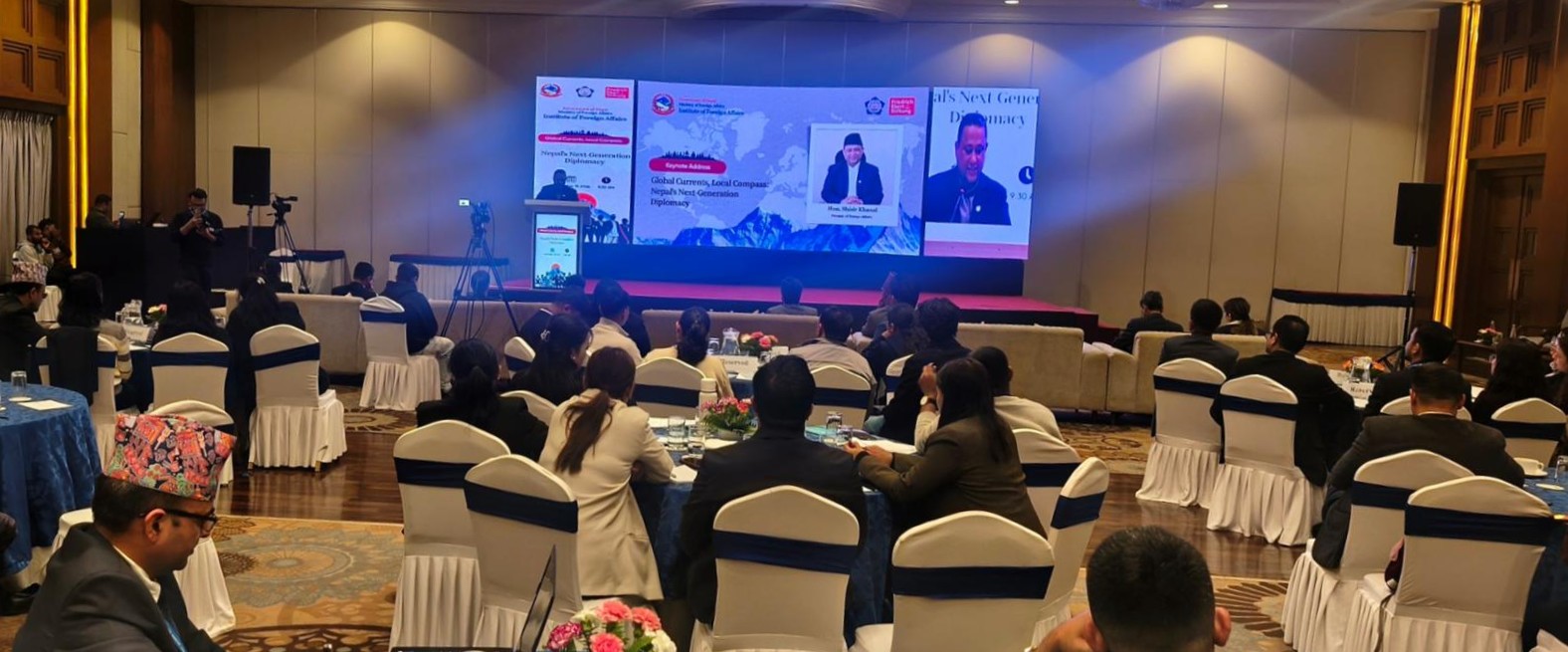
Kathmandu. Foreign Minister Shishir Khanal has said that critical thinking, adaptability, cooperation and continuous learning are needed in the new generation of diplomats for the protection of Nepal’s national interest and effective representation on the international stage.
Inaugurating the seminar on ‘Global Trends, Local Direction: Nepal’s Future Generation Diplomacy’ organized by the Institute of Foreign Affairs (IFA) on Wednesday, he said that diplomats should focus on national interests and strategic capabilities in the changing global environment.
He said that effective diplomacy begins with a deep understanding of one’s country, society, culture, strengths and limitations.
“One cannot effectively represent the country to the world without understanding oneself, one’s community and one’s country,” he said.
Mentioning that Nepal is a meeting place of ancient civilizations, Khanal emphasized that the cultural, natural and philosophical identity of Nepal should be presented confidently on the international stage.
He said that there is a need for a diplomat who can understand the aspirations and expectations of the mountain, hill and plain communities, farmers, entrepreneurs, youth and workers. He said that evidence-based analysis, critical thinking to solve problems, the ability to adapt to crises, understanding the concerns of different cultures and communities, empathy and collaboration skills are important for diplomacy.
Minister Khanal said that individuals and organizations that cannot acquire new knowledge and skills in a rapidly changing world will be left behind and urged the young diplomats to acquire proficiency in new subjects and genres along with world languages such as English, Chinese and Arabic.
Referring to the message of the Bhagavad Gita, ‘Karmanyevadhikaraste ma faleshu kadachan’, he said that one should fulfill one’s responsibilities honestly in diplomacy and nation building. He called upon the young diplomats, researchers and professionals to actively contribute as an integral part of Nepal’s diplomatic community in various fields of government, research and lobbying.
In the program, Rozina Tamrakar, executive director of the Institute of Foreign Affairs, said that technology, climate change, economic interdependence, immigration, energy transformation and changing geo-political equations have created new challenges and opportunities in international relations.
She said that it is necessary to enhance the capacity of young diplomats, researchers and policy makers to understand global changes in time and connect them with Nepal’s national interests and foreign policy priorities. He said that diplomacy is not limited to the state and traditional diplomatic institutions, but the role of individuals, organizations, networks and non-state parties is also becoming important.
In the day-long seminar, there will be group discussions on technology, digital transformation and the future of diplomacy, climate, energy and Nepal’s place in the changing world order and migration, movement and Nepal’s global participation in thematic sessions.
According to the foundation, the program was organized with the aim of creating an opportunity for exchange of ideas and policy dialogue between university students, young diplomats, government employees, researchers and young professionals.
Election Commissioner of Election Commission Rajeev Subba, senior officials of the Ministry of Foreign Affairs, representatives of diplomatic missions, researchers, personalities from the academic field and young professionals participated in the program.



