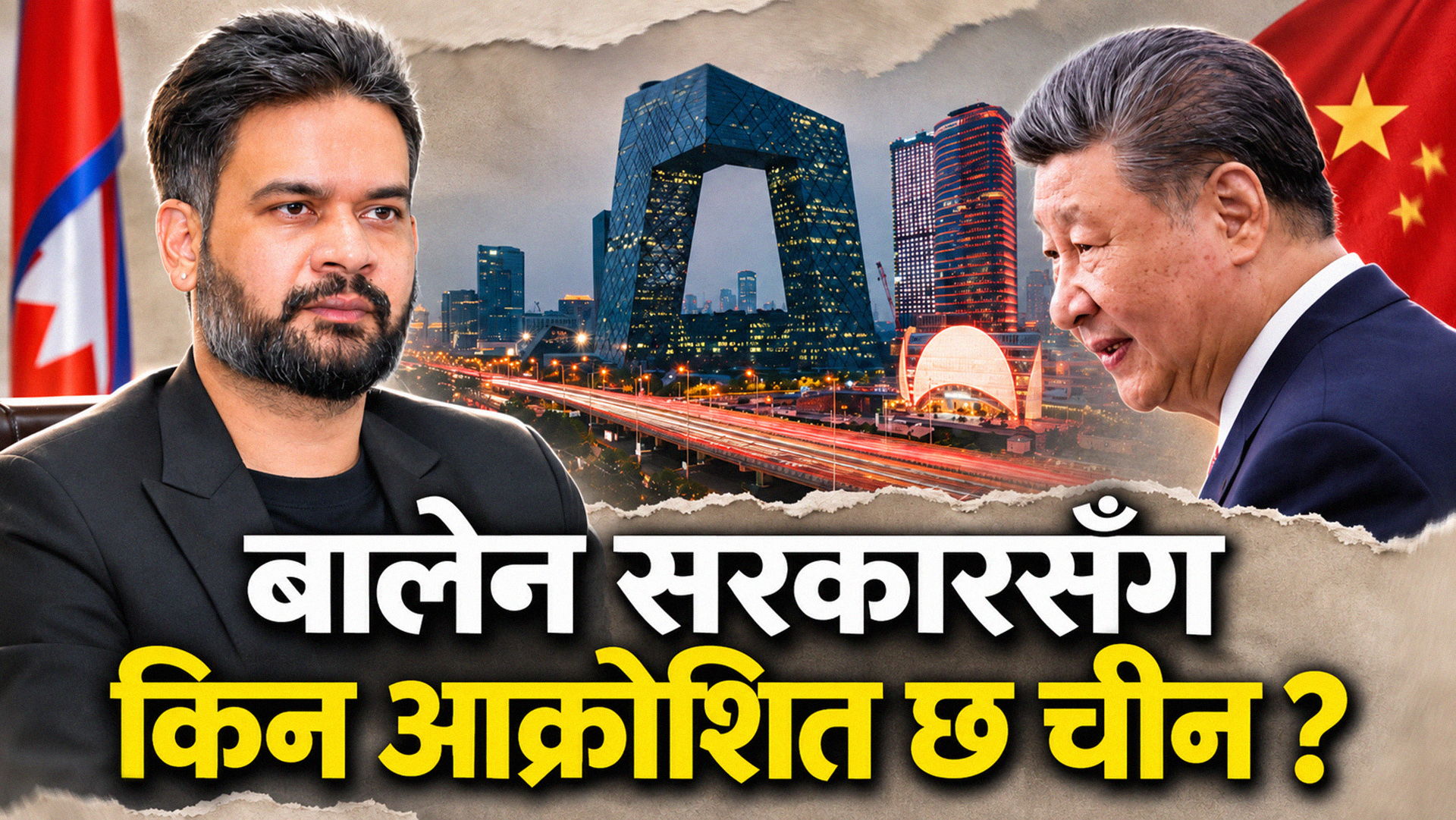
Kathmandu. Recently, the relationship between Nepal and China has become a matter of diplomatic concern and suspicion. After the formation of the new government between the two countries, which have traditionally had close relations, there has been a slowdown in the expected political dialogue, economic cooperation and implementation of bilateral agreements. While Nepal is continuing dialogue and cooperation with India and America at various levels, the relationship with China seems to have become relatively relaxed.
Meanwhile, 20 leaders of the National Independent Party (NRP) are visiting China at the invitation of the Chinese Communist Party. Their visit is seen more as an effort to expand relations and build trust between political parties rather than formal government relations between the two countries. During the visit, there are plans to hold talks with top leaders of the Chinese Communist Party in Chengdu and Beijing. But it is said that there is no official meeting with representatives of the Chinese government.
China has always prioritized the expansion of relations with Nepal’s political parties. Therefore, the invitation given to the leaders of RSWP can be understood as an attempt to establish relations with the new political power of Nepal. But it seems that the environment of trust between the government led by Prime Minister Balendra Shah and Beijing is relatively weak. It can be analyzed that there are not only one diplomatic incident behind it, but five major reasons connected with geopolitical interests, development partnership, Tibet affairs and international strategy.
1. Government’s reluctance towards BRI
Belt and Road Initiative (BRI) is one of the major issues of disagreement between Nepal and China. China has been promoting the BRI as an important project of its international economic and infrastructure partnership. Nepal has also participated in it.
But after the formation of the new government, the expected activity has not been seen in promoting the projects under BRI. The modality of BRI implementation, nature of loans, economic feasibility and national interest have been debated within Nepal for a long time.
The statement that Prime Minister Balendra Shah, before leaving for China, asked the party representatives not to make any new commitments on BRI as it is a controversial issue, has also raised questions about the government’s priorities. From China’s point of view, BRI is not only a plan for building infrastructure, but also a means of expanding long-term economic and strategic relations with Nepal. Therefore, when Nepal shows reluctance to take it forward, it is natural to cause dissatisfaction in Beijing.
2. Ravi Lamichhane’s reluctance to visit China
It is understood that China has shown special interest in expanding relations with the National Independence Party, which has emerged as a new political force in Nepal. In this context, it is said that Ravi Lamichhane, president of RSWP, has also been invited for an official visit to China. China’s desire may be to communicate with Lamichhane at a high political level, to understand the views of Nepal’s new political leadership, and to build an environment of trust between the two sides.
But it has been analyzed that Lamichhane did not go on a visit to China and raised some questions in Beijing. There is also talk that he is reluctant to visit China due to political sensitivities that may affect relations with India and America. However, until the official reason for this is publicly confirmed, it should be taken as speculation.
China does not want to limit its relations with Nepal’s political parties with the change of government. It is part of his long-term diplomatic strategy to expand relations at an early stage, especially with established parties as new powers. Therefore, the fact that the President of the People’s Democratic Party did not go on a visit to China and only other leaders of the party participated in the visit may convey the message that China has not achieved the expected success in building high-level political trust.
3. China’s sensitivity to the Dalai Lama and the Tibet issue
The Tibet issue has always been a sensitive issue in Nepal-China relations. China regards Tibet as its internal affairs and views political activities related to the Dalai Lama as related to its national security and sovereignty. It is said that after the formation of the new government, China has expressed interest and concern about the movement of representatives of the Dalai Lama in Kathmandu and the activities related to Tibet.
Similarly, it is said that Beijing is cautious about the appointments made in the Lumbini Development Fund and the possibility that people related to the Dalai Lama may visit Nepal in the coming days. It is also being analyzed that China is interested in the activities of Home Minister Sudhan Gurung and the management of political activities related to Tibet in Nepal.
For China, Nepal is not only a geographical neighbor, but also a country of strategic importance connected with Tibet. Therefore, Beijing has been giving special priority to the issue of Nepal not allowing anti-China political activities to take place on its land.
4. Apprehensions about US strategic projects and Pak Silica
Nepal’s geopolitical location is very important for China. Therefore, China has been closely monitoring the possibility of American influence expanding in Nepal. In this context, the increased interest in Beijing regarding strategic projects and partnerships promoted by the US is analyzed.
It is said that China has doubts about Nepal’s possible participation in the Pak Silica Project in particular. China may be sensitive about the strategic implications of Nepal’s participation in such a project. The suspicion that US companies or other external powers may be involved in the possible mining of uranium in Nepal may also increase China’s security concerns.
But such suspicions cannot be taken as confirmed facts. Similarly, China may also be interested in the utility and potential expansion of projects under the MCC. As the American presence expands in the infrastructure, energy and digital sectors, Beijing may understand that its strategic influence in Nepal will weaken.
5. A slowdown in bilateral cooperation and dialogue
Another important sign of strained relations between Nepal and China is the slowness in the implementation of past agreements between the two countries. After the formation of the new government, political dialogue and cooperation activities are going on with India and America at various levels. However, bilateral mechanism meetings and cooperation programs with China have not been activated as expected. This may raise the question whether Nepal is about to change its foreign policy priorities in Beijing.
Among the important areas of Nepal-China cooperation are infrastructure, energy, trade, transportation, railways and exploration of natural resources. But there is not enough speed to implement the agreements made in the past in these areas. In Dailekh, the slowdown in the petroleum exploration work carried out with the involvement of Chinese companies is also seen in this context. The progress of such projects being affected by the change of government is not a positive sign for policy continuity between the two countries.
However, the details of the bilateral meeting on railways a few weeks ago show that the doors of dialogue are not completely closed. The main challenge is political will to implement past agreements, regular dialogue and practical implementation of projects. If these issues can be improved, Nepal-China relations can become easy again.
Conclusion: How will Nepal maintain diplomatic balance?
The recent discomfort in the relationship between Nepal and China is not the result of a single incident. Attitude towards BRI, relationship with new political leadership, Tibet issue, China’s apprehension about US strategic presence and slowdown in bilateral cooperation are seen as major reasons for this.
China considers Nepal to be related to its security and strategic interests, and it is imperative for Nepal to maintain a balanced relationship with India, China and the US. Therefore, Nepal’s foreign policy should not be directed on the basis of appeasing one power nation or provoking another power nation.
It is natural for Beijing to closely monitor Prime Minister Balendra Shah’s possible visit to India. But expanding ties with India should not be seen as an anti-China move. Likewise, improving relations with China cannot be taken in the sense of moving away from India or America.
Ultimately, the future of Nepal-China relations will depend on the government’s diplomatic maturity, policy clarity and mutual trust between the two countries. Nepal can protect its national interest only if it practices an independent and balanced foreign policy rather than becoming an arena of geopolitical competition.