

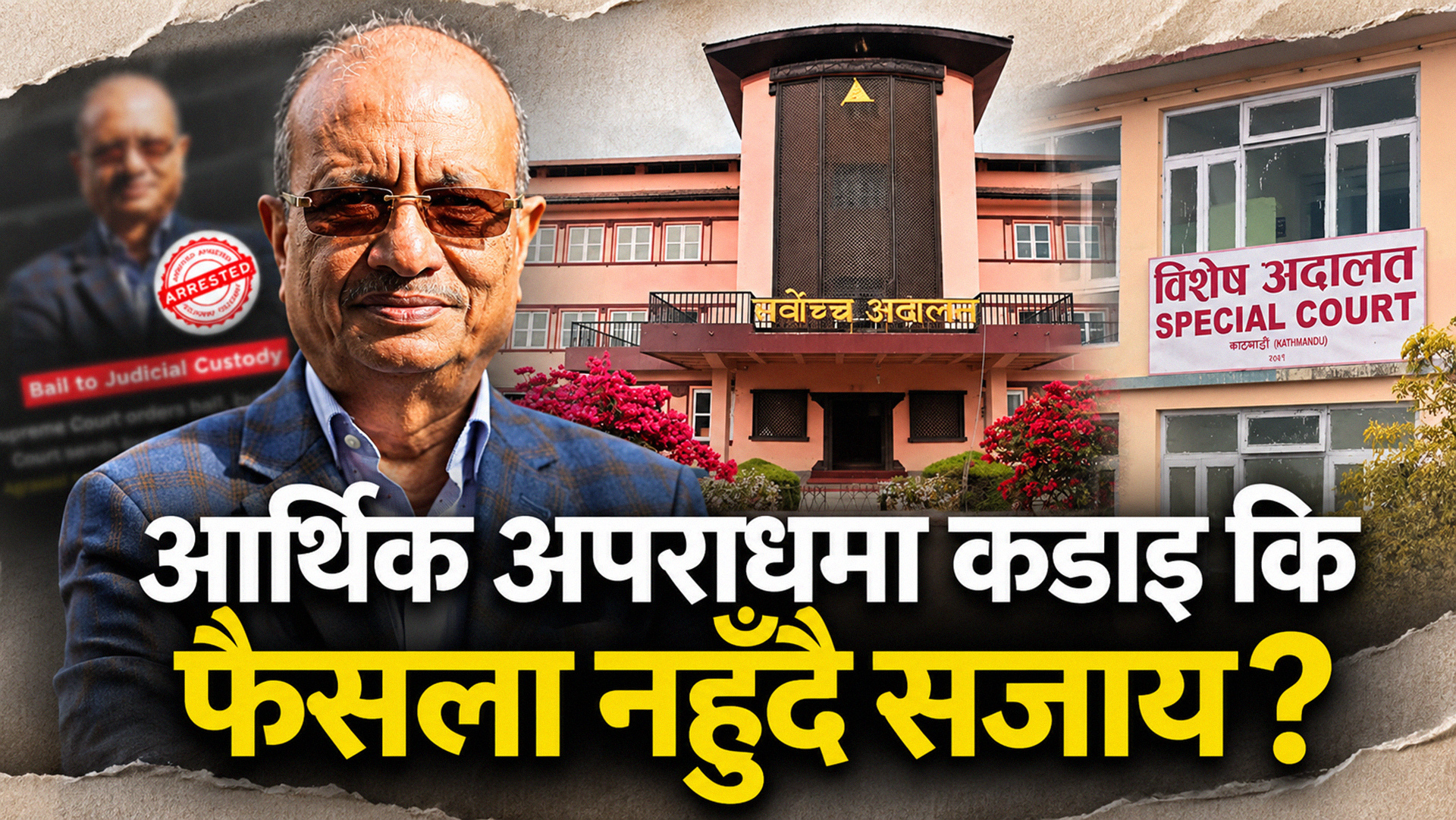
Kathmandu. Shankarlal Agarwal has been active in the field of Nepali industry and business for a long time. The name of Agarwal, who is associated with the Shankar Group and its leadership, comes up whenever there is a discussion about the expansion of the private sector, industrial investment and job creation.
He is heading the Shankar Group, which has a business legacy of nearly 9 decades, and is appearing in court this week. Although he has been in the news lately due to the legal process, his long professional journey and the presence made by the group in the Nepali industrial sector cannot be forgotten.
Nepal’s private sector has been facing various ups and downs in the last decade. Operating an industrial business is not an easy task amid political changes, policy instability, investment environment, ups and downs in the banking system and market competition. Agarwal is one of the industrialists who have continued their business activities for a long time despite such challenges.
Companies under the Shankar Group have been working in industry, trade and various commercial activities. Jagdamba Steel is a major industrial name associated with this group. The importance of steel industry is also increasing with the demand for construction materials, infrastructure development and expansion of industrial production in the Nepali market. Investing and conducting commercial activities in such areas affects many aspects related to production, supply and markets.
The success of any industrial group is not measured only by the size of the company’s turnover or investment. It is equally important how many jobs it has created, how many families have been fed and how much it has made other sectors of the economy run. About 20,000 employees are directly involved in various companies of Shankar Group. The financial activities of employees, their families, suppliers, distributors, transporters and other service providers associated with the group companies are also linked to this.
The process of raw material supply, production, market management, distribution and financial transactions is a big network in itself. In this, the activity of one company affects another sector as well. Therefore, the business continuity of a large industrial group is not only a matter for a private sector organization, but also related to employment and overall economic activity. Due to the size of the Shankar Group and the manpower associated with it, recent events connected with its leadership seem to have increased the interest in the business community.
Another important aspect of the group is its relationship with the banking sector. According to details, various companies of Shankar Group have financial relationship with 18 banks. Banking credit, investment, payment and financial management are important while running industrial business. Since the business of large industrial groups has a direct relationship with the banking sector, the commercial uncertainty in such groups can also increase the interest of financial institutions.
The expansion of the manufacturing industry in Nepal is considered important for the long-term development of the economy. The government has repeatedly presented the private sector as a partner in economic development. Industrialists have been raising investment security, policy stability, easy administrative procedures and working environment as their main expectations.
In this context, Finance Minister Dr. Swarnim Wagle recently presented the current government as the most private sector-friendly government in the history of Nepal. Mentioning that the role of the private sector in economic development is important, he said that the government is committed to removing the legal and practical knots seen in the business and development sectors. Prime Minister Balendra Shah also said earlier in the discussion with industrialists that the government has no policy to discourage the private sector or make unnecessary arrests.
Among these commitments of the government, legal cases connected with big business houses are also in discussion. Among them, the case of Shankarlal Agarwal is being watched with interest by the private sector. Separate legal proceedings related to banking offenses and money laundering are underway against Agarwal.
In the case related to banking offences, the Patan High Court ordered him to be kept in custody pending trial. After approaching the Supreme Court against the said order, the joint bench of Justices Balkrishna Dhakal and Nripadhwaj Niraula overturned the order of the High Court on August 31 and ordered to release him on a bond of Rs 10 lakh.
In the order of the Supreme Court, it was mentioned that Agarwal did not have his signature on the disputed co-financing loan document, that he was not directly involved in the decision to purchase land in the name of Jagdamba Steel, and that his signature was not on the document related to the illegal agreement and payment. In addition, the Supreme Court concluded that his involvement in the executive role of the company was not clear, and considering his age and health condition, there was no need to keep him in custody and try the case.
However, another legal process related to this, in the case of asset laundering, the special court ordered to send him to prison for preliminary investigation. The bench of special court president Vasudev Acharya and member judges Hemant Rawal and Vidur Koirala passed this order on October 13th after the statement and closed debate. The government has charged Agarwal with a sum of Rs 21 crore 744 thousand 403.
Agarwal denied the allegations against him while giving a statement in the special court. He claimed that Jagdamba Steel was being run by his son Sulabh Aggarwal, the shares had already been shared in the family and he was the only person signing the check for commercial convenience. He said that he was not directly involved in the company’s daily business, bank loans and disputed transactions.
Agarwal maintained that the financial transactions with the ‘controversial’ businessman Deepak Bhatt were also a continuation of personal transactions. He mentioned in the statement that out of the stipends given at various times, Rs. He claimed that some of the checks mentioned in the indictment did not have his signature and those transactions could not be connected with the misuse of the company’s credit.
The public prosecutor has accused Agarwal of playing a role in the money laundering case involving Deepak Bhatt and Sulabh Agarwal. The company’s bank account is also operated with his signature and the fact that 45 million rupees went to Bhatt’s account from Agarwal has been made the basis of the prosecution by the government side. Agarwal had claimed that the amount was sent as part of a long-standing personal financial transaction.
Thus, Agarwal’s legal situation came into more discussion after the court orders were different in two different cases related to the same business case. However, the final decision on whether he is guilty or innocent in the money laundering case has not yet been made. In the upcoming judicial process, it seems that his real role in the company, signature authority, relationship between personal and company transactions and the source and purpose of the amount mentioned in the indictment will be important topics.
Agarwal’s legal process has raised interest not only in his personal life but also in the future of the business group he leads. Continuity of leadership and effectiveness of management are important in the group, which is said to have approximately 20,000 employees directly involved. When running a large group, the decision-making process, financial responsibility, personnel management and relationship with the market must be continuous. In such a situation, it is natural to be interested in how the uncertainty associated with leadership will affect the daily operations of the company.
Looking at Agarwal’s professional journey, his name is not limited to one company or one business. Leadership of an industrial group with a long history, professional network connected with thousands of employees and financial relations with the banking sector have made him an established name in the Nepali private sector. Although the judicial trial of the allegations against him is still ongoing, it seems that the discussion about his professional identity and the financial role of the group will continue.
There is a need for investigation and action in financial crimes. But when a person granted bail by the court is sent to prison again in another case, it is natural to raise questions about its justification, legal basis and necessity of imprisonment. The case of Shankar Lal Aggarwal, chairman of Shankar Group, has now brought this debate to the surface.
A person is considered innocent until proven guilty by a court. The law also provides for detention if necessary during the investigation. However, its purpose is not to punish. Facilitate investigation and judicial process. If there is a situation of detention for a long time without the final decision of the case, it may raise questions about the judicial process itself. Shankarlal Agarwal’s latest developments have made this question more complicated.
The issue is not whether Shankarlal Aggarwal is innocent or guilty. The court will make that decision based on the evidence. The question is how the state will protect the freedom and legal rights of the citizens until the decision is made. This legal trouble faced by Shankarlal Agarwal today may apply to the life of an ordinary citizen tomorrow.



