turn away The government of Nepal and South Pole, a global climate solution provider, have agreed to develop a carbon program in more than 2.5 million hectares of forest areas in Koshi, Karnali and Sudurpaschim provinces.
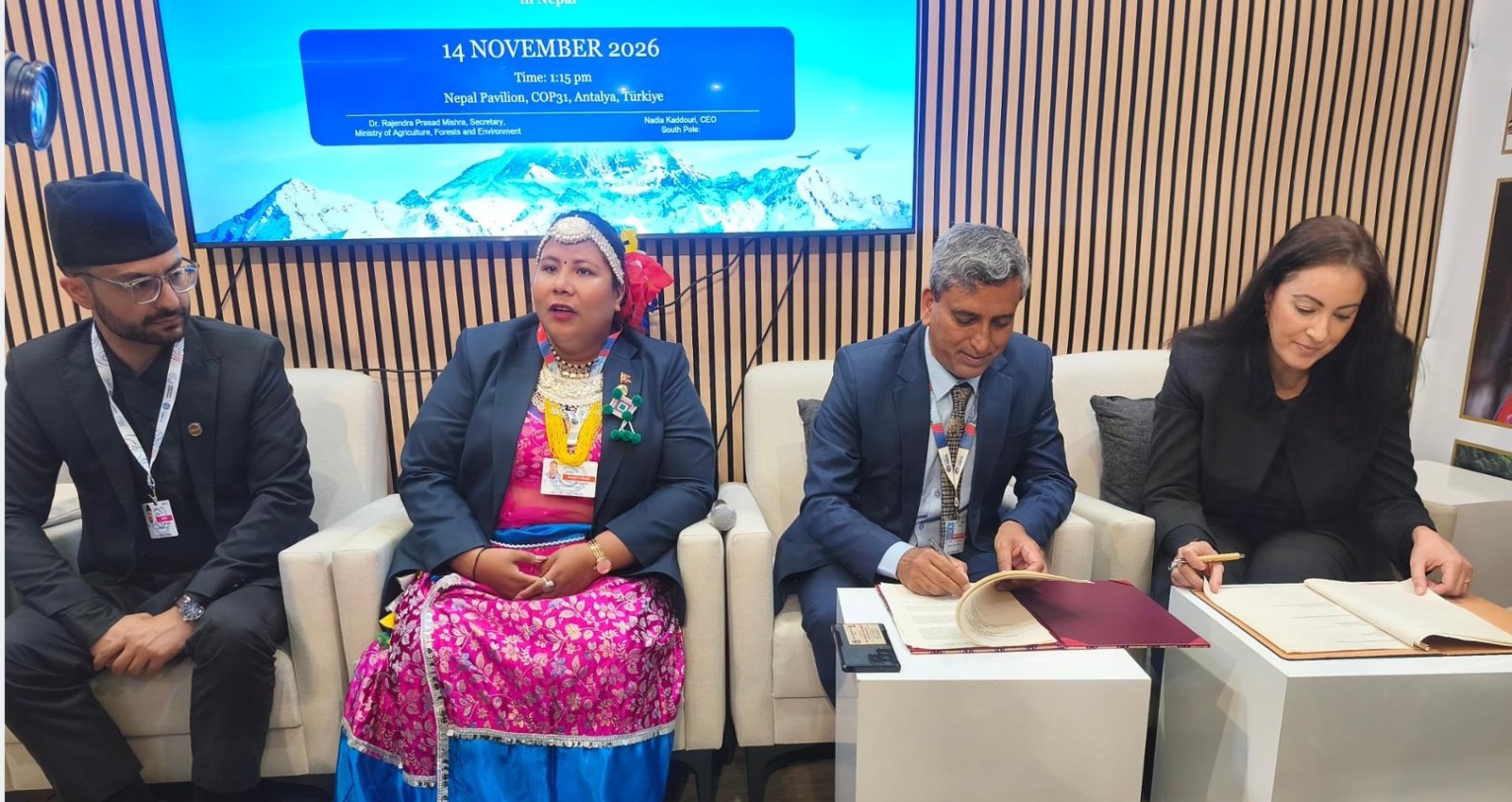
On the occasion of COP-31, regional forest carbon program (J-Red Plus) will be conducted in three provinces according to the agreement reached today between the Ministry of Agriculture, Forestry and Environment and South Pole. This program, which will be implemented in three provinces in the initial phase, is aimed to be gradually expanded throughout the country.
The program, which will be developed according to the TRIG standards of Architecture for Red Plus Transactions (ART), aims to reduce greenhouse gas emissions from deforestation and degradation, promote sustainable forest management and make forest fire control effective.
Through the program, one carbon credit that can be sold on the international market will be produced under the International Civil Aviation Organization’s Carbon Offsetting and Reduction Plan (CORSIA) and Article 6 of the Paris Agreement.
According to the agreement, the necessary policy and regulatory structures for the implementation of the program, the assurance of rights related to carbon and land, safety standards and benefit sharing will be arranged. In addition, the process of obtaining free, prior and well-informed consent of the local community will also be developed.
South Pole will assist in technical design of the program, construction of investment structure, mixed finance operation and international market management of produced carbon credits. It is mentioned in the agreement that produced carbon credits will be delivered to international buyers under Article 6 of the Corsia and Paris Agreement.
Agriculture Minister Geeta Chaudhary mentioned that Nepal has achieved international recognition in community forest management and conservation and expressed the belief that this cooperation will help in the mobilization of international climate finance for the protection of forests and ecosystems.
She said that the program will be important to protect tribal and local communities dependent on forests, reduce the risk of wildfires and create sustainable economic opportunities for youth and women.
Ministry Secretary Dr. Rajendra Prasad Mishra informed that the program is going to be jointly developed to cover more than 2.5 million hectares of forest area in the three provinces. According to him, livelihood opportunities of poor and marginalized tribal communities will be expanded through sustainable forest management and mountain watershed protection programs.
South Pole Chief Executive Officer Nadia Kadduri said the supply of high-quality forest carbon credits must be increased before the start of the second phase of CORSIA in 2027. According to him, this collaboration will help to connect private investment, technical capacity and international market access to Nepal’s approach to forest protection and climate priorities.
According to the International Air Transport Association, airline companies need three times more eligible carbon units than the currently available supply to fulfill their obligations under CORSIA. As the second phase of the plan will start in 2027, there is an opportunity to mobilize international climate finance for forest-rich countries, according to South Pole.
Established in 2006, South Pole has been serving more than 3,500 organizations worldwide. According to the organization, it has more than 850 carbon projects in its portfolio. Also, it has helped in reducing carbon dioxide emissions by more than 200 million metric tons so far.
It is expected that this collaboration will contribute positively to forest protection, climate adaptation and the livelihood of forest-dependent communities.