

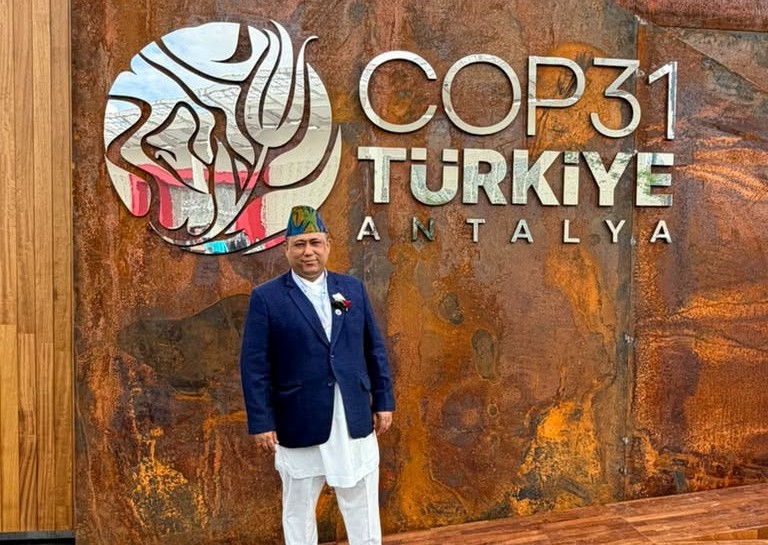
Kathmandu. Foreign Minister Shishir Khanal has emphasized that the problems and challenges faced by the Himalayan region due to climate change should be made the main agenda of the global climate talks.
Minister Khanal returned home on Saturday after participating in the 31st Conference of Parties to the United Nations Convention on Climate Change (COP-31) being held in Antalya, Turkey from November 9 to 20. Agriculture, Forestry and Environment Minister Gita Chaudhary will lead the Nepali delegation in the meetings and talks during the rest of the conference.
According to the Ministry of Foreign Affairs, at the conference, Nepal prioritized mountains and climate change, the goal of limiting global temperature rise to 1.5 degrees Celsius, climate justice, protection of mountain ecosystems, financial support for adaptation and damage-losses, and multi-disaster early warning system.
Addressing the opening session of the conference, Minister Khanal drew the attention of the international community to the damage caused to people’s lives, livelihoods, physical infrastructure and ecological systems by the recent catastrophic climate disasters in Nepal.
He proposed to establish a separate work program related to ‘Mountains and Climate Change’ under COP-31 and said that the specific indicators of mountain areas should be included in the global adaptation target and the new collective quantitative climate finance target. He said that international cooperation is necessary to deal with the effects of climate change from Mount Everest to the sea and for post-disaster reconstruction and rehabilitation.
Addressing the Baku High-Level Climate Adaptation Dialogue on behalf of the least developed countries (LDCs), Minister Khanal mentioned that the countries that contribute least to climate change have suffered its disproportionate impact. He established adaptation as an integral part of climate justice and emphasized that the financial commitments made for climate adaptation should be effectively implemented.
Similarly, while speaking at a high-level program on ‘early warning system for all’, he said that an effective early warning system is indispensable for the survival of the Himalayan community. He pointed out that there is a need for data collection, satellite-based monitoring, snow monitoring and providing advance notices in local languages in the high mountain areas.
In a program related to the promotion of the Himalayan agenda organized jointly by Nepal, Bhutan, Kyrgyzstan, Pakistan and Tajikistan, Minister Khanal said that if the mountain region is in crisis, the entire humanity will be in crisis. He emphasized on massive reductions in emissions, climate finance based on grants instead of loans, prompt and equitable financial assistance for damages and scientific monitoring of glaciers.
During the conference, Nepal also organized a high-level program on adaptation finance for mountain resilience in collaboration with Bhutan, Kyrgyzstan and international partner organizations ICIMOD and Join Environment Network. In that program, Minister Khanal informed about the human, physical and economic damage caused by the recent floods in Nepal and said that adequate and easily accessible adaptation finance is necessary for the upliftment of the Himalayan region.
In a program held at the Nepal Mandap on the exchange of experience gained from cross-border climate-related disasters in the Hindu Kush Himalaya region and the regional cooperation mechanism, he said that regional cooperation, technology transfer, knowledge and experience sharing, and multi-stakeholder partnerships are necessary to face common climate challenges.
Similarly, while addressing a program on climate finance needs of small island developing countries (SIDS) and least developed countries, he held the view that easy, predictable, accessible and grant-based climate finance should be ensured for the protection of high mountain ecosystems and countries affected by climate change.
Minister Khanal inaugurated the Nepal pavilion on November 9 at the conference venue. Through the pavilion, Nepal’s climate ambitions, biodiversity conservation achievements and climate adaptation efforts being conducted at the community level were presented to the international community, the ministry said.
During the conference, Minister Khanal had separate meetings with United Nations Secretary General Antonio Guterres, Ethiopia’s Foreign Minister Gedeon Timothios and Finland’s Foreign Trade and Development Minister Ville Tavio. Various matters of mutual interest and interest were discussed in that meeting. He also held a group meeting with the Secretary General of the United Nations along with the members of the ministerial delegation of least developed countries.
Meanwhile, Minister Khanal also interacted with the officials of Non-Resident Nepali Association, National Coordination Council of Turkey President Vinod Poudel. On that occasion, he said that the government is committed to solving the problems of Nepalis abroad, providing customer-friendly digital consular services, addressing complaints in a timely manner and promoting safe, dignified and productive employment. He said that protecting the rights and interests of migrant workers and women workers is a priority of the government.
According to the ministry, from November 9 to 13, Minister Khanal addressed the opening session of the conference, participated in the Antalya Summit, addressed six high-level and thematic programs, inaugurated the Nepal Pavilion, three bilateral and high-level meetings, a group meeting of the LDC delegation with the Secretary-General of the United Nations, interacted with the non-resident Nepalese community and participated in a press conference.
The Ministry said that Nepal’s participation in COP-31 has contributed to present the specific challenges facing the Himalayan countries due to climate change to the international community. According to the ministry, Nepal has a clear opinion on the issues of separate action program related to mountains and climate change, fair access to climate finance, effective response to damages, scientific monitoring of the Himalayan region, technology transfer, capacity development, early warning system and regional cooperation.



