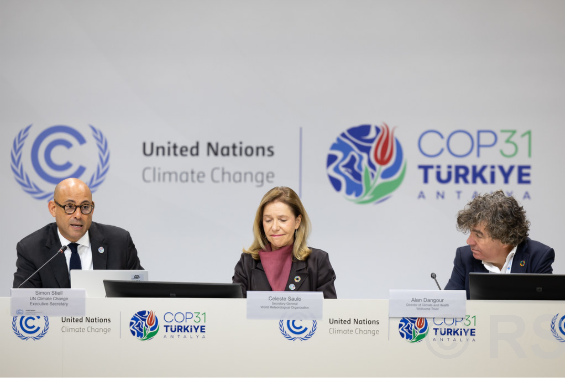
Kathmandu. At a time when the global temperature increase is increasing the challenge from the natural balance of the earth to human existence, the United Nations Climate Change Conference 9 COP-310, which started in Antalya, Turkey from Monday, has started a serious brainstorming and debate about the seriousness of the climate crisis and how to deal with it.
At the conference, there was a wide discussion about the steps that the world community should take to deal with rising temperatures, extreme weather events and climate-related disasters that are adding challenges to the earth’s ecological balance and human existence.
On the same day as the opening of the COP, the World Meteorological Organization (WMO) study showed that the abnormal trend of global temperature increase continues, and the debate on the issue has heated up in the ongoing COP-31. Thus, in the past too, discussions were held giving priority to the topic of preventing the temperature rise, saying that it was causing a climate crisis due to the increase in global temperature. Due to the powerful El Nino, the risk of extreme heat and extreme weather events will increase until 2027, warns the WMO.
The main conclusions of WMO’s report on the ‘State of the Climate 2026’, 2026 will be among the top four years of the hottest year so far, the temperature will increase further due to El Nino and the climate risk will remain intense, the temperature of the sea surface and ocean will be at the highest point so far, and the major human and economic losses due to extreme weather events have worried the world.
The report states that new records are being set in global temperature, sea level rise and ocean temperature and shows that the effects of climate change will become more serious. According to the report, the last 12 years have been the hottest years on record. The report mentions that the four years from 2023 to 2026 have become the hottest years.
According to the report, the average surface temperature of the world from January to September 2026 has reached 1.47 degrees Celsius higher than the average before the beginning of the industrial age. It is estimated that the temperature may rise further till the end of the year due to the increasing influence of El Nino.
The WMO estimates that El Niño may reach its strongest state by December 2026 and its effects will continue until the beginning of 2027. The report pointed out that the risk of temperature increase will be high even in 2027, as its effect on the global temperature is more visible in the year after El Nino is developed than in the year after.
According to WMO, the earth’s energy imbalance is increasing. Due to the increasing emission of greenhouse gases, the balance between the energy that the earth receives and the energy that it sends out, while keeping heat in the atmosphere, is disturbed. About 90 percent of the excess heat being stored on Earth is being absorbed by the oceans. The year 2026 is expected to be the tenth year in a row that the ocean temperature will set a new record.
Likewise, the sea level has reached its highest point so far and the sea surface temperature has also set new records in various months of 2026. It is mentioned in the report that the melting of glaciers is also continuing. Annual ice loss from glaciers in 2025 is estimated to be equivalent to filling five Olympic-sized swimming pools every second.
The report shows that the storage of clean water has also been decreasing since 2014. This risks creating more challenges to water availability, food security and human life. United Nations Secretary-General Antonio Guterres has also expressed concern about the rising tide. At the very opening of the COP, he expressed concern that climate risks are increasing when the powerful El Nino effect is added to the already warming earth due to human-made climate change.
He said, “Noting that the communities least responsible for climate change are suffering its effects first and most, I urge world leaders to rapidly reduce greenhouse gas emissions, make a just transition from fossil fuels to clean energy, and provide the necessary financial and technical support to countries at risk.”
WMO Secretary General Celeste Saulo has said that El Niño will not add new heat to the earth, but will accelerate the process of removing stored heat to the oceans. He says that since the temperature of the ocean is the highest ever, the amount of heat coming out will also be higher.
“The combined effect of climate change and El Nino is increasing the intensity of events such as heat waves, tropical cyclones and heavy rains”, said Saulo, “This year, millions of people in the world have been affected by extreme heat and the mountain ice and rock fall events in Nepal and flash floods have exposed the multi-disaster risks faced by the communities in the high mountain regions.”
The report has also pointed out the importance of weather forecasting, early warning system and continuous scientific observation to reduce the risk of climate-related disasters. According to the report, the number of countries with multi-disaster early warning systems increased from 56 in 2015 to 136 in 2025.
Greenhouse gas emissions are also continuously increasing. In the year 1750, the amount of carbon dioxide in the atmosphere was 278 parts per million (ppm), and in 2025, it has increased to 426.8 ppm. This is about a 53 percent increase. Similarly, the amount of methane has increased by 167 percent and the amount of nitrous oxide by 26 percent, it is mentioned in the report.
The report published by WMO on the first day of COP-31 includes available scientific data up to September 2026. The recent impact of El Niño is not included in the report. According to WMO, a detailed report on the final climate conditions of 2026 will be published in March 2027.
Scientists of the world have also expressed concern that the global temperature is increasing due to climate change, and it is having a serious impact on human health. Due to extreme heat, air pollution, drought and climatic disasters, millions of people in the world are being affected.
Rasuwa Bhotekoshi flood is also discussed
Simon Stillel, the Executive Secretary of the United Nations Climate Change Agency, also presented the Rasuwa Bhotekoshi flood on August 10 as an example of a climate-related crisis. “Devastating disasters in China and Nepal have shown that incidents in the high Himalayan regions pose serious risks to low coastal and riverside communities,” he said.
Steele, while announcing the 2026 report on the climate situation of the WMO, said that the effects of climate change are intensifying. About 900 million people living in coastal areas are at risk due to rising sea level, he said.
Steele noted that due to climate change, weather events such as heat waves, tropical cyclones and heavy rains are becoming more intense than previously estimated. He said that in 2026, thousands of people died due to excessive heat in Europe and dangerous heat waves were also observed in various regions of India, Pakistan, Asia and North America.
Steele said that the expansion of the early warning system should be taken as a positive achievement for climate risk reduction. He informed that the number of countries with multi-disaster early warning system will increase from 56 in 2015 to 136 in 2025.
However, for effective forecasting, it is necessary to continue collecting and observing weather data in all regions of the world, he said. He emphasized that the Climate Conference (COP-31) should make immediate decisions according to the climate risk and ensure the necessary financial resources. Climate is a global health crisis.
Likewise, Allan Dangor, climate and health director of UK-based charity Wellcome, which supports health and medical research, said that climate change has now emerged as a global health crisis.
Noting that in 2025, about 52 percent of the world’s land will be affected by extreme drought for at least one month, he said that this would have a serious impact on farmers, workers working in the rural areas and food security.
Dr. Rajendra Prasad Mishra, Secretary of the Ministry of Agriculture, Forestry and Environment, informed that Nepal attended the COP to emphasize that it should take ambitious steps to achieve the goal of limiting the global temperature increase to 1.5 degrees Celsius compared to the pre-industrial era.
Such was the agreement on global average temperature rise
The historic agreement 9 Paris Agreement, signed in the 21st COP in the capital of France from November 30 to December 12, 2015, aims to limit the global average temperature increase to 1.5 degrees Celsius and not to exceed 2 degrees Celsius.
In order to achieve these goals, countries that are parties to the Paris Agreement will have to submit Nationally Determined Contributions (NDCs) every five years. Nepal has made NDC to cover the period till 2035. The third NDC includes a detailed blueprint for climate mitigation, adaptation, and financial management, sustainable development goals up to 2035, mobilization of domestic and international financial resources, and climate implementation plans at the local level.
In the third NDC, Nepal aims to contribute to climate crisis management by cooperating with global efforts to limit the global temperature rise within 1.5 degrees Celsius. Currently, the NDC implementation plan has been prepared.