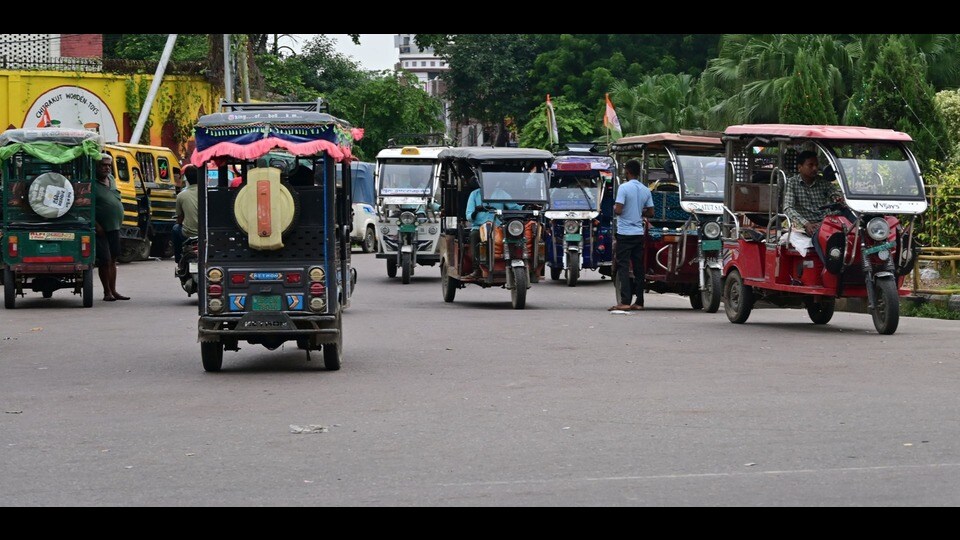
Hyderabad. The use of electric three-wheeled vehicles (auto rickshaws) is increasing rapidly in India. The fact that an electric auto rickshaw is being produced in Indian factories every 90 seconds shows that India has become the world’s largest market in this field.
At a busy Mahindra Last Mile Mobility factory, workers and robots are busy installing batteries, attaching exterior panels to the vehicle’s metal structure and fitting wheels. The company is expanding its production to meet the growing demand for auto rickshaws plying on the busy roads of India.
More than half of the new three-wheelers sold in India last September were electric. During the same period, only 8.5 percent of cars and 11.6 percent of two-wheelers were electric. This has confirmed India’s position as the largest market for electric three-wheelers.
According to Suman Mishra, chief executive of Mahindra Last Mile Mobility, the company’s electric vehicle market has grown sixfold in the last five years. He said that its use has intensified in the last two years due to government subsidies, improvement in the quality of vehicles and reduction in operating expenses.
A decade ago, e-rickshaws started appearing on the streets of New Delhi. At that time, Chinese batteries were installed in old bicycle rickshaws and prepared in local workshops. Now, with the entry of big companies including Mahindra, this sector has expanded as an organized industry.
Electric auto rickshaws are becoming a common sight outside railway stations and busy markets in northern Indian cities. It has gradually replaced the use and noise of auto rickshaws that run on conventional fuel.
The fuel-saving Mahindra is one of the 15 finalists shortlisted for the EarthShot Award to be presented by Britain’s Prince William in Mumbai on November 17. But for many drivers, the attraction to electric vehicles is the savings in operating costs rather than the environmental benefits.
A 31-year-old driver from Hyderabad, Afroz Alam, has switched from petrol-powered cars to electric vehicles this year. According to him, hundreds of rupees are being saved daily because the cost of charging the battery is low. It has also made it easier to pay off the loan taken to buy an electric vehicle.
According to the estimate of the year 2025 by the Indian think tank CEEW, the operating cost per kilometer of petrol-powered three-wheelers is more than double that of electric vehicles.
According to analysts, the decrease in the price of batteries and the increase in the price of fuel are the main reasons for the expansion of the use of electric vehicles. Since India imports most of the oil and natural gas, the expansion of electric vehicles can also help in reducing the dependence on imported fuel.
However, lack of charging infrastructure and parking have added challenges to its expansion. Mishra said that due to limited parking space in Mumbai, it will be difficult to charge electric vehicles.
Similarly, the ban imposed by China on the supply of rare mineral magnets used in the manufacture of electric motors affected Indian manufacturers. India is trying to increase domestic production of materials including battery cells. But most of these materials are still being imported from China and South Korea.
According to analysts, the expansion of electric taxis and commercial vehicles can also open up new opportunities in this sector.