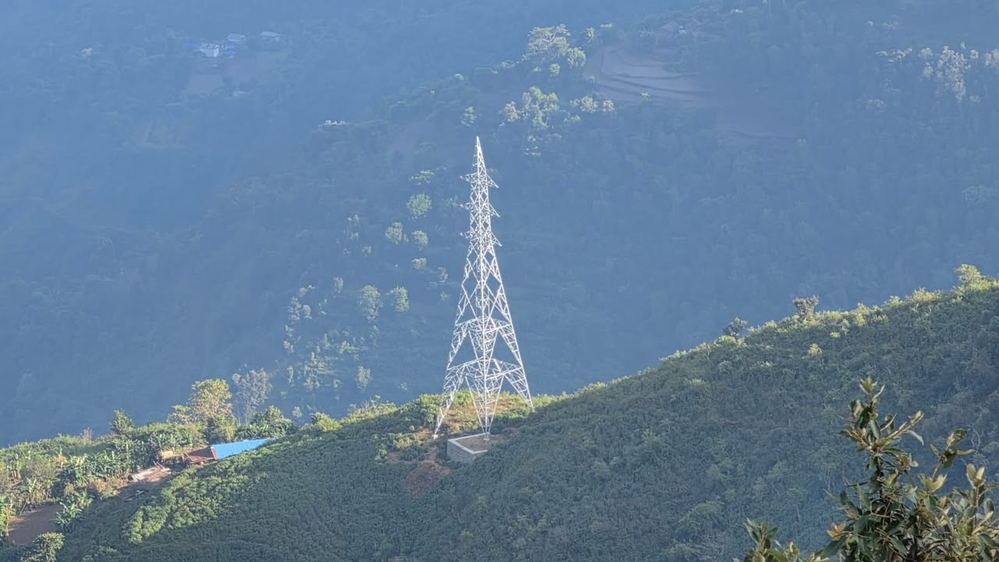
Surkhet. The Surkhet-Dailekh 132 KV transmission line, which started delivering quality electricity to Karnali province, is entangled in forest-related legal troubles. This section under the Kohalpur-Surkhet-Dailekh project was signed in 2080 and was supposed to be completed in 2082. However, 70 percent of the material progress is stuck in the circle of tree felling and land ownership. Even with the extension of the deadline, 30 percent of the work remains.
The total cost of this project, which starts from Subbakuna substation at Birendranagar in Surkhet and ends at Chupra in Dailekh, is Rs 80 crore. Sigma Kathmandu has taken charge of the construction. 101 angle towers will have to be built in this 32 km long section. But so far only 41 have been made. The foundations of 40 towers have been prepared, but due to the forest’s legal entanglement, the foundations of 20 towers have not even been dug. The main reason for the slowness of the project is not the geographical difficulty or the negligence of the builders, but the legal and administrative bottlenecks within the government system.
There is a legal provision to obtain mandatory approval from the Council of Ministers for cutting down trees in the transmission line construction area. But since a formal decision could not be made for a long time, the work of 20 towers could not be started.
According to the project, more than 19,000 trees, small and large, will have to be cut. Ravikumar Chaudhary, the project head, said that after completing all the administrative procedures under the Ministry of Forests, the environmental impact assessment, measurement and verification, the file has been submitted to the Ministry for approval. “As soon as we get permission from the Council of Ministers, the construction will speed up,” he said. Although the construction of the tower was stopped due to tree felling, 60 percent of the 132 kV substation under construction in Dungeshwar Rural Municipality-1 Chupra of Dailekh has been completed.
Repetition of Kohalpur-Surkhet
This problem is not new. The Kohalpur-Surkhet 132 KV section, which was signed on June 22, 2076 between the Nepal Electricity Authority and the Indian company RS Infraproject for about 70 million rupees, was supposed to be completed in two years. When the Banke and Bardia National Parks delayed giving permission to cut land and trees for 161 towers, the project came into operation only on 18th January 2082 after a delay of four and a half years.
Common people are paying the price of this delay. 33 KVA transmission line was extended in Surkhet for the first time in 2045, i.e. about 38 years ago. Due to such old infrastructure, citizens of many districts including the state capital are forced to endure low voltage and unannounced load shedding.
Surkhet-Dailekh transmission line is not only a project related to the electrification of a district, it is the backbone of the energy security of the entire Karnali province. According to the long-term plan of the government, the goal is to extend this line to Jumla via Kalikot. However, the government has not yet put forward any concrete policy and budget plan for the second phase of Kalikot-Jumla transmission route.
According to the detailed study report, this section will be 82.14 km long. It is proposed to make it as a 132 kV transmission line with double circuit. Only 279 towers will have to be built in this section.
According to the Electricity Development Department, a total of 150.33 hectares of land is required for this section. Out of which, about 12.4 hectares will have to be acquired for the permanent structure of the tower, while 132.69 hectares of land will be used for the project under the right of way. According to the Electricity Regulations, 2050, the jurisdiction of the transmission line is maintained at a minimum of 18 meters from the center point to nine meters to the right and left.
Due to lack of 132 KV transmission line, local citizens have not been able to consume regular and quality electricity. The future of dozens of hydropower projects under construction and waiting for construction in various rivers and streams of Karnali is also in confusion. Due to the fear that the produced electricity cannot be connected to the national grid, even independent energy producers in the private sector are hesitant to invest heavily in Karnali. Nepal News Bank News Agency