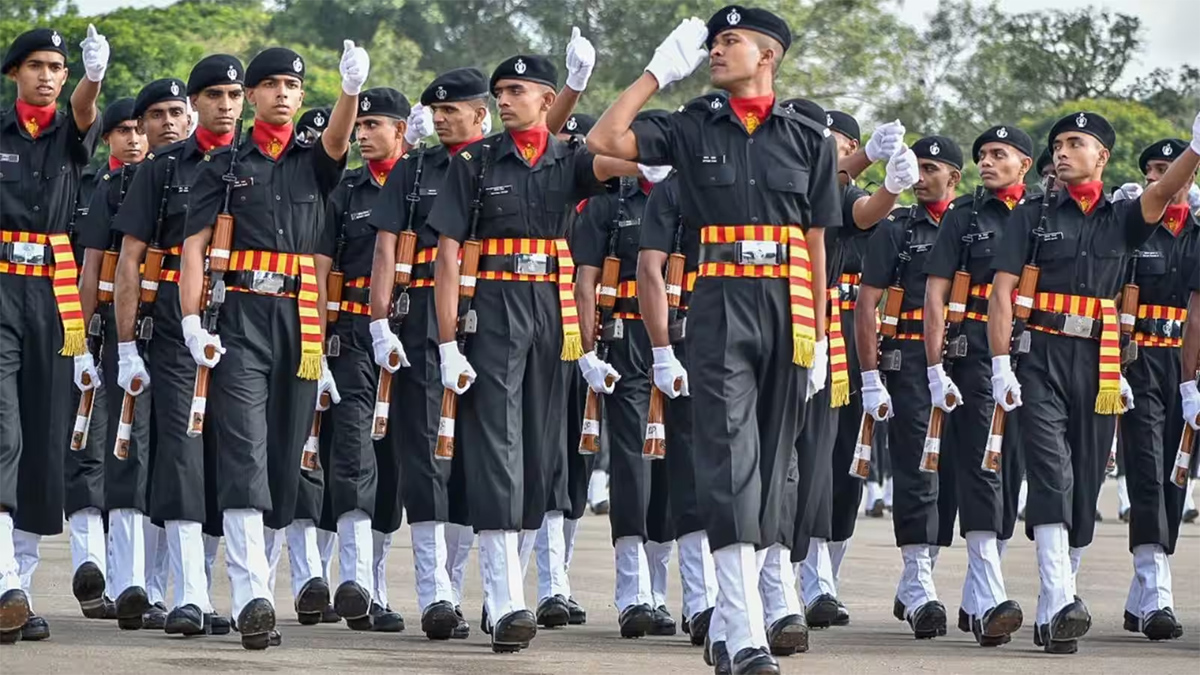
Kathmandu. The Government of India has decided to extend the service period of the ‘Agniveer’ who will be enrolled under the Agneepath scheme. Now, 75 percent of fire fighters who complete four years of service will be allowed to serve two more years. After that, if they show their desire and fulfill the prescribed criteria, they will get the opportunity to become regular soldiers.
India’s Ministry of Defense has said that a new arrangement has been made to maintain a balance between the aspirations of fire fighters and the needs of the army.
What has changed in the Agneepath scheme?
Starting in June 2022, under the Agneepath scheme, soldiers are recruited into the Indian Army, Navy and Air Force for a period of four years. According to the old system, only a maximum of 25 percent were kept in regular service after four years. There was a provision to leave the remaining 75 percent with a service fund package.
In the new system, the old system of including 25 percent in regular service is maintained. The remaining 75 percent will get an option to serve two more years. It will depend on their wishes.
Why change when the service of the first batch is about to end?
More than 18,000 Agnivirs of the first batch of Agneepath Yojana are completing four years of service till the end of December 2026. According to the old system, only 25 percent of them could become regular soldiers. The remaining 75 percent had to retire from service.
After four years of military training and experience, thousands of young men had to leave the service at a young age, and questions were constantly raised about their employment and future security.
Defense expert C. According to Udayabhaskar, the government is facing the challenge of providing more employment opportunities to Agniveer and keeping the army’s recruitment system balanced. Even if the provision of two more years provides some relief, the question of employment and social security of the youth who cannot enter the regular service after that will remain.
Why does the army need trained fire fighters?
During the four years of service, fire fighters have performed well in terms of physical ability, discipline, technical skills, motivation and ability to learn new technology, according to the Defense Ministry.
According to the ministry, a proposal to increase the service period has been made based on the suggestions received from the army and the performance evaluation of fire fighters. It is expected that the army will be able to use the experience of the trained manpower for more time.
The old controversy over the Agneepath scheme remains
Ever since the Agneepath scheme was announced, there has been opposition on the issues of short service period of four years, no pension facility and no guaranteed employment after service. In 2022, youths in different parts of India also demonstrated against the plan.
Critics argue that since a large number of trained personnel leave after four years, the army cannot benefit enough from their experience as it takes time and resources to train soldiers and make them proficient in military equipment and operations.
Opposition leaders, including Congress leader Rahul Gandhi, have been raising questions about the future of Agniveer, regular soldier-like facilities and post-service employment.
The government added two more years of service phase without canceling the plan. Even after 6 years, the problem of employment and social security of the youth who cannot become a regular soldier has not been resolved.
Dissatisfaction of Nepal in Gurkha recruitment
Nepal has been expressing displeasure regarding the recruitment of Gurkha soldiers in the Indian Army under the Agneepath scheme. The Gorkha recruitment process is currently suspended after Nepal’s ruling that it is not in compliance with the Tripartite Treaty of 1947.
Before India’s independence, a tripartite treaty was signed between India, Nepal and Britain in 1947 to arrange the distribution and recruitment of Gurkha soldiers in the British army. Since then, Nepali citizens have been joining the Indian and British armies. At present, it is said that about 35 thousand Gurkha soldiers are working in the Indian Army.
Since the salaries and pensions received from India account for about three percent of Nepal’s gross domestic product (GDP), the issue of Gorkha recruitment is sensitive from the economic and political point of view of Nepal. With the help of the agency