

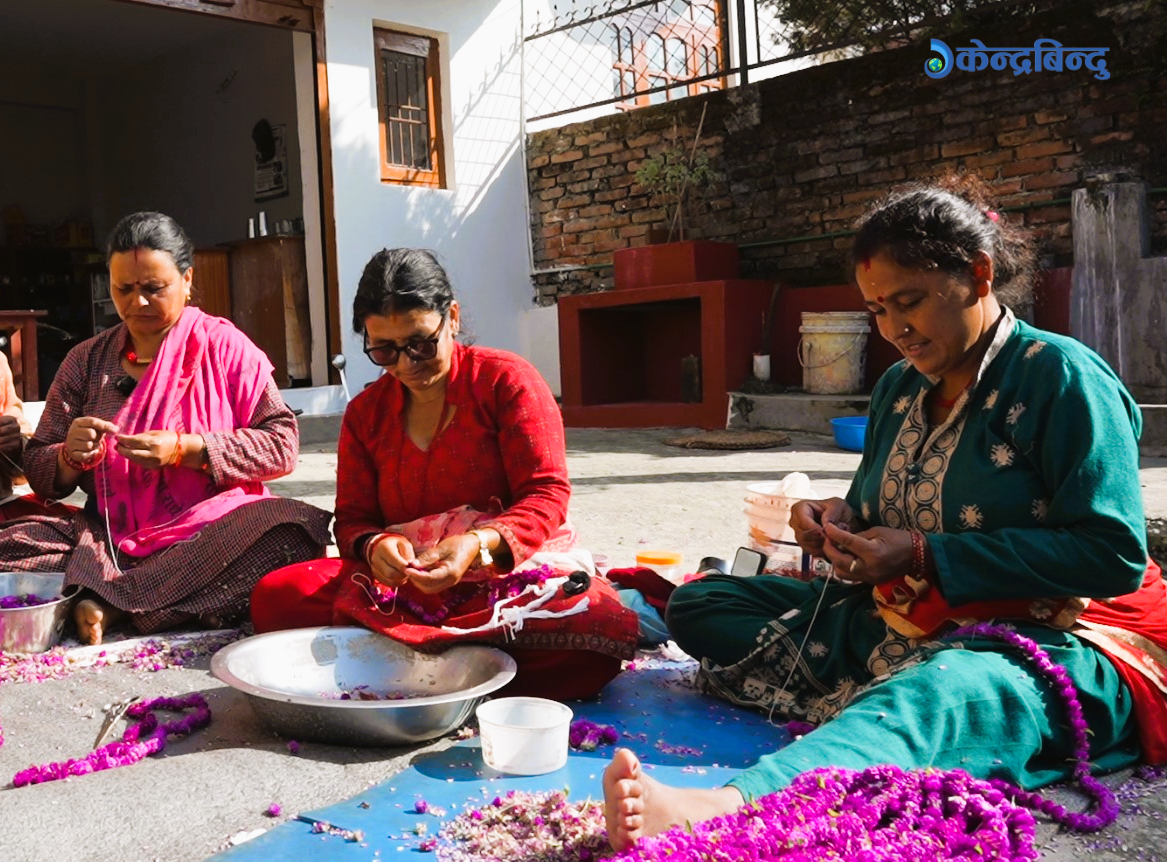
Bhaktapur. Women, who were once confined to housework, are now joining the way of income through commercial flower farming. The women of Bhaktapur’s Gundu are moving towards self-sufficiency by making velvet flower farming a means of income.
Flower farming aimed at Tihar has now become a good source of seasonal income for the women here. They have been cultivating velvet flowers commercially by renting land from one to one and a half plants. They spend their time in farming along with household work, from planting seedlings to picking flowers, picking garlands and selling them.
One of them is Nirmala Basnet. In the past, she used to plant limited flowers saying that people should not buy flowers for the house during Tihar, but for the past 6 years, she has made it a part of her business. After doing housework, she spends her days playing with flowers. Nirmalala is also supported by her husband.
She said that flower farming does not require much financial investment. “You don’t need to invest a lot for seeds, medicines and fertilizers, but you have to give a lot of time,” she said.
Similarly, Dambarakumari Vick of Sindhupalchok has been doing commercial flower farming for two years by renting land in Gundu. Velvet and 100-peti flower cultivation, which is necessary for Tihar, has now become a reliable source of income for him. Dambarakumari, who has been growing flowers on two plantations of land to pay an annual rent of Rs 48,000, has picked flowers and sold garlands without coming for Tihar.
According to him, 3,500 garlands have been sold in this season alone. She says that the garlands, which are initially sold at 22 rupees, are sold up to 30 rupees as Tihar approaches. Despite her old age and physical ailments, Dambara sold thousands of garlands before Tihar.
Flower farming has not only made many women independent like Gunduka Nirmala and Dambarkuma, but has also created employment for the locals. They have also given employment to 2-3 people daily.
They said that they employ local laborers on daily wages for the work of picking flowers and tying garlands. They say that they are paid five rupees for garlands and one hundred rupees per hour for picking flowers.
There is a complaint that the women of this area are not getting the appropriate price even though they spend a lot of effort and time in flower cultivation. According to the women farmers, a velvet garland has to be sold for 20 to 25 rupees in the local market. Although the merchants collect flowers and garlands by reaching the farm, they are forced to depend on middlemen because they cannot reach the market and sell them themselves.
According to the farmers, the flowers purchased from the village at a cheap price are many times more expensive when they reach the consumers. They complain that they are not able to get a fair price for the flowers they produce due to lack of easy transport and marketing arrangements. They say that despite their enthusiasm for commercial flower farming, frustration increases as they cannot get income according to the cost and effort.
It seems that flower farming can become a means of sustainable income for women by arranging market management, collection centers and direct sales from the local level to give fair value to the labor and production of women.



