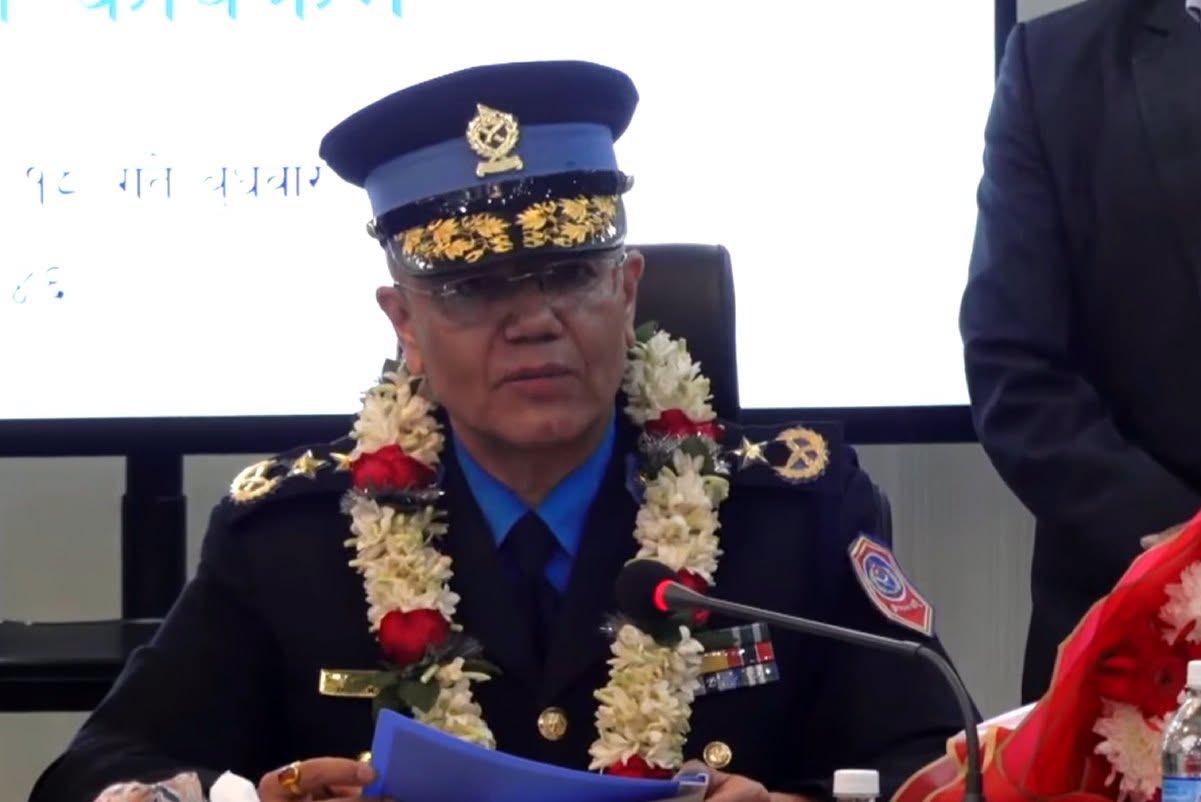
Kathmandu. Newly appointed Inspector General of Police (IGP) Dr. Manoj KC has expressed his commitment to make Nepal Police an organization where citizens feel trust and not fear.
Speaking after receiving the badge from Home Minister Sudhan Gurung, he said that the police badge is not just a flower but a symbol of the trust placed by the state of Nepal, the Nepali people and the Nepal Police, which has a history of more than seven decades.
He respected the contribution made by the former police leadership, including the outgoing Inspector General of Police, in building the organization and said that the foundation laid and the values established by them will be the basis of the journey of his tenure. Paying homage to the immortal police martyrs who made the supreme sacrifice in the service of the nation, he prayed for the speedy recovery of the injured police personnel and search for those who went missing in the line of duty.
IGP KC said that there are new challenges facing the Nepal Police such as digital crime, cyber fraud, online financial crime, crypto transactions, deepfake and misleading information. Similarly, he said, controlling organized and international crime related to drugs, human trafficking, money laundering, abuse of open borders and foreign employment is also a major challenge for the police.
He mentioned that recent developments including the Genji movement of August 2082 have taught important lessons about the relationship between Nepal Police and citizens and the dignity of using force. Pointing out the need to rebuild public trust, he said there should be effective coordination between the union, state and local levels on matters of peace and security.
He said that the risk of disasters such as floods, landslides, earthquakes and fires is increasing, he emphasized on the need to strengthen the capacity of the police in search, rescue and relief. Along with external challenges, internal problems such as lack of resources and buildings, long working hours, fairness in transfer and promotion and mental health of police personnel should also be addressed, he said.
He says that these challenges are not only seen as problems but also as opportunities for organizational transformation. Mentioning that Nepal Police has proved its capabilities in armed conflict, earthquake of 2072, Covid-19 epidemic and international peace missions, he said that the human resources should be made more specialized and morale.
He promised to address the complaints of basic level police personnel, especially police jawans and constables on priority. He said that a mechanism would be started immediately to listen to the problems and complaints of the police personnel and it would be conducted with priority in the Secretariat of the Inspector General of Police. He said that the complaints regarding transfer, promotion etc. will also be addressed.
He said that apart from listening to the complaints of junior police officers, they should be professionally specialized and senior police officers should be made effective and accountable in the field command. For this, he said, the organization will carry out more plans in the parental role of the Ministry of Home Affairs.
Stating that the most important asset of a modern police service is the relationship with citizens, he asked the Nepalese government to provide necessary resources, legal clarity and operational autonomy. He urged the political parties to help keep the police free from partisan influence and the media to highlight the good work of the police along with its weaknesses.
Expressing his commitment to remain unperturbed by the constitution and laws during his term, to keep the safety and respect of citizens as the most important thing and not to compromise on the dignity and fairness of the organization, he said that his tenure should be evaluated on the basis of what he was able to give to the Nepalese people rather than what he got.