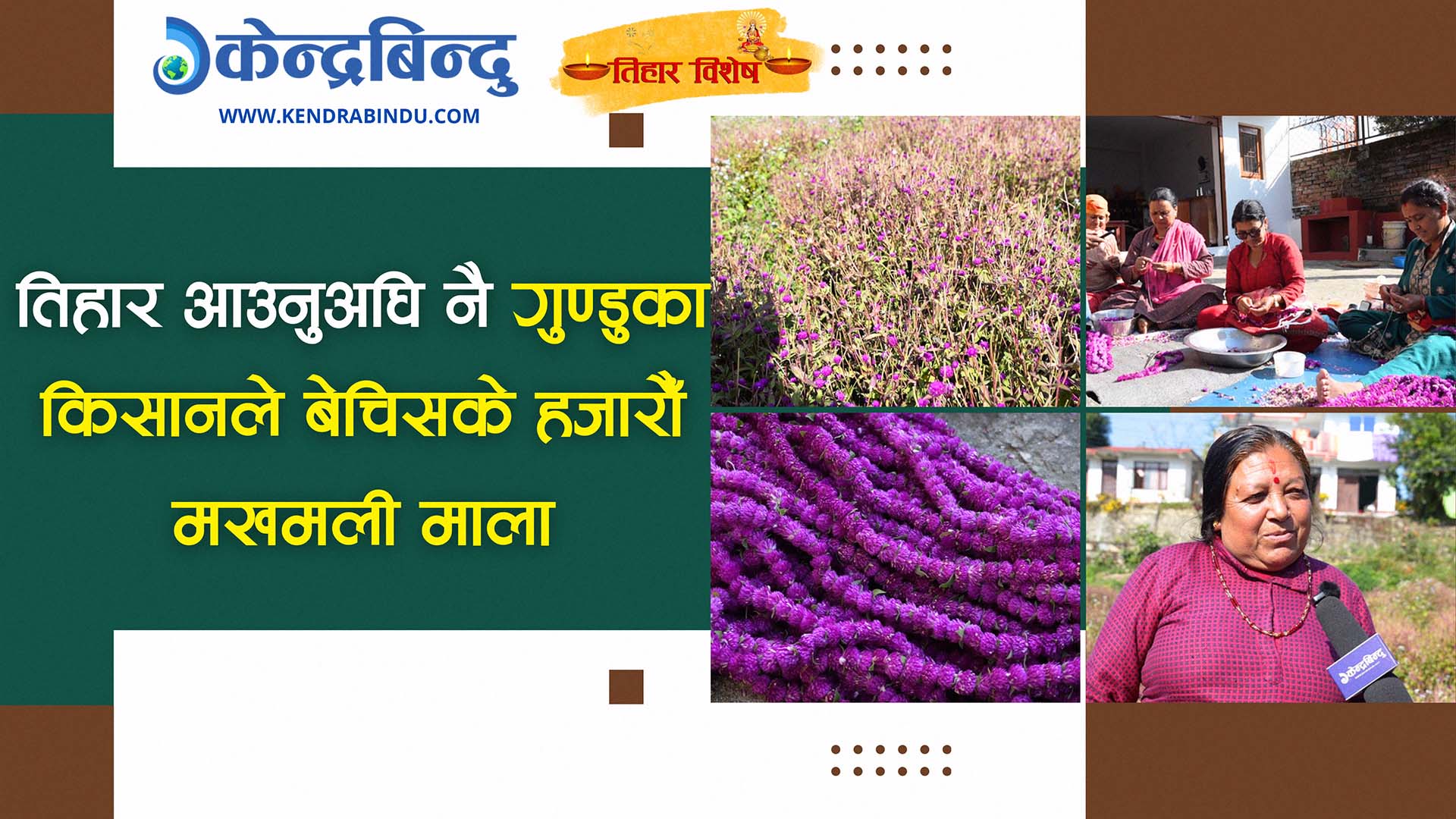
Kathmandu. Radha Thapa, a Gunduki of Bhaktapur, has been cultivating flowers professionally for the past 6 years. But now there are no flowers in his field. She has been cultivating velvet flowers on one and a half acres of land and started sending velvet garlands to the market from the last week of June. So far, she said, she has sold around five thousand velvet flower garlands.
According to him, from the last week of June, the work of picking flowers, making garlands and selling them starts. After that, velvet garlands are sold regularly from July, August, October to October. “From June, we pick flowers and start selling them little by little. Velvet flower garlands are regularly sold in July, August, October and October. By the time we get to Tihar, all the flowers in the fields are gone,” said Thapa.
As Tihar, the second biggest festival of Nepali people, is approaching, the demand for velvet and hundred-leaf flowers in the market has started to increase. Flowers and garlands are used especially during Tihar, so flower farmers are busy during this time. Their busyness is not limited to Tihar.
The business of velvet flowers does not start only when Tihar approaches. The farmers of Gundu have been sending velvet flowers to the market since the last week of June. According to the farmers who pick flowers and start selling garlands from June, its business runs regularly from July, August, October to Tihar.
Dammarkumari Vick, a farmer who came to Gundu from Sindhupalchok and has been cultivating commercial velvet flowers on rented land, has also started sending flowers and garlands to the market since July. After the velvet flower planted in Baisakh began to bloom from July, she started selling garlands.
According to him, 3,000 to 3,500 velvet garlands have been sold before Tihar. To buy flowers and garlands, traders used to reach the fields with vehicles. According to the demand of the market, flowers are collected from once a week to daily, she said.
Most of the families in Gundu have been cultivating flowers. Farmers are cultivating flowers professionally by renting land for one to two plants. Local farmers have been attracted to this as they can earn good income even by farming in a small area. Compared to traditional farming, farmers here have been making it a means of livelihood and income generation because they can earn regular cash income from flower farming.
Due to its long-lasting and durable characteristics, velvet flowers are in demand not only during Tihar but also at other times. The velvet flower garland worn by sisters wishing their brothers long life and good health is also considered important from a religious and cultural point of view. Due to this cultural importance, its demand is high during Tihar.
However, the velvet flower market is not limited to just a few days of Tihar. As the products targeted for Tihar start reaching the market from June, its commercial business also starts months before. This has helped to establish flower farming as not only a source of seasonal income but also as a business that can be transacted for a long time.
Velvet flowers and garlands produced in Gundu are being sold in various areas of Terai including Kathmandu Valley. Farmers say that in the last few years, the garlands produced here are reaching America, Australia, Europe, Japan, Dubai and other countries. They say that the Nepalese community living abroad demand velvet garlands on the occasion of Tihar, so its market is expanding to the international level.
The flowers produced at the local level are meeting the demand of the domestic market as well as connecting with the cultural festivals of the Nepalis abroad. However, it seems necessary to facilitate market management, transportation, storage and export processes to make flower farming more systematic and professional. If the flowers produced by the farmers get a reasonable price and the system to deliver them to the market is effective, the farmers hope that the velvet flower farming can become a stronger base of the local economy.