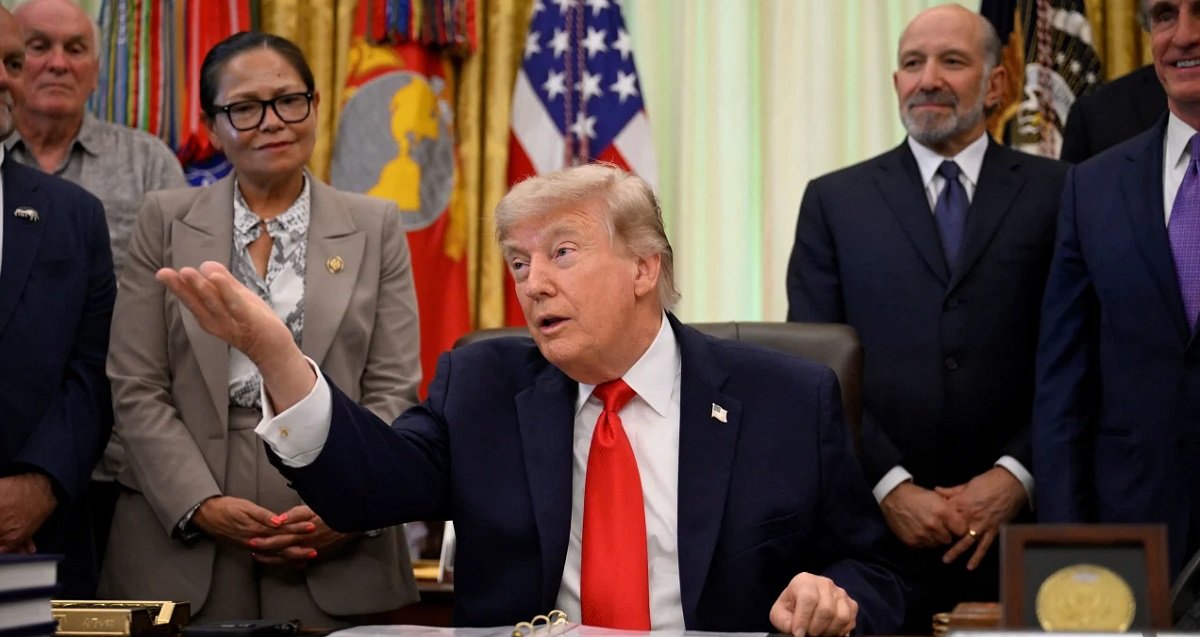
Washington. The White House of American President Donald Trump has been making special preparations for the past few months, keeping in mind the possible control of the Democratic Party in the Parliament (Congress).
A White House official and two people with knowledge of the plan told Reuters that Trump would prioritize using executive powers if he loses his majority in Congress.
The government plans to advance its main agenda through this step. A plan has also been prepared to deal with the investigation that the Parliament can do about the government’s actions.
Senior officials, including Deputy Chief of Staff Stephen Miller and Budget Director Russell Vaught, have been working with the White House Counsel’s Office since last April to plan to advance measures on immigration, tariffs, housing costs and federal spending through executive orders.
According to the information provided by White House officials, Consul Will Scharf and his team are also seriously studying the executive steps that Trump can take. “The team is doing a serious study of what Trump can legally do on his own, how far he can push the scope of his authority and how he can defend those decisions in court,” a White House official said.
If Democrats take control of Congress, they will have the power to scrutinize Trump, block legislation and control his spending priorities. However, Trump’s broad executive powers on trade, foreign policy and the federal bureaucracy will be preserved. Elections will be held in the United States on Tuesday.
If Republicans lose control of Congress, Trump has said he could issue a veto for a month or two before reaching a deal with Democrats. That is, he has the right to delay the decisions passed by the Congress for one or two months.
“I think I’m going to be Mr. Vito,” Trump said in the New York Post’s Pod Force One podcast released on Sunday. And then at some point we will probably come to an agreement.
Republicans now have a narrow majority in Congress. (218-214 in the House of Representatives) and (53-47) in the Senate. Opinion polls have shown that the Democratic Party will win the majority in the lower house. For the majority, Democratic will increase 4 seats from the current number of seats. According to opinion polls, the competition for the upper house and Senate will be interesting.
For the past one month, Trump has been organizing rallies across the country to maintain the grip of Republicans in Parliament. However, his allies have already started preparing internally for the new political scenario of 2027. On the other hand, the White House dismissed the possibility of the Republicans losing and accused the media of bringing out a false story.
Exercising executive powers by bypassing Parliament
Since taking office for a second term in January 2025, Trump has been extensively testing the scope of executive powers.
Without the approval of parliament or new laws, they have used executive authority to impose large tariffs, tighten immigration controls, reduce the number of federal employees, and advance foreign policy, including the war against Iran.
The only exception was a comprehensive package of tax and spending cuts passed by the Republican-controlled Congress in July 2025 and signed by the president.
Nathan Gonzales, editor of Inside Elections, a political analyst, says, “Over the past two years, President Trump has been basically ignoring Congress and trying to do as much as possible through executive orders and powers.” Even if the majority of the Democrats comes, he will continue this style.
Trump has repeatedly invoked national emergencies to extend his ability to act without new laws. Parliament can vote to end such crises, but Trump can veto them. It is not easy to overturn the President’s veto. For this, a two-thirds majority in both houses of Parliament is required.
However, if the Democrats control the House, it can create major obstacles for the President. If Democrats gain control of the Senate, they can block all of Trump’s nominees for judicial and executive positions, including Supreme Court justices.
Andrew Bush, a professor of public policy at Tennyson University and author of the history of midterm elections, says, “I think they’re going to be very reluctant to approve any appointment the president makes.”
Courts can block Trump’s executive actions that go beyond his legal authority. The White House plans to seek a legal opinion from the Justice Department on what Trump can do without Congress and how to defend such decisions in court, a person familiar with the matter told Reuters.
Democrats can also refuse to pass the laws brought by Trump. Similarly, Trump can veto the laws passed by the House. A two-thirds majority is required to overturn such a presidential veto.
Trump cannot avert a parliamentary investigation through executive action. Democrats have already discussed the matter by demanding documents related to national decisions and the use of executive power used by Trump.
They are discussing whether or not Trump acted in the interest of his allies, donors or relatives. According to all three sources, Trump’s allies have been making defensive preparations for months in view of this possibility.
White House lawyers have been briefing political appointees and agency heads on how to face parliamentary inquiries, document requests and hearings. They advised the officials to speak only on matters mentioned in writing.
Trump wants to seek permission to use “executive privilege” to protect conversations with his private advisers from congressional scrutiny. For this, he has sought a legal opinion from the Ministry of Justice. Reuters