

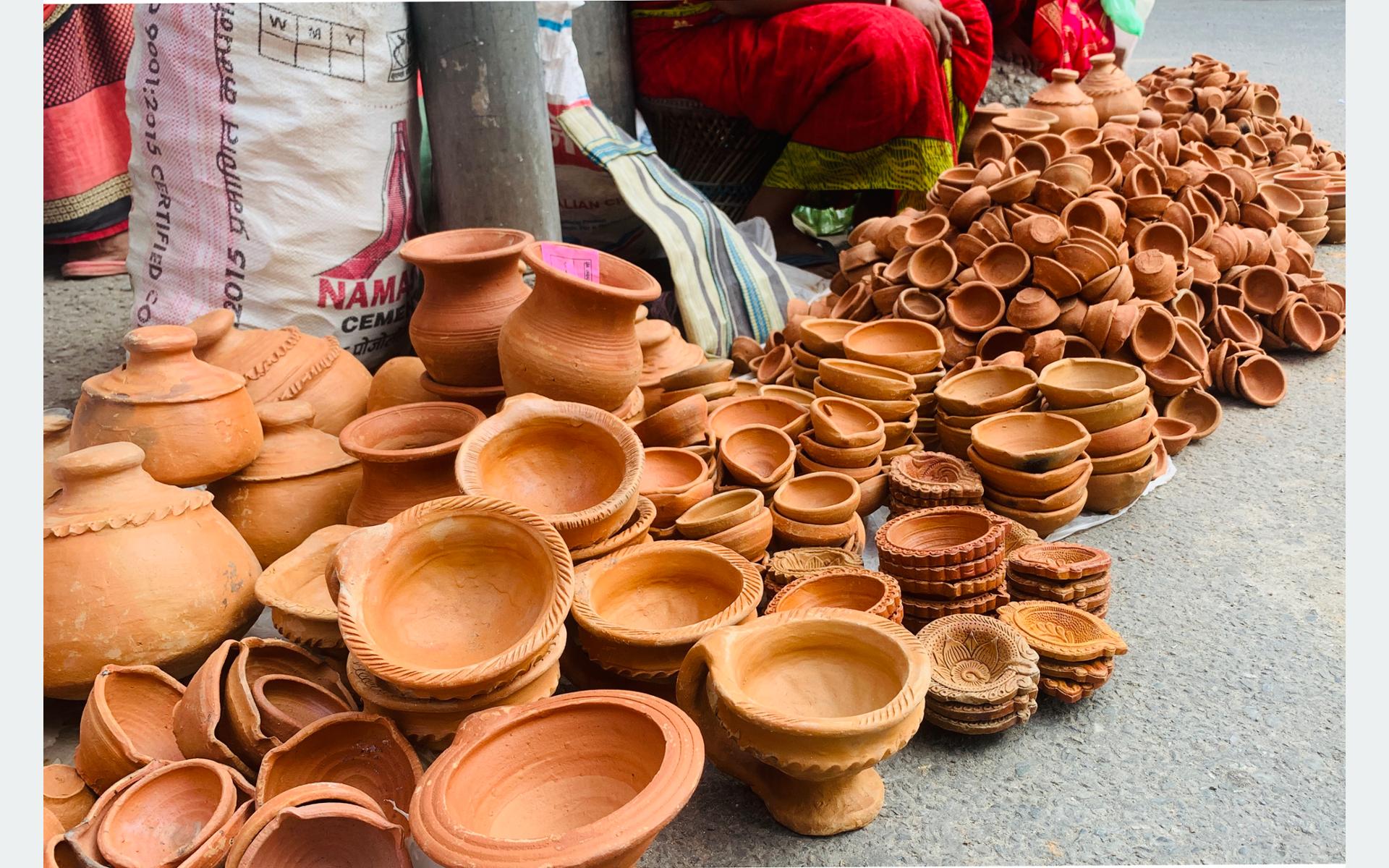
Janakpurdham. On the eve of Diwali and Chhath, the potters of Janakandani rural municipality-4 Khajuri are busy making lamps, kalash, ghainto, handi, incense burner, elephant, kosia, kurwar, matka.
From early in the morning till late in the evening, they are busy with mud and chakra. Some hands are engaged in kneading the clay, while others are turning the wheel and shaping the lumps of clay. Along with the excitement of the festival, people have also started to see people making clay materials in the courtyards of the Kumhal community in the village.
They are now concentrating on their production in the hope that the business of mataka material, which is slow throughout the year, will pick up during Diwali and Chhath. “The business is slow throughout the year, we only sell during the festival”, said Pritam Pandit of Khajuri, “so now we are busy making the pala.”
For them, this time is not only the preparation of the festival, but also an opportunity to earn some income from the profession that has been kept throughout the year.
“It is connected with our sweat and hard work and the continuity of the family’s livelihood and traditional profession”, said the local Sundar Pandil, “For us, soil is not just a raw material, it is the basis of skills, culture and identity that have been handed down from generation to generation.”
“As soon as Dasai is over, I start making pottery,” Ayodhi Pandit said, “Now, selling pottery makes a good income, so we put aside other work and started doing it.” He said that by selling earthenware from Dasain to Chhath, the income would be up to one lakh rupees.
Ramnarayan Pandit, the leader of the Kumal community, said that although the demand for pottery materials increases during the festival, it is not easy to support the family’s expenses from this profession throughout the year.
As plastic, steel, aluminum and other modern materials expand their space in the market, the use of traditional earthenware is decreasing. He said that due to this, the Kumal community, who lived with the soil, have the challenge of preserving their profession and attracting the new generation to it.
“There was a time when it was customary to use earthenware in households, pots for holding water, vessels for cooking, kalash for worship and lamps to light up the courtyard on Diwali were considered as mandatory,” said Ramnarayan, “but now those places are gradually being taken by modern materials. Due to the limited use of earthenware even during festivals, the income of families dependent on traditional occupations has started to be affected.”
According to the Kumal community, it is necessary for the state, local government and the consumers to not extinguish the light of the traditional profession connected with the soil due to the increase in the brightness of plastic materials in the market.



