

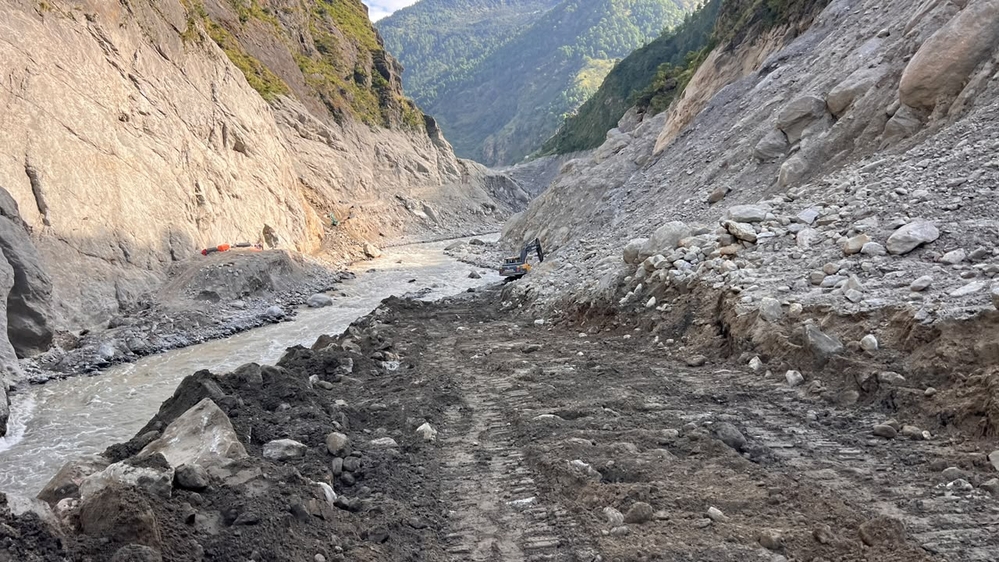
Kathmandu. After the flood of 10th of August, the Rasuwagadhi border connecting China is closed. Until two months after the flood, neither the road leading here is ready, nor the necessary infrastructure for the operation of the checkpoint. After the flood, only the track of the road has been opened from Nuwakot to Rasuva’s Syafrubensi. Before that, there is no road or bridge.
When will the checkpoint be operational? The answer is neither with the customs department, nor with the road department. At present, the foundation is being prepared for connecting the Belybridge at Bhotekoshi in Syafrubansi. According to Vijay Jaisi, Director General of the Roads Department, the work of Belybridge connection will be completed at that place before Tihar. “After that, 4 belay bridges should be installed from Syafrubansi to Rasuwagadhi crossing,” Jaisi said.
After that, studies for road construction will be carried out on a permanent basis, he said. “The goal is to connect the villages to the road network immediately,” says the director general, “after that we will start the feasibility study, for this we have requested resource consent from the Ministry of Finance and sent it.” Even though Rasuwagadhi is the most imported electric vehicle crossing, this crossing is not well known. Before the flood, electric vehicles accounted for 60 percent of the total imports from this point, according to the customs office sources.
Goods such as electrical materials, ready-made clothes, shoes-sandals, agricultural products, telecommunication equipment, machines used in hydropower projects, vehicles and industrial machinery were being imported to Nepal through Rasuwagadhi crossing. Located about 152 kilometers north of the capital Kathmandu, this border has been playing an important role in Nepal-China import-export trade, revenue collection, border management and expansion of economic relations. According to the website of the office, the customs office was established in 2013 in Rasuwagadhi with the aim of generating revenue through trade through barter for the daily living of the local residents of Rasuwa and the people of the Kerung region of Tibet.
In the past, the Tatopani crossing of Sindhupalchok was the main center of Nepal-China trade, but after the earthquake of 12 Baisakh 2072, the crossing was blocked for a long time. After that, Rasuwa Customs Office was developed as the main center of northern trade of Nepal. After the earthquake, after the Rasuwagadhi border was re-opened, the import of goods increased. It started doing well in terms of business. According to the Rasuwa Customs Office, after the Chinese government recognized this border as an international border in 2017, its international importance has increased.
On June 24, 2082, the Miteri bridge was swept away by the flood in the Lhende river on the Nepal-China border. When the customs yard in Timure was washed away, the vehicles and containers kept there were also heavily damaged. 6 months after the flood, the checkpoint was put into operation from 17th December 2008. Now the operation of the checkpoint has become uncertain again. “We will study to build a permanent road, we will proceed with the construction work only after taking the opinion of the expert team,” said Jaisi, the director general of the road department.
Krishnanath Ojha, head of planning of Vidura, said that only after the bridge is built at Syafrubansi, the work of opening the track towards the border will be started. Currently, the work of opening the road track and connecting the Belybridge is being carried out as per the requirement. Sushilbabu Dhakal, Head of Development Assistance Coordination and Quality Division under the Ministry of Infrastructure Development, said that since Rasuwagadhi is an old checkpoint, there is a gentlemanly agreement between the officials of the two countries to operate it.
“No decision has been taken on where to place the customs and immigration office, China has not said anything about it either,” Dhakal said, “We have to decide whether to put it in the old place or in a new place.” He said that a technical team of 8 people from China will also reach Rasuwagadhi and study the damage caused by the flood. “The way to solve the long-term problem was to study the railway connecting Kathmandu-Kerung, now it is not a railway, but there is also a discussion of making an expressway,” he said.
Before the flood, work was being done to upgrade the 16 km road connecting Syafrubansi to Rasuwagadhi to two lanes with the help of the Chinese government. He said that since the floods have damaged this section, it is not possible to work as before. “A team with structural engineers and economists has come from China,” said Dhakal, “they study how the road can be built, what are the possibilities, what are the difficulties.”
Dhakal said that the team came after the ministry requested China to provide technical suggestions in the Rasuwagadhi area. The team came before Dasain and reached the Korla border in Mustang. He said that he is now preparing to go to Rasuwagadhi. “The Chinese government is positive about building roads and opening the border,” he said. “It is more important because it is an international border.”