

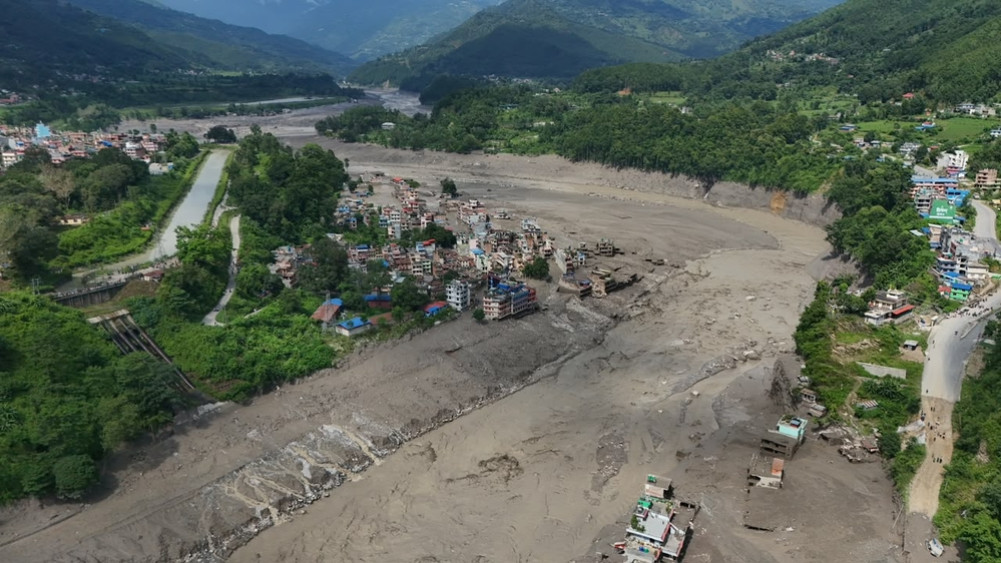
Kathmandu. Even after two months, those who have been rendered homeless by the Bhotekoshi floods are wandering in search of temporary camps, roadside tents and rented rooms. Even though the government has promised to provide Rs 15,000 to families of up to four people and Rs 2,000 more for families with more than 4 members, they have not received the funds.
On August 25, the Council of Ministers had decided to provide room rent to families of up to four people with a monthly income of 15,000 and more than that at an additional rate of 2,000 rupees per person. The meeting decided to provide financial assistance to 7,570 private houses in Rasuwa, Nuwakot, Dhading, Gorkha and Chitwan due to flood damage. However, even after two months, this aid has not been distributed. While the citizens of the flood-affected areas are suffering under the open sky and in rented rooms, the slowness and administrative hassles of the government agencies are burning.
Ram Bahadur KC, spokesperson of the National Disaster Risk Reduction and Management Authority, responded that the funds could not be disbursed due to the lack of timely identification, registration and verification of the beneficiaries from the local levels. KC said that since the local level did not enter the data in the Reconstruction Management Information System (RMIS) prepared by the authority and did not request the funds formally, the funds could not be sent from the central fund.
“In order to provide the announced aid amount, the beneficiary must first be identified, registered and verified by the local level. For this, the authority has prepared an online system called RMIS, in which the local level has to enter data,” KC said, “Until now, most of the local levels and districts have not received formal requests for disbursement of funds and the data has not been registered in the RMIS system, so funds have not been sent from the central fund.”
Recently, the authority has deployed a team in the field for facilitation to see if there is any problem or technical complication in the matter of data entry in the said system. The team is providing training on RMIS to flood-affected wards and municipal employees of Rasuwa, Nuwakot and Dhading. Spokesperson KC says that the tendency to claim by increasing the number of families after the disaster, the buildings and documents of the ward office were destroyed by the flood and there is no clear record of squatters or renters has added complexity to the identification of beneficiaries.
KC said that as per the rule of “temporary housing construction subsidy for disaster-affected households, 2081” there is a rule that intermediate or temporary housing should be constructed within 6 months, so rent subsidy will be given for the same period. He promised that as soon as the beneficiary is verified from the local level and entered into the system, the amount will be deposited directly into the bank account of the affected by calculating from the date of the flood. He also mentioned that relief funds provided by non-governmental organizations such as the Red Cross Society, Plan International, and the World Food Program will be matched with government grants.
The Deputy Mayor of Vidur Municipality, Prabha Bogti, admitted that since the federal government sent the necessary online forms and procedures for relief and housing assistance only recently, it took time to proceed with the work and the work was delayed due to the roundabouts of the administrative process. He said that only this week, ward secretaries and computer operators were trained to fill online forms from the district administration office.
“Now, within three days, preparations are being made to fill the form from the ward and send it to the center through the municipality and district disaster management committee,” she said.
Bogti disclosed that the initial data is that 1,786 houses have been completely damaged and 2,657 plots of land have been damaged in Vidur Municipality. He says that although the municipality has decided to demand Rs 3 crore in the first phase, the amount is yet to arrive in the bank account from the centre.
“The goal is to complete and send all the forms at the ward and municipality level by next Monday/Tuesday,” she said, “Emergency funds have been distributed at the rate of 15,000 and 45,000 rupees in various wards through organizations such as WFP and Plan International with the permission of the municipality so that the affected people do not lack cash as it will take time for the government relief funds to arrive.”
The Red Cross has distributed relief money at the rate of 15,000 rupees per family to the affected families of Ward No. 5. Plan International has provided Rs 15,000 per family to the affected families of Ward No. 1 and 7 and the World Food Program has provided funds at the rate of Rs 45,000 per family in Ward No. 5 (for 3 months of assistance). The Union Government had instructed the local level and other related agencies to provide assistance to the development partners who want to provide cash support in accordance with the ‘Disaster Sensitive Social Security and Relief Distribution Standards, 2081’.
Ward Secretary of Vidur Municipality-1 Vishnu Gajurel said that due to the online system and limited manpower, the work could not pick up speed. More than 450 houses have been completely damaged in this ward alone. Gajurel says that with only one computer and two employees, it is difficult to enter online with fingerprints while obtaining citizenship, spare parts, insurance and recommendations.
“There is only one computer in our ward and we have only two working employees,” Gajurel said, “There is no time to speak or breathe while checking the citizenship, red parts, insurance documents and recommendation letters of more than 450 families from morning to evening. The services of other ordinary citizens who come for daily administrative work cannot be stopped.
According to Gajurel, it has become difficult to get in touch with the flood affected people as they have taken refuge with their relatives in various places in Kathmandu, Dhading and Nuwakot. “Despite an order from above to work quickly, it takes more than 15 to 20 days for beneficiary identification, registration and verification at the ward level,” he said.
Dipesh Rizal, Assistant Chief District Officer of Rasuwa and Spokesperson of the District Administration Office, said that the work of identifying the beneficiaries is ongoing and the funds will be released only after the process is completed. According to Rizal, there was confusion in the collection of details in the beginning because the affected people were scattered in the capital or elsewhere and the ward office building was damaged. “Currently, the number of people coming to the administration office to inquire about the declaration of dead and registration of missing citizens is more than the rent of a room,” he said.
The anger and frustration of the flood victims, who have been spending days in cold tents and tents while being entangled in the government paperwork for two months, is becoming more and more intense. “Neither the name is registered in the relief list nor is there any help from anywhere, I am shocked,” Ravin Tamang of Dhunge told Kantipur on the phone, “I have met the ward president, members, secretary, and when I ask the reason why my name and family’s name was cut from the relief list, they all say, ‘I didn’t cut it.'” No one takes responsibility for the poor.
The Office of the Prime Minister and Council of Ministers announced on October 28 that cash has been distributed to 4,108 households in Rasuwa, Nuwakot and Dhading directly affected by the Bhotekoshi flood at the rate of 45,000 rupees. It was said that the cash support provided by the development partner ‘World Food Program’ was distributed by adopting a one-door system so that there is no duplication.
The meeting of the Prime Minister’s Divine Disaster Relief Fund Management Committee decided to provide 1 billion rupees from the funds in the fund for disaster risk reduction and management. Since then, the committee has not allocated additional funds as there has been no demand from the authority.
Currently, there is 18 billion 28 billion rupees in the Prime Minister’s Disaster Relief Fund. When the authority asks for more funds, the committee makes a decision and allocates the funds according to the need,” said Gunakar Bhatta, coordinator of the Prime Minister’s Disaster Relief Fund Steering Committee and vice-chairman of the National Planning Commission. Bhatt said that the responsibility of the committee is only to manage funds and the responsibility of spending funds in coordination with the district and local levels is the responsibility of the National Disaster Risk Reduction and Management Authority. Ekantipur