

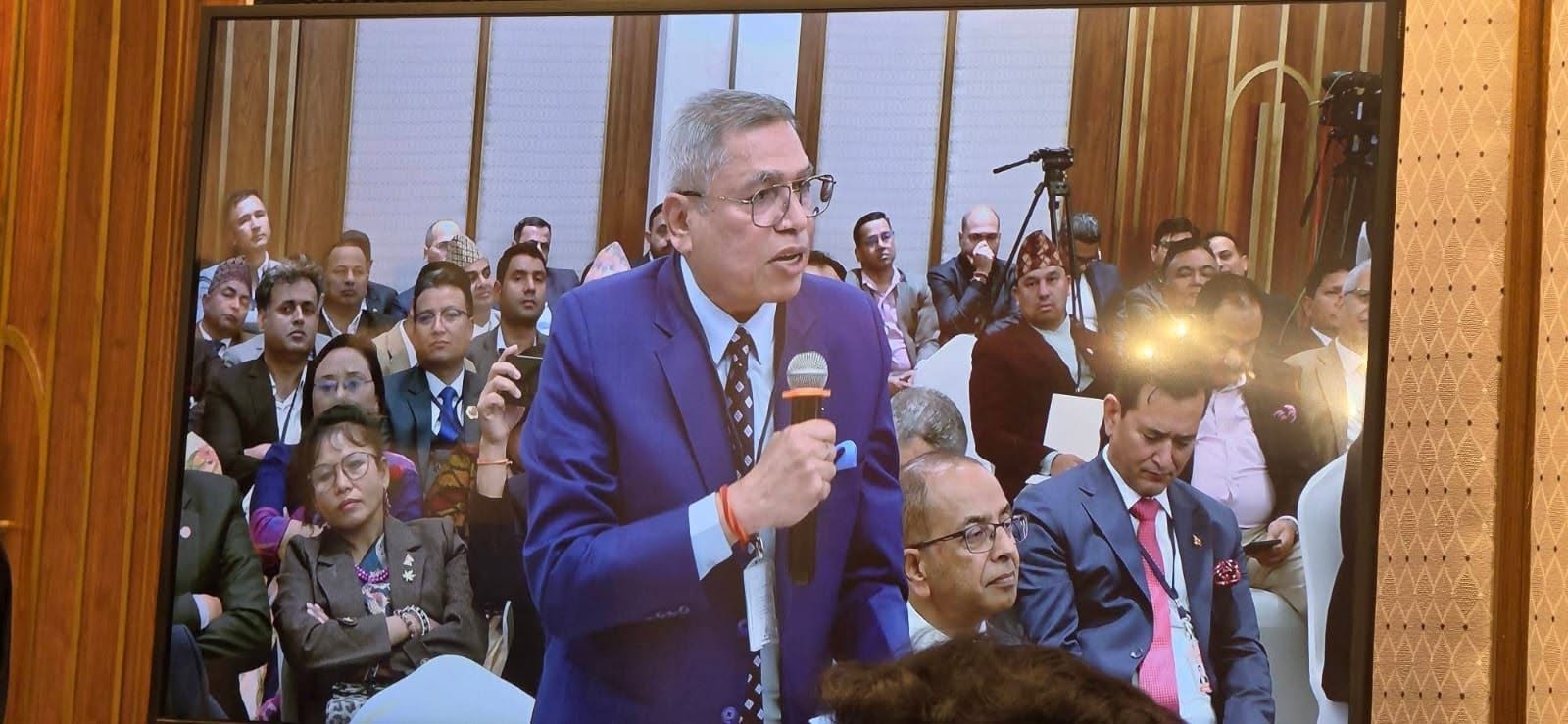
Kathmandu. Nepal Chamber of Commerce President Kamlesh Kumar Agarwal has said that the economic relations between Nepal and India should be upgraded from traditional trade exchanges to a strategic, investment-based and production-oriented economic partnership.
Speaking at the ‘India-Nepal Business Forum’ organized by the Confederation of Indian Industry (CII) at Hotel Taj in New Delhi, Chairman Agarwal said that Nepal and India are natural economic partners linked by geographical proximity, historical ties, culture, trust and common economic aspirations.
He opined that Nepal and India should see each other not only as markets but as partners in production, innovation, investment, technology transfer and common prosperity. He mentioned that despite the long-standing economic relations between the two countries, there are still not enough opportunities in the fields of trade, investment and industrial cooperation.
Agarwal presented trade facilitation and market access, investment and industrial cooperation, energy and connectivity, technology and digital economy and tourism, agriculture and small and medium enterprises as priority areas to make Nepal-India economic partnership more effective.
According to him, to facilitate trade between Nepal and India, reduction of non-customs barriers, simplification of customs procedures, solution of delays at border crossings, harmonization of standards and stability and predictability in trade policy are necessary. He said that making cross-border trade effective in terms of time, cost and competitiveness should be a common priority of both countries.
Stating that Nepal has investment potential in hydropower, agriculture, manufacturing industry, information technology, infrastructure, healthcare and mineral-based industries, Indian investors can contribute significantly to Nepal’s industrial development through joint investment, technology transfer, value chain integration and long-term capital investment.
Emphasizing that energy cooperation should be made an important basis of bilateral economic relations, he opined that the expansion of electricity trade, development of cross-border transmission infrastructure and investment in energy-using industries should be promoted.
Similarly, to expand cooperation in the fields of digital economy and innovation, artificial intelligence (AI), fintech, digital payments, information technology startups, innovation and knowledge exchange should be made part of bilateral partnership, he said.
Agarwal said that there is a great potential for Nepal-India cooperation in tourism, agricultural modernization, food processing and strengthening the relationship between micro, small and medium enterprises. He mentioned that integrated tourism route, cross-border tourism investment, modernization of agricultural production and development of food processing industry can create jobs and promote inclusive economic growth.
Chairman Agarwal said that as a representative of the private sector, emphasis should be placed on solid partnerships, measurable achievements and implementable commitments, not just limited to dialogue and announcements. He opined that such a partnership should aim to create jobs for the youth of both countries, promote entrepreneurship, empower women-led enterprises and increase the competitiveness of small and medium businesses.
Stating that the economic future of Nepal and India are interconnected, Agarwal expressed his belief that the bilateral economic relations can be taken to new heights through continuous cooperation, trust and joint efforts between the government, private sector, investors and commercial organizations.
Finance Minister Dr. Swarnim Wagle and Indian Minister of State for Industry and Commerce Jitin Prasad were present in the program organized on the occasion of Prime Minister Balendra Shah’s two-day state visit to India.



