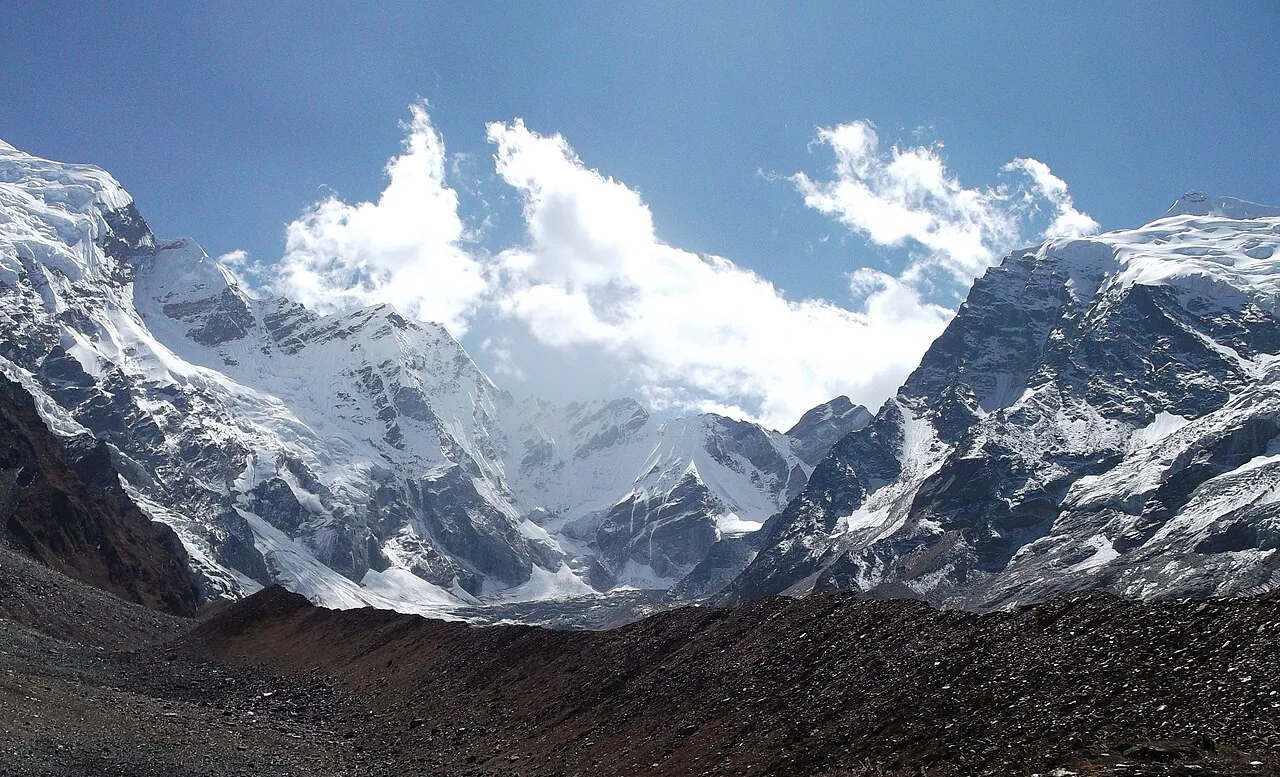
Bajhang. The silvery mountains all around, the huge falls in the middle, the streams coming out from the bottom of the mountains and the lovely lake. These unique shades of nature make the Api Himal base camp area at Darchula a beautiful piece of heaven. Encircled by Api, Nampa, Kapuchuli and Babai mountains, this geography offers visitors the silent music of nature.
Api Himal, the highest peak in the Far West at a height of 7,132 meters above sea level, is the main attraction of this region. From the base camp area located at an altitude of 3,900 meters, the magnificent form of the snow chain can be observed from close. Huge falls, blue lakes, glacial streams and rare vegetation add to the beauty of this region.
Getting here is an exciting journey in itself. After reaching Makrigad by jeep through Marma Rural Municipality, one has to trek for about two days. Traveling through difficult uphills, steep gorges and river banks, the traveler gets to see various forms of mountain topography. Reaching the base camp after crossing the long road, the fatigue of the journey is lost in the breathtaking view of the mountains.
Kalidhunga, Bayeli Lake, Dharmi and Markandeya Caves, source of Chamelia River and Farakila Patan are the major attractions of this region. Along with the natural heritage, places of religious, cultural and historical importance have further increased the tourism potential.
Patan, which is covered with colorful flowers in summer, is important not only for tourists but also for the livelihood of the locals. Valuable herbs such as yarsagumba, panchaunle, padamachal, hatwajadi, bayujadi, jatamsi etc. are collected here. The area is known as a traditional grazing ground for sheep, goats and goats.
Bhakta Singh Thekere Bohra, Chairman of Api Himal Rural Municipality, is planning to make this region a strong base of modern tourism economy. He believes that if tourism activities are increased, employment and income opportunities will be created at the local level.
He said that preparations are being made to increase local participation in community homestays, local transport, hiking guides, porters, hotels and food services. For this, the necessary manpower has been trained many times. “We have already trained many people in the municipality about the role of local people in expanding the tourism economy by training the human resources of different sectors,” said Chairman Bohra.
In the current fiscal year, the rural municipality aims to bring in 10,000 internal and external tourists to the base camp area. “According to the current preparations, we believe that the expected number of tourists will come,” he said.
According to him, the main problem at present is communication ‘network’ and ‘internet’. He claims that other infrastructure has been prepared. “The originality of the people here is a great asset. The tourists who come do not have to face any problem. We have done the necessary work to reach now. The infrastructure will be added according to the additional needs,” he said.
The identity of Api Himal is not limited to its natural beauty. The costumes, customs, folklore, Deuda and traditional knowledge are equally important. Mahadev Dhami, owner of Gara Eco Resort, Ghusa, says they are active in providing hospitality to tourists while preserving the local culture. He says that after the training received from the rural municipality, it is easier to provide food, accommodation and hospitality to the guests.
The rural municipality has arranged for homestay operation at various locations from Makrigad to the base camp. Accommodation facilities are available for tourists at Dhanbora, Ghusa, Nali, Lamamadau, Arukhor, Siti, Khayakot, Chhirchire, Simar, Bhalyakhola and Dhauliodar. After that, a permanent hotel and large tents have been arranged for the guests reaching the base camp area, which can accommodate 70 people per day. Carrying a tent personally is also not uncomfortable.
Although the distance from Makrigad to the base camp is 34 km, the homestays built at intervals of three to five km have made the traveler comfortable. Local originality and friendly behavior are the hallmarks of the hospitality here. In every homestay, the tradition of welcoming guests with flower garlands, showing cultural identity dances and serving local dishes attracts the guests.
Devaki Thami, vice president of Bigu Rural Municipality of Dolakha, praised the hospitality here. “Welcome at the beginning with flower garlands. Local dances are presented to reflect the cultural identity. Accommodation and food are not lacking in star hotels. The speech and behavior of the people here is sweeter than that. This property brings tourists closer to Api Himal,” she said. He believes that if tourism can be linked with cultural preservation, the original identity can be passed on to the new generation.
According to Bisan Budhathoki, who oversees the tourism department of the rural municipality, the rural municipality is working on extending reliable communication services to the base camp, arranging first aid materials, mobilizing trained manpower and developing an emergency rescue system.
Api Himal is also a center of religious faith. It is believed that the river Chamelia, which rises from the foot of this place, is the form of the Ganges flowing from the head of Lord Shiva. According to Jhalaksingh Lothyal of Khayakot, devotion to Surma Bhavani in Kshetti and Ghajir, tradition of pilgrimage to Surma Sarovar and Markandeya and Dharmi Caves have enriched the religious identity of this region. He believes that the local temple also has added spiritual significance due to the presence of Shiva on the head. He said that Api Himal is not only a gift of nature but also a symbol of faith.
Climate crisis in the lap of the mountains
Along with the beauty of Api Himal, the concern about its future is also increasing. Due to climate change, snow melting has become faster and water sources have started drying up. Changes in the rain cycle have started to affect traditional livelihoods.
On the one hand, there is an opportunity to establish this region on the world tourism map, on the other hand, climate change is increasing the risk to the Himalayan ecosystem and local life. Keeping this challenge in mind, the rural municipality has started a campaign to protect the environment along with tourism promotion.
Nepal Himalaya is known as the third pole of the world. Its glaciers, lakes, rivers, forests, grasslands and wetlands have provided the basis for the lives of millions of people in South Asia. But due to global warming, the glaciers are melting at a faster rate. The risk of avalanches has increased. Water sources are drying up, agricultural systems are being affected and biological diversity is decreasing.
Tribhuvan University Vice Professor and Environmentalist Dr. According to Rameshraj Pant, the effects of climate change are beginning to be seen in high mountain areas like Api Himal. He says that the local lifestyle has been affected by the change in the time and pattern of rain, irregular snowfall and drying up of water sources.
Its effect is not limited to the snow of the mountains, it has reached the kitchens, barns and farms of the locals. He said that the changing climate has become an additional challenge for families who depend on sheep rearing, cattle rearing, agriculture and herb collection.
Dr. According to Pant, the climate crisis will not affect everyone equally. Families with low economic capacity, women, children, senior citizens and people with disabilities are more at risk. He said that the Himalayan community, which has contributed little to climate change, has to pay a huge price.
The Chamelia Watershed: A Shared Responsibility for Conservation
The Chamelia watershed area extending from about 700 to 7000 meters (Api Himal) is important in terms of geographical and ecological diversity. Environmentalist Dr. According to Pant, the available studies have shown that the average temperature here is 7 to 18 degrees Celsius, the annual rainfall is about 1700 millimeters and the average water flow is 177 cubic meters per second. As a result, climate change has had an impact on various areas, including the agricultural system in the upper and lower coastal areas, he says.
Research has also shown that water quality is decreasing in Rithegad and other areas of Chamelia’s branch river. A study of the year 2025 suggested that the Chamelia watershed should be given high priority for the management of the upper and lower coastal areas of the Mahakali River. Pant said.
These facts make it clear that watershed protection is not the sole responsibility of any municipality. He said that the joint role of inter-municipality, state and federal government is necessary.
Integrated management of rivers, tributaries, springs, forests, pastures and biological diversity is required. Geologist Kamal Thapa says community-based water security programs need to be implemented along with reviving dwindling sources, groundwater recharge and rainwater harvesting.
Apinampa Conservation Area is a haven for rare wildlife and flora. Species like red panda, snow leopard, muskrat and leopard are found here. A variety of valuable herbs are available. Climate change, uncontrolled use of natural resources and human activities have added challenges to the existence of these heritages, says Thapa.
A common resolve to protect the future of the Himalayas
Api Himal has great potential for tourism. Geologist Thapa says that if natural beauty, biological diversity, culture and mountain lifestyle can be systematically linked with tourism, this area can become an important destination in Nepal.
If nature is not protected, the future of tourism will not be secure. Therefore, he believes that development should not be limited to roads, hotels and the number of tourists. He says, “Mountains, water resources, biological diversity and lifestyle protection of local communities should be kept at the center of development.”
The climate dialogue from the base camp gave the message that the Himalayan crisis is not only a problem of the local community. The impact on the mountains reaches the settlements, farms and human lives through rivers. Therefore, cooperation from local to international level is necessary for its protection, said Thapa.
The voice of climate justice from the mountains
‘Api Himal Manifesto-2083’ has been released in the Api Himal Tourism Festival and Climate Dialogue organized by the Api Himal Rural Municipality in the base camp area. Its main objective was to strengthen cooperation between the municipalities of the Chamelia river coastal area and show a common commitment to the Himalayan nature, climate justice and sustainable development.
The manifesto covers 17 topics including biodiversity conservation, ecological restoration, sustainable use of natural resources, promotion of local knowledge and culture, climate sustainable livelihoods, sustainable tourism and research and innovation.
It has given a message that the problems of the Himalayan region are not limited only within the local boundaries. The manifesto emphasized scientific and judicious use of forests, land, water, herbs and pastures. A commitment has been expressed to conduct climate adaptation programs by combining traditional knowledge with modern science.
Focusing on women, youth, farmers and marginalized communities, the aim is to expand opportunities based on green employment, organic farming, herbal enterprises and renewable energy.
Priority has also been given to making Himalayan footpaths environmentally friendly, controlling plastic and solid waste, protecting glaciers and lakes and reviving water sources.
Tourism, Sport and International Identity
High Himalayan sports are another basis for identifying Api Himal as a new tourist destination. A friendly cricket and volleyball tournament organized by the village council has been completed.
Chief Administrative Officer of Api Himal Rural Municipality, Lokendra Bahadur Bista, said that the Games were organized with the belief that if the sports can be organized at high altitude, the talents of the local players will emerge and help in the development of sports tourism and expansion of the regional identity.
He believes that Api Himal can become a center of national and international attraction if the natural beauty and high mountain environment can be combined with tourism and sports.
He said that Api Himal’s dream is to connect local culture and livelihood with tourism while preserving the unique heritage given by nature. He said that the mountains should be understood not only as a tourist attraction but also as the basis of life, civilization, water resources and biological diversity.