

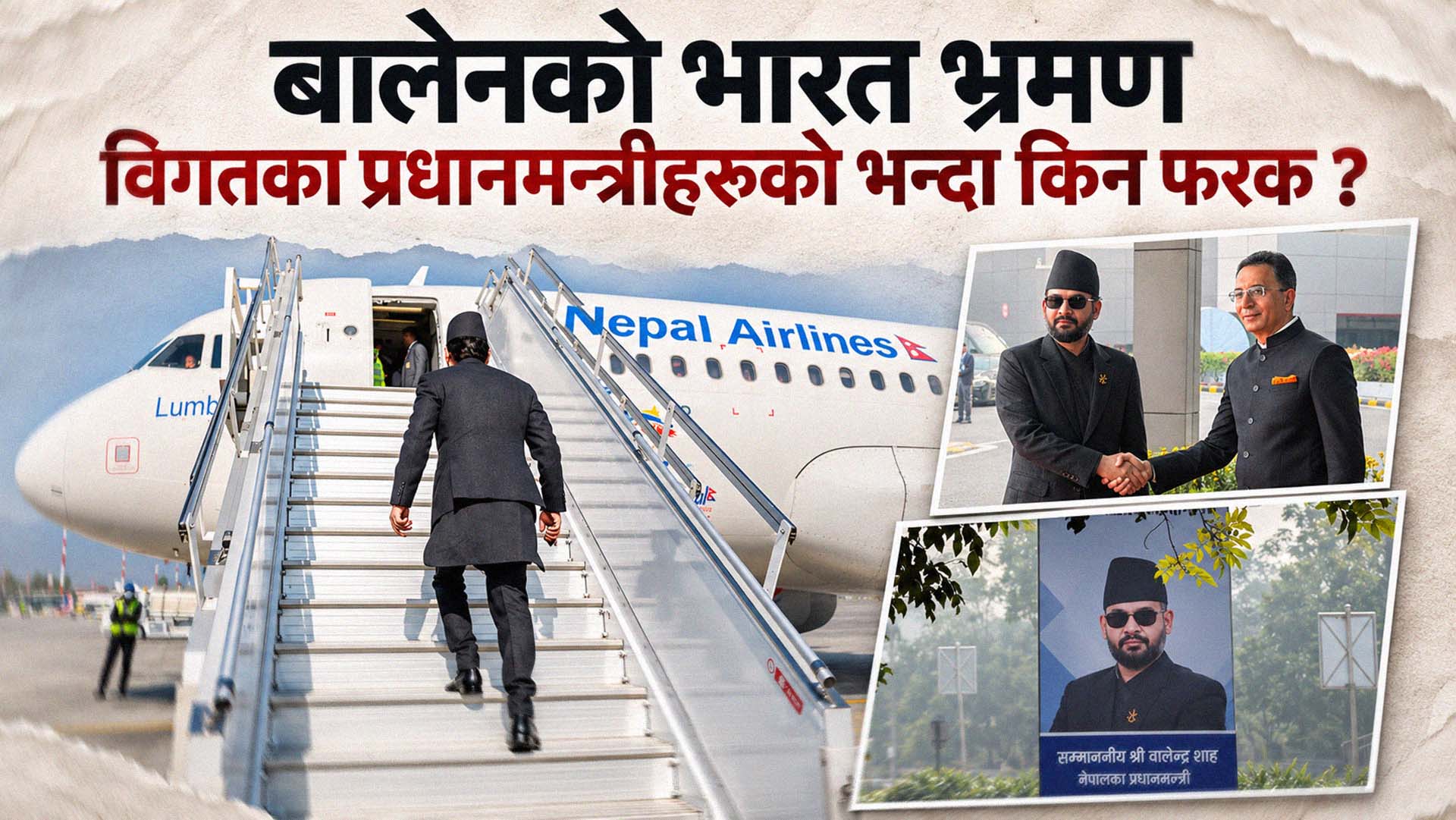
Kathmandu. Prime Minister Balendra Shah’s visit to India has been in the news for various reasons this time. It seems that he has proceeded with his visit in a different manner from the traditional style usually adopted by the Prime Ministers of Nepal when visiting India. It has been seen that he has chosen a different path from the practice followed by past Prime Ministers regarding the duration of the visit, formalities, political consultations, family participation and meetings with the Nepali community.
Earlier, when the Prime Ministers of Nepal visited India, it was a practice to prepare a two- to three-day program, inform the President about the visit, consult with former Prime Ministers and experts, and participate in various formal programs. However, Prime Minister Shah’s visit this time does not include many such traditional practices. In this sense, his visit to India can be seen as a political exercise of a different style than a diplomatic formality.
A total of 24 hours visit to India Nepali Prime Ministers used to schedule a two to three day program during their visit to India. Sufficient time was allocated for meetings with the Indian leadership, bilateral discussions, various formal programs and interactions with the Nepalese community. However, Prime Minister Balendra Shah has planned a 24-hour tour. This has made his visiting style different from that of past prime ministers.
The President was not briefed on the visit
Before going on a foreign visit, the previous Prime Ministers used to inform the President about important bilateral visits and give necessary briefings. However, the topic of Prime Minister Shah not meeting the President before going on a visit to India has come into discussion. Not only that, the fact that he did not meet the President formally after becoming the Prime Minister has also become a matter of public debate. This has raised new questions about the institutional relationship between the Prime Minister and the President and traditional political practices.
Departure to the airport without any frills
When the Prime Minister of Nepal went on a foreign visit, a special formality was seen at the Tribhuvan International Airport. It was customary to have a large presence of ministers, senior government officials and security personnel and formally bid farewell to the Prime Minister. However, this time Prime Minister Shah reached the airport in a normal manner and left for India. According to available details, only two ministers were allowed to reach the ship. This conveyed the message that the Prime Minister wanted to reduce unnecessary formalities and frills.
Visiting without family members
In the past, when the Prime Ministers of Nepal visited India, it was a practice to include their wives and other family members in the tour team. In some visits, the participation of the Prime Minister’s family was also a part of the official program. However, Prime Minister Balendra Shah has not taken any member of his family on a visit to India this time. This indicated that the visit was intended to focus on government and diplomatic purposes rather than personal and family participation.
Ex-Prime Ministers and experts were not consulted extensively
As India is an important neighbor and strategic partner of Nepal, the visit to India is viewed with special importance. In the past, Prime Ministers used to hold discussions with former Prime Ministers, Foreign Ministers, diplomatic experts and experts in various fields before visiting India. However, details have been made public that Prime Minister Shah did not conduct such a comprehensive consultation this time. Although it is said that he consulted with party chairman Ravi Lamichhane, he did not have extensive discussions with other political leaders and experts. Leaders of the opposition parties, including the Nepali Congress, have publicly expressed their displeasure for not consulting.
There is no meeting program with the Nepali community in India
A large number of Nepali citizens and people of Nepali origin have been living in India. In the past, the Prime Ministers visiting India used to hold meetings with representatives of the Nepali community there, listen to their problems and demands, and hold programs to understand the demands. However, in this visit of Prime Minister Shah, it is seen that there is no formal meeting program with the Nepali community in Indian land. This also indicates a change in the traditional practice of addressing the problems and interests of Nepali citizens abroad.
The Nepali Embassy does not have a grand dinner program either
It has been a tradition to organize a grand dinner at the Nepali Embassy in New Delhi in honor of the Nepali Prime Minister who is visiting India. Indian political leaders, diplomats, experts, businessmen and representatives of various fields used to participate in the program. Such programs used to be not only a formal meeting for the Prime Minister but also an important opportunity for informal dialogue and relationship expansion. However, this time, Prime Minister Shah’s visit did not have such a grand dinner program.
Conclusion:
Prime Minister Balendra Shah’s visit to India has created a new debate on political and diplomatic traditions practiced in Nepal for a long time. The short visit duration, limited formalities, lack of family participation, lack of extensive political consultation and meeting with the Nepalese community and no dinner program at the embassy made his visit different from that of past prime ministers.
One can interpret these changes as a new political culture of reducing unnecessary frills, frugal use of time and resources, and focusing on work. On the other hand, it can be argued that formal consultation, institutional coordination and dialogue with various stakeholders are equally necessary in relations with an important neighboring country like India.
How short the Prime Minister’s visit is, how much formality is reduced or how much tradition is broken does not determine the success of the visit. What Nepal has achieved from the visit, how strong the relationship between the two countries has become and what decisions have been made in the interest of the Nepali people will be evaluated in real terms.



