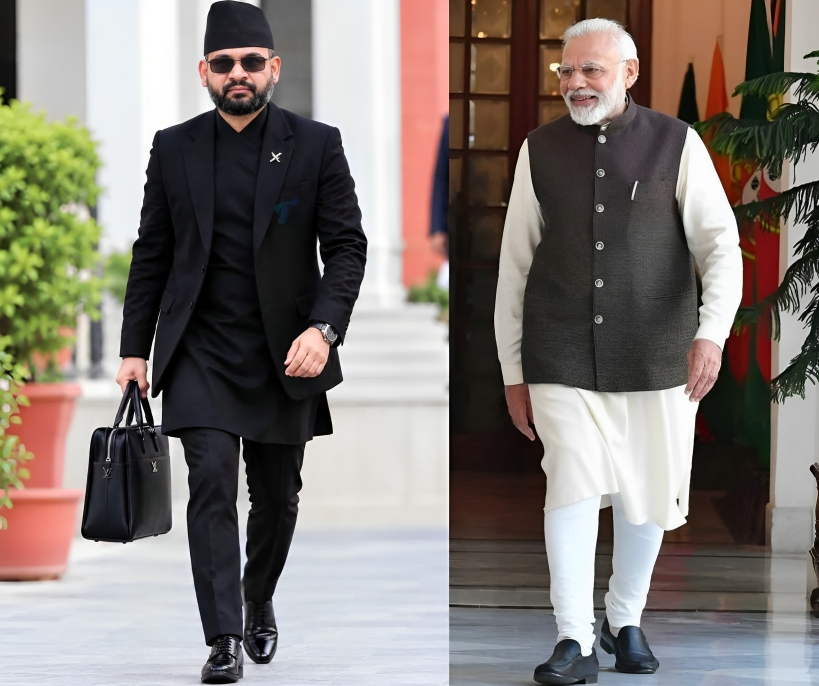
Kathmandu. Prime Minister Balendra Shah is going to India today (Sunday) for a two-day state visit. This visit, which is to be held at the invitation of Indian Prime Minister Narendra Modi, is his first official bilateral foreign visit after becoming the Prime Minister. However, this visit seems to be somewhat different from the previous visits of other Prime Ministers to India.
Prime Minister Shah, who will spend about 25 hours in New Delhi, is going to break some traditions of old visits and make a short, limited and mainly focused on economic and diplomatic agenda. The frills, long tour schedules, trips to cities outside the capital and political and business meetings at various levels seen in the past when Prime Ministers visit India will be less this time.
What is the tour schedule? Prime Minister Shah will leave for New Delhi today at 1:45 pm on a regular flight of Nepal Airlines Corporation. Shah, who is going to India as the leader of a 34-member government delegation, is scheduled to be welcomed at the Indira Gandhi International Airport in Delhi by Jitin Prasad, Minister of State for Industry and Commerce of the Government of India.
Prime Minister Shah will directly reach Hotel Taj Mansingh from the airport. There will be a courtesy meeting with Indian Foreign Minister S. Jaishankar at 6 pm. On the second day of the visit i.e. Monday at 10 am, he will be formally welcomed at Rashtrapati Bhavan. After that, at 10:40 a.m., there is a program to pay respects by reaching Rajghat, the mausoleum of Mahatma Gandhi.
There will be a meeting with Indian Prime Minister Narendra Modi at Hyderabad House at 11 am. Initially, the two Prime Ministers will have a one-on-one discussion, followed by bilateral talks at the delegation level. Trade, transportation, investment, energy, air connectivity, infrastructure development and economic cooperation between the two countries will be prioritized in the talks.
At 12:25 in the afternoon, there is a program to exchange various memorandums of understanding and hold a joint press conference between the two countries. After that, Indian Prime Minister Modi will host a luncheon in honor of Prime Minister Shah. After a courtesy meeting with President Draupadi Murmu at 3:15 pm, Shah will return home in the evening.
How is Balen’s visit different from other prime ministers? The most interesting aspect of Prime Minister Shah’s visit to India is its short duration and different working style. In the past, it was a tradition for the Prime Ministers of Nepal to visit India and stay for three to four days, visit cities outside Delhi, meet with various political leaders and interact with Nepali businessmen and the Nepali diaspora community.
However, Shah will not go outside Delhi this time. Although the Indian side offered to take him to Bengaluru or Ahmedabad to observe India’s development projects, news has been published citing diplomatic sources that he has shown no desire to go outside the capital.
Similarly, in the past, when the Prime Minister went on a foreign visit, a large group of high-ranking officials used to be present at the Tribhuvan International Airport for farewell. But this time, Shah has taken a policy of not making such frills. Even when he went to New York to participate in the United Nations General Assembly, he did not follow the traditional farewell style.
Likewise, the Prime Minister himself does not have a separate meeting with Nepali businessmen in India. The responsibility of their interaction has been given to Finance Minister Dr. Swarnim Wagle and Foreign Minister Shishir Khanal. There is no official visit to the Nepali Embassy. The Prime Minister’s visit seems to be focused on limited high-level talks and economic cooperation rather than long political meetings.
What issues are being discussed with Modi? The main purpose of Prime Minister Shah’s visit is to further strengthen the economic relations between the two countries and to advance development and infrastructure projects that have been discussed for a long time. This time, Nepal is looking for concrete agreement with India, especially on economic assistance package, more air access routes, energy trade, trade facilitation and infrastructure development.
For a long time, Nepal has been demanding India to provide more air access routes from Mahendranagar, Bhairahawa, Nepalganj and Janakpur to facilitate international flights. But India did not agree to it easily, raising the issue of security sensitivity.
This time, Nepali officials say that India has shown some positive attitude towards providing air access route from Mahendranagar and Bhairahawa. Especially, the possibility of reaching an agreement on the Mahendranagar route has been seen to be strong. However, as the technical issues are yet to be finalized, the subject of final agreement has not been decided.
Nepal expects that international flights from Gautam Budh International Airport will be made easier if the entry route from Bhairahawa is available. Likewise, it is expected to discuss financial assistance, loans and grants with India for the reconstruction of structures damaged by the Bhotekoshi flood. The topic of Nepal’s initiative for a financial assistance package worth about two billion US dollars is also in discussion. In energy trade, Nepal has also given priority to increasing electricity exports to India, expanding electricity trade to Bangladesh and attracting Indian investment in hydropower projects.
Projects from railways to petroleum pipelines In this visit, there is a program of joint inauguration of some completed projects and foundation laying of new projects. According to preparations, Janakpur-Ayodhya railway service, Bhairahawa-Sunauli integrated check post, bridge built over Mahakali river in Darchula and new building of Nepal Police Academy at Panauti in Kavre will be inaugurated.
Similarly, the Dodhara Chandni Integrated Checkpoint, the petroleum pipeline from Amlekhganj to Chitwan and the petroleum infrastructure project from Siliguri in India to Charali in Jhapa, Nepal are set to be laid. These projects are expected to help in the expansion of transport, trade and energy infrastructure between Nepal and India. In addition to this, there are plans to exchange MoUs in the fields of information technology, artificial intelligence (AI), education, health, agriculture, sports, disaster management and human resource development.
Topics ranging from proposals to open branches of Indian educational institutions IITs and IIMs in Nepal to cross-border gas pipelines, cricket infrastructure and expansion of air connectivity between different cities of the two countries are also on the list of discussions. However, there is a diplomatic analysis that there is little chance of concrete achievements in matters related to the border dispute, trade deficit, Pancheshwar multi-purpose project and the recruitment of Nepali citizens in the Indian Army.
A 52-member private sector team is also going to India. Attempts have also been made to link the Prime Minister’s visit to economic diplomacy, not just limited to political and diplomatic meetings. For this, in addition to the 34-member government delegation with the Prime Minister, 52 businessmen from the private sector are also going to India. They are going to participate in the tour at their own expense. Representatives of various professional organizations including Federation of Nepal Industry and Commerce, Confederation of Nepal Industry, Nepal Chamber of Commerce will be in this team.
Nepal-India Business Summit and interaction between businessmen will be organized in Delhi. Finance Minister Swarnim Wagle and Foreign Minister Shishir Khanal will address the programme. Nepali businessmen have prioritized easy access of Nepali products to the Indian market, removal of obstacles in exports, facilitating quality certification, solving customs and transportation problems and attracting Indian investment in Nepal.
However, when Nepal is trying to attract Indian investment, the news that Indian government ministers will not participate in the interaction of businessmen has also increased interest. It has also raised the question of how effectively the agenda of economic diplomacy can be advanced.
After eight months, the policy of not visiting foreign countries was changed. There was talk that Prime Minister Shah had adopted a policy of not visiting foreign countries for a year after assuming office. But within eight months of becoming the Prime Minister, he is going to go on a state visit to India. Soon after becoming the Prime Minister, India invited him for a visit. At that time, Prime Minister Shah refused to meet Indian Foreign Secretary Vikram Mishri when he came to Nepal, saying that the protocol was not agreed. The tour process, which was stopped after that, has now officially moved forward.
India has been prioritizing the expansion of relations with Nepal’s top political leadership. But what kind of hospitality India will give in this visit and how much Nepal will achieve in its priority matters is in the center of interest.
Overall, although the duration of Prime Minister Balen Shah’s visit to India is short, it can play an important role in determining the future direction of Nepal-India relations. Changing the old style of travel is one aspect, but the real success will be determined by a solid agreement on issues such as air access routes, economic cooperation, energy trade, infrastructure development and access of Nepali products to the Indian market.