

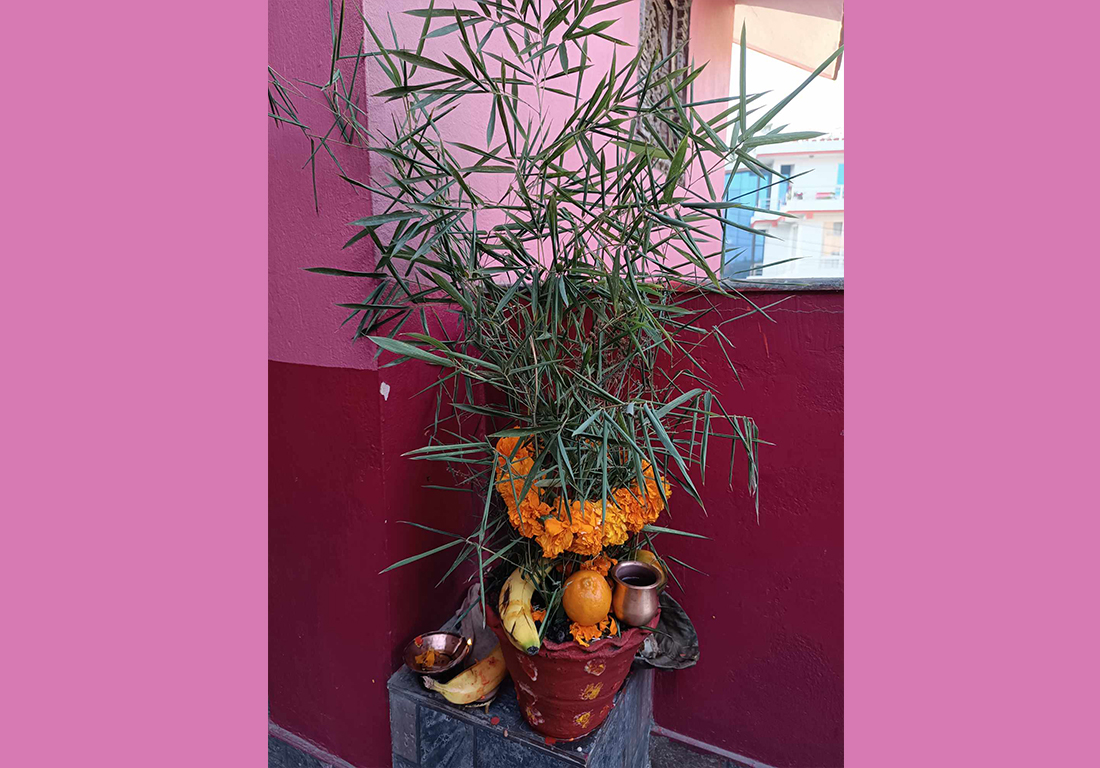
Kathmandu. On the day of Kartik Shukla Ekadashi, Haribodhini Ekadashi festival is being celebrated today by worshiping Tulsi which has medicinal properties.
There is a Vedic Sanatani tradition of celebrating the marriage of Lord Damodar (Vishnu) with Tulsi on the day of Haribodhini Ekadashi. On the day of Ashadha Shukla Ekadashi i.e. Harishayani Ekadashi, Vishnu, who slept in Kshir Sagar, wakes up today, so this Ekadashi is also called Haribodhini or Pravodhini Ekadashi.
For four months from Harishayani to Haribodhini Ekadashi, the devotees of Vishnu observe Tulsi fast and worship special puja. As Vishnu sleeps in Kshirsagar, there is a tradition that during these four months no manglik acts like marriage vows are performed. During this time, it is considered auspicious not to travel due to the fear of floods, landslides and creatures like snakes in rivers and canals.
On the day of Harishayani Ekadashi, Tulsi is planted at home and specially worshiped at the Tulsi Math, sprinkled with cow dung and red soil and decorated with Singari flower garlands, the Tulsi of Vishnu is married.
Since Tulsi is Vishnupriya, there is a tradition of marrying Tulsi with Vishnu on this day. Nigala’s lingo is buried as a symbol of Vishnu near Tulsi’s monastery and ritually worshiped. There is a classical saying that all the gods and goddesses reside in Tulsi throughout the month of Kartik. Devmani Bhattarai said.
The glory of Tulsi, which has been worshiped since ancient times, has also been scientifically proven to be beneficial. Therefore, the house where Tulsi’s monastery is is considered as a pilgrimage. It is said that ten directions are purified by the fragrance of Tulsi. Due to the belief that even Yamadoots do not enter the house where Tulsi is worshipped, Hindus build a Tulsi monastery at home.
Tulsi leaf, stem or flower juice is a medicine for colds and malaria. Mosquitoes will not bite if you apply this juice on your body and sleep. Even poisonous snakes do not come around the place where Tulsi’s monastery is located. The wind blowing around the monastery destroys the poisonous germs. Modern science has also proved that Tulsi has the power to destroy air that causes malaria. Tulsi is considered a great medicine for all animals throughout autumn.
It is a religious belief that in the month of Kartik, one’s wish will be fulfilled by wearing a garland of basil and offering one lakh basil leaves to Vishnu. As mentioned in the Garuda Purana, offering one Tulsipatra to Lord Vishnu in this month will yield the equivalent of donating 10,000 cows. Ramchandra Gautam informed.
Nowadays, there is also a tradition of taking the idol of Lord Vishnu on a chariot. At night, Vishnu is woken up by sounding conch shells, bells and drums saying ‘Govinda wake up, you sleep, the world sleeps, you wake up, the world wakes up’. As a symbol of this, it is used to conquer the five sense organs, the five action organs and the mind. For this, after worshiping for four months with devotion and devotion, on Haribodhini Ekadashi special worship of Lord Vishnu, all 11 will wake up.
Farmers bury the sugarcane plant in the monastery. Since no food is eaten on this day, fruits are eaten with sugarcane, pindalu and wild yam. There is a religious belief that if you fast in this way, sins will be destroyed and virtue will increase and you will get salvation.
It is believed that today’s Ekadashi fast, also known as Big Ekadashi, is equivalent to performing a thousand Ashwamedha Yagnas and Rajasuya Yagnas. It is described in the scriptures that during the month of Kartika, bathing, donating, chanting and homa with devotional remembrance of Lord Vishnu will yield fruits and get rid of the sins of a hundred births.
Today, special fairs are held at Char Narayan in Kathmandu valley, Changunarayan in Bhaktapur, Sheshnarayan, Ichangunarayan and Visankhunarayan in Kathmandu. For those who cannot go here, it is believed that a visit to Budhanilkanth Narayansthan, located in the north of Kathmandu, will give the same results as seeing and worshiping the four Narayans. Today, this festival is celebrated with special worship in Narayan places and temples across the country. Rasas



