Kathmandu. It has been clarified that the leadership role played by the Nepali Army in the post-disaster challenging situation for the protection, rescue and rehabilitation of citizens has become an important basis of the state’s disaster response capacity.
According to the army, the organization has demonstrated its professional capabilities in the Bhotekoshi and Budhigandaki floods of last Bhadour Asoz and other natural disasters in this year’s monsoon by carrying out risky rescue operations such as air, land and tunnel without error.
As Nepal is a sensitive country in terms of natural disaster risk, due to climate change, global temperature rise, geographical structure and weather adverse events, disasters like floods, landslides, inundation, avalanches and earthquakes have been recurring in Nepal.
Military spokesman Rajaram Basnet said that the multifaceted role of the army in addressing the humanitarian needs after the disaster has been made clear by the activities conducted in disaster-affected areas such as decontamination, psychosocial counseling and quality testing of relief materials.
The following is the article provided by the army about the actions and coordination carried out by the army, the main security organization of the country, in the disaster-affected areas:
Bhotekoshi flood on 10th of August caused huge loss of human wealth and serious impact on roads, bridges, electricity and communication infrastructure. While the search, rescue and relief work of flood-affected citizens continues, the incessant rains of October created the risk of further floods, landslides and inundation in various areas of the country. Local residents and tourists were also affected due to the damage to the human capital and physical infrastructure such as roads and bridges, especially in Baglung, Parbat, Myagdi, Manang and Mustang districts.
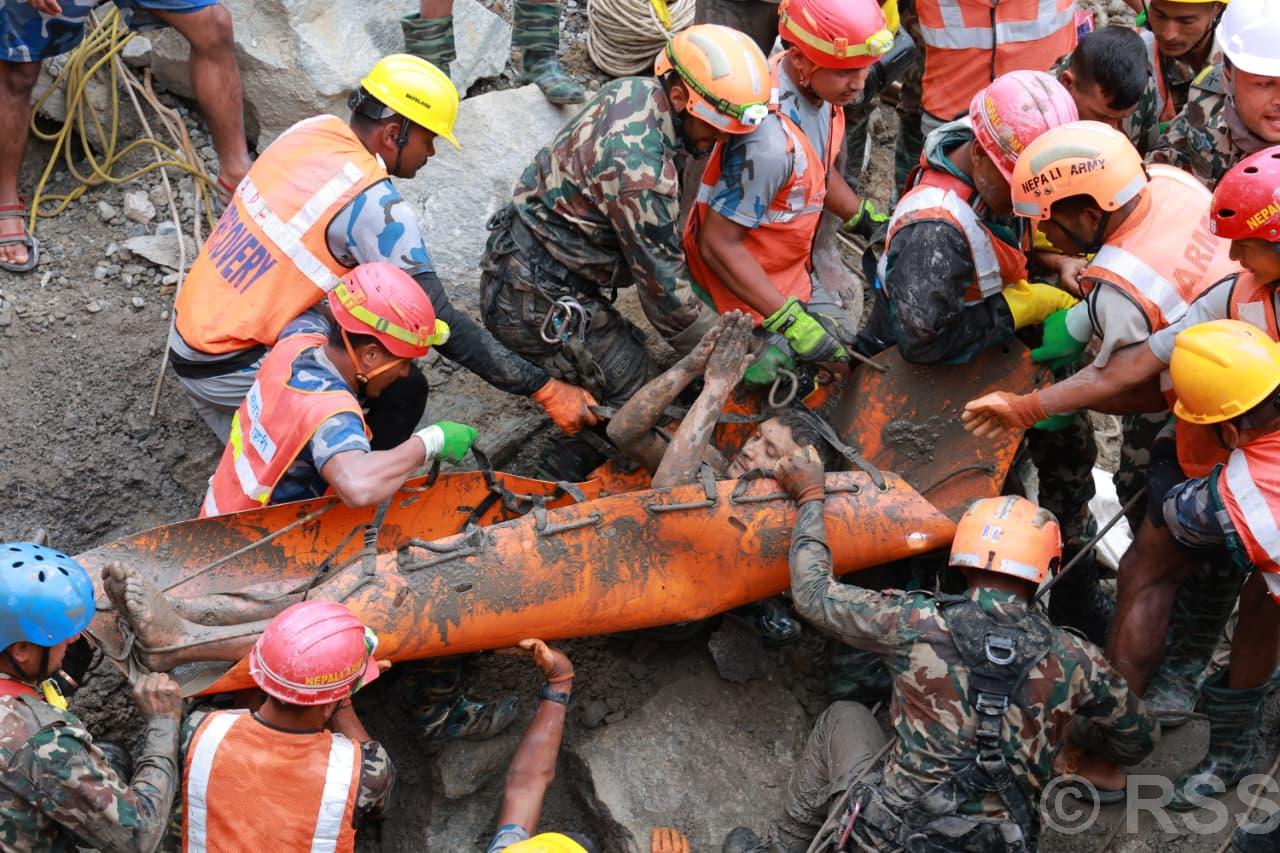
In such a dire situation, the Nepali Army mobilized a large number of manpower including land and air vehicles, medical personnel and engineering forces and remained active in search and rescue, distribution of relief and safe relocation of citizens at risk. In response to the Bhotekoshi flood, the army prioritized the planned deployment of available resources to protect the lives of vulnerable citizens. The fact that 4 thousand 81 people were rescued by air until August 24 reflects the activeness and rescue capability of the army. At the same time, the rescue of three people trapped inside the tunnel of the hydroelectric project alive after 10 days is a remarkable achievement of the disaster response.
The role of the army in disaster response is not limited to search and rescue. After the Bhotekoshi flood, the Emergency Medical Response Team, deployed to provide health services in the affected areas, provided health services to 3,535 people. Activities such as decontamination, psychosocial counseling and quality testing of relief materials were also conducted to control the epidemic. It has clarified the multifaceted role of the army in addressing humanitarian needs after disasters.
Similarly, due to the incessant rains and floods in October, the army has also contributed significantly to the rescue and safe relocation of the affected citizens of Parbat, Baglung, Myadi and Manang districts. 127 people who were in dangerous places were transferred by air to safe places. Similarly, on October 25th, 1,106 people affected by the floods in Budhigandaki, including natives and foreigners, were rescued by helicopter and ground. Transported about 18,680 kilograms of food and relief materials to the areas where the road network was cut off and assisted in the safe removal of the flooded goods from the affected houses.
The contribution of the army in post-disaster rehabilitation and infrastructure reconstruction is also significant. To re-operate the road network damaged by the Bhotekoshi flood, the army assisted by installing acrobridges on Tadi Khola at Devighat and Falaku Khola at Betravati to facilitate the movement of Rasuwa.
Likewise, the army played a role in restoring the flow of the Marsyangdi River, which was blocked due to a landslide in Chame, Manang, assisting in the operation of the blocked electricity transmission line, and restoring traffic with Upper Manang by constructing a temporary bridge in place of the washed away bridge.
In place of the bridge at Arughat, which was damaged by the Budhigandaki flood, a Beilibridge connection was immediately installed and handed over to the road project. Another important basis for these achievements is the coordination and cooperation between various agencies. Disaster management is not possible only through the efforts of a single agency. Under the direction of the Government of Nepal, the integrated efforts between the Nepal Army, Nepal Police, Armed Police Force, Nepal, local administration, local level, non-governmental organizations and local communities have made rescue, relief and rehabilitation effective. During the Bhotekoshi flood, a disaster response tactical headquarters was established at Maithili camp in Trishuli and a forward command center was established at Dhunche in Rasuwa to solve the problems at the field level immediately. It reduced the distance between the decision-making process and implementation and assisted in the systematic mobilization of available manpower and resources. In that process, the Nepali Army has demonstrated its adventurous and professional capabilities by carrying out risky rescue operations such as air, land and tunnels in an error-free manner.
The joint disaster response exercise conducted every year under the leadership of the Nepali Army has further strengthened such coordination. Preparation, training, practice and collaboration at the actual scene helps to maintain operational consistency between various agencies during a disaster.
Despite the adverse weather, remote geography and blocked roads, the use of technology such as drones to facilitate the transportation and rescue of essential materials has also shown the army’s ability to adapt to changing technology.
Although natural disasters cannot be prevented, their damage can be minimized through effective preparedness, timely rescue, relief, re-establishment and mutual cooperation. The role of the Nepali Army dedicated to protecting the lives of citizens in every difficult moment of disaster is not only limited to security responsibility, it is also a strong example of humanitarian service, national responsibility and commitment to citizens.
Recent disasters have reconfirmed the message that coordination, cooperation and collective efforts between concerned agencies are the basis of effective disaster response.