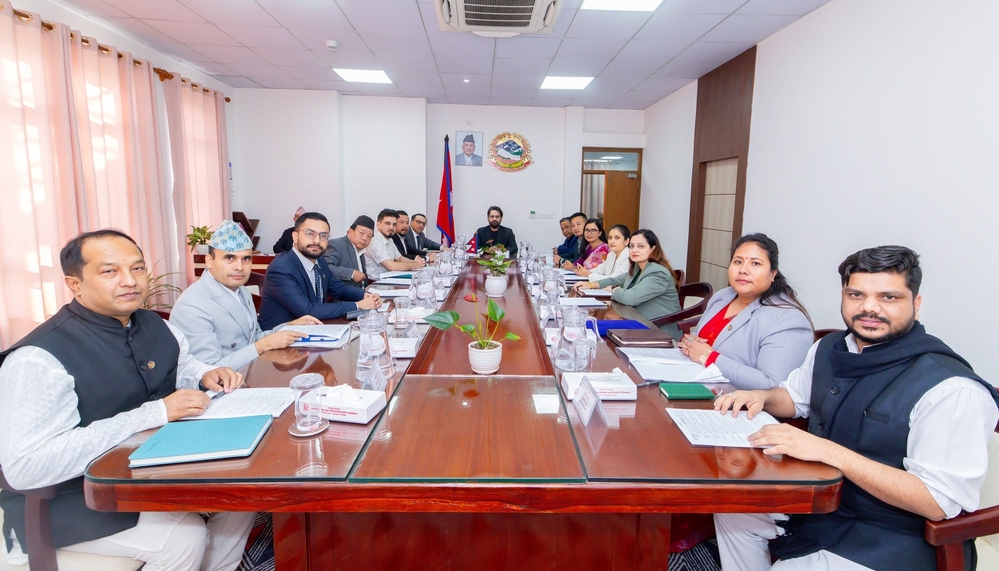
Kathmandu. The government led by Prime Minister Walen Shah is practicing ruling through ordinances by bypassing parliament. By bringing one ordinance after another, the government is exercising its power and making and revising laws by using its own legislative powers.
Since the formation of the government under the leadership of Prime Minister Shah, only 13 ordinances have been issued, two more ordinances have been recommended to the President. There is a provision in the constitution that an ordinance can be introduced if something needs to be done immediately when the parliament is not in session. Ordinances are recognized as laws. But the ordinances issued by the government do not seem to have come as a product of the special circumstances of the time.
Constitutionalist Bhimarjun Acharya comments that the spirit of the constitution is misused when new laws are urgently needed during times of emergency, crisis, war or epidemic in the country. The government can bring an ordinance only in extremely exceptional situations. But this has become a general rule. Practiced wrong yesterday. Today, the government, which got about two-thirds of the votes, is repeating the same,” he said.
On 27th June 2078, the Constitutional Bench of the Supreme Court decided that it is not possible to promulgate an ordinance without delaying the Parliament on matters of long-term importance. The Supreme Court said that when the government passes an ordinance bypassing the parliament to achieve governmental facilities or a certain political objective, it is deemed to interfere improperly with the authority and effectiveness of the legislature.
According to the ruling of the Supreme Court, the principle of separation of powers is the theoretical recognition that the power of the state or governing authority should be exercised by separate bodies such as the legislature, the executive and the judiciary. The Citizenship Ordinance brought by the KP Sharma Oli-led government at that time was invalidated by this decision of the Supreme Court. But the government has not stopped the trend of bringing ordinances to exercise its own power.
A month after the formation of the government led by Shah, the ordinance was brought. An ordinance was issued by suspending the Parliament session which had been called by the President last May. On the recommendation of the Council of Ministers, the President issued 8 ordinances from 17-22 Baisakh. As soon as the budget session of the Parliament ended, the government again brought an ordinance. Five ordinances were issued on 23-30 October.
The cabinet meeting held on October 17 has recommended to the President an ordinance to amend the Press Council Nepal Act, 2048 and an ordinance to amend some Nepal Acts including culture, tourism and civil aviation. These two ordinances are yet to be promulgated. The government has also prepared to bring some Nepal amendment ordinances related to investment and infrastructure.
The government is holding an infrastructure conference in Kathmandu on December 23 and 24. Before that, various laws are going to be amended through ordinances. In the past, it was often seen that the government would introduce ordinances when the equation of parliament was not favorable to pass the bill. This time, the ruling RSVP has almost two-thirds majority in the House of Representatives. A simple majority is enough to pass a bill. RSVP has no representation in the National Assembly. But it does not affect the progress of the Bill for ratification.
Last May, an ordinance was introduced regarding cooperatives (first amendment), public procurement (second amendment), amendments to some Nepal Acts related to universities, money laundering (money laundering) prevention (third amendment), and amendments to some Nepal Acts related to health science institutes. Similarly, a special provision ordinance regarding the dismissal of public officials, an ordinance to amend some Nepal Acts, and a Constitutional Council (First Amendment) ordinance were issued. 81 Acts were amended through eight Ordinances.
Act 24 was amended through a special ordinance on the dismissal of public officials, which was brought to dismiss the officials who were politically appointed during the previous government. Similarly, 14 university-related laws were amended through an ordinance to amend some Nepalese laws related to universities, and 6 health institute-related laws were amended through an ordinance to amend certain Nepalese laws related to health science institutes. More than 1,500 officials who were politically appointed during the previous government were dismissed at once due to the ordinance. 19 Acts were simultaneously amended by the Ordinance made to amend some Nepal Acts.
The procedure for the meeting of the Council in the Constitutional Council Act was amended through an ordinance. The procedure was amended through an ordinance to make it easier to recommend the person you want to the constitutional body. After this amendment, on 24 Baisakh, the chairman of the council, Prime Minister Shah, convened a meeting of the council and recommended the fourth ranking judge Manoj Kumar Sharma as the chief justice. Before that, there was a tradition of recommending the most senior judge of the Supreme Court to the Chief Justice.
Out of the eight ordinances introduced by the government in Baisakh, four ordinances were approved by the federal parliament within 60 days of the constitution, while the other ordinances became inactive. Ordinances related to Constitutional Council (work, duties, rights and procedures), Ordinances to make special arrangements for dismissal of public officials, Ordinances to amend some Nepali Acts related to universities and Ordinances to amend some Nepali Acts were inactive.
The ordinance was rejected because only the opposition party was represented in the National Assembly. Four other ordinances were approved with the support of other parties in the parliament. There is a provision in the constitution that the issued ordinances should be submitted to both houses after the sitting of the federal parliament and if they are not accepted by both houses, they will automatically become inactive.
After the end of the budget session of the Federal Parliament on October 16 midnight, the government has brought an ordinance to amend some Nepal Acts related to disaster, an ordinance to amend some Nepal Acts related to forests, an ordinance to amend some Nepal Acts related to land, an ordinance for the Nepal Science, Technology and Innovation Academy Ordinance and a Science, Technology and Innovation Ordinance. In Baisakh, the new provisions introduced in some Nepal Amendment Ordinances in Forest Act and various Acts related to land have been re-introduced for the second time through Ordinances. After the Ordinance promulgated in Baisakh became inactive, the government has again chosen the Ordinance as it has to go through the process of making a law through the Parliament.
Former Secretary General of the Federal Parliament Suryakiran Gurung says that the government has disregarded the Parliament by bringing one ordinance after another. This is not a culture of democratic governance. When the session of the House is not in session, the ordinance will be brought for the legal arrangements that should not be made immediately,” he said, “but the way in which the ordinance has been brought. It seems that the government is trying to take the legislative power into its own hands. This not only interferes with the jurisdiction of the legislature, but also defies the sovereign parliament.
According to the Ordinances in Nepal: Situation and Practice study report published by the Federal Parliament, after the promulgation of the 2047 Constitution, only 30 ordinances were issued until 2059. No ordinance was issued in 2053 and 2056. After the dissolution of the House of Representatives, it seems that most ordinances were issued during the period from 2060 to 2062. 27 Ordinances were issued in 2060, 33 in 2061 and 79 in 2062.
After the promulgation of the Interim Constitution in 2063, the Interim Parliament and the Constituent Assembly Elections of 2064 and 2069 worked for the Legislative Parliament. 39 ordinances were issued from 2063 to 2072. No ordinance was promulgated in the year 2068. In the year 2069, 16 ordinances were issued. In 2072, only one ordinance was issued regarding the reconstruction of structures affected by the earthquake. After the new constitution, not a single ordinance was issued in 2072, 2073 and 2076. 3 ordinances were issued in 2074, 5 in 2075, 11 in 2077, 28 in 2078 and 4 in 2079. 2 Ordinances were promulgated in 2080, 7 in 2081 and 3 in 2082. In 2083, 13 ordinances have been issued, 2 have been recommended. Ekantipur