

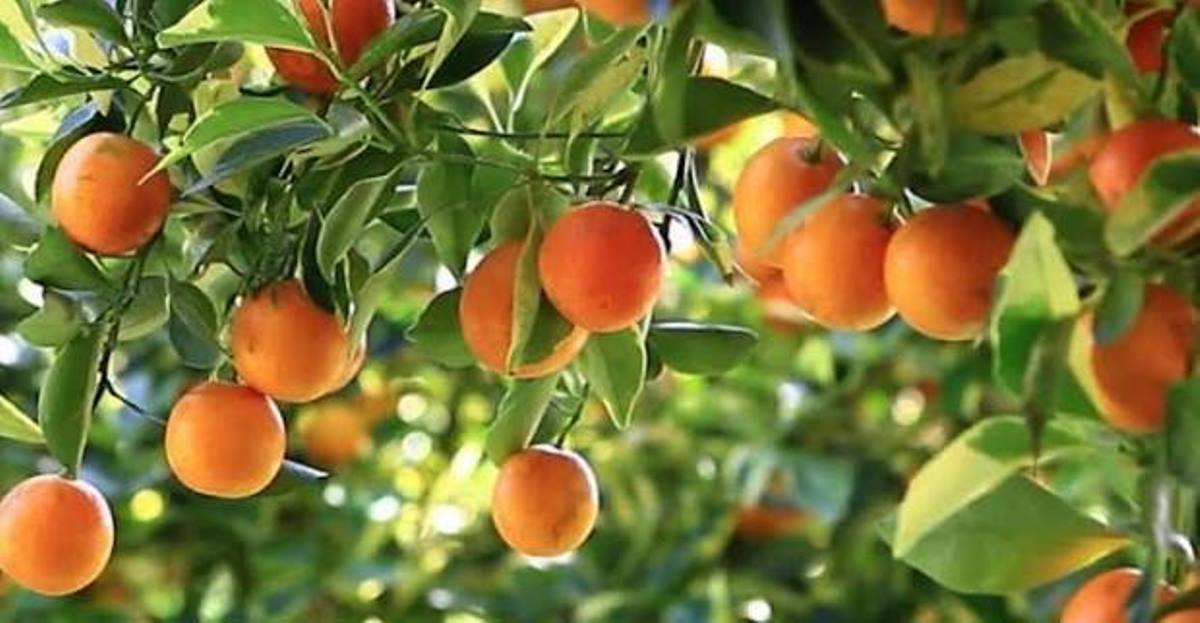
Kathmandu. Junar consumption in the market increases during major festivals like Tihar and Chhath. Stakeholders say that its consumption is increasing due to the use of fruits and the tradition of offering junar during Chhath. As it is the festival season, Junar has started to be seen in abundance in the market.
The government data of the last decade has also shown that junar production and cultivation is increasing. Junar production, which was 34 thousand 675 tons in the financial year 2071/72, increased to 46 thousand 277 tons in 2081/82. During this period, the production has increased by 11,602 tons, i.e. by 33.5 percent, according to the data released by the National Fruit Development Center.
Agricultural expert Krishna Prasad Poudel said that market demand, price and its cultural importance are the main factors in increasing junar production. He says that its market potential is good because it can be stored for a relatively long time and is needed during festivals. “Junar is a fruit that does not spoil relatively quickly, has traditional and cultural importance and is prepared during the festival, so its production has increased,” said Paudel. He said that more studies are needed on the similarity between the official production data and the actual production.
It is mentioned in the data booklet on fruit and flower business published by the center that the production has increased with the expansion of the area under junar cultivation and the improvement in productivity. According to this, in the financial year 2071/72, the total area of junar cultivation was 4 thousand 834 hectares. In one decade, 6 thousand 151 hectares increased to 1 thousand 317 hectares in 2081/82.
The productive area of Junar has also increased by 816 hectares in a decade. In the financial year 2071/72, the productive area was 3 thousand 440 hectares, but in 2081/82, it reached 4 thousand 256 hectares. It has also shown that the productivity of corn has improved.
In the financial year 2071/72, the productivity per hectare was 10.1 tons. In a decade, productivity per hectare increased by 0.77 percent to 10.87 tonnes in 2081/82. Along with the expansion of the productive area, the improvement in productivity seems to have contributed to increase the total production.
The main production and market selling time of junar in Nepal is from November to January. During this period, the supply of domestic and foreign sugar increases in the market. Junar has been cultivated in various hilly districts of Nepal. Ramechhap, Sindhuli and Dhankuta are considered as pocket zones of Junar. Apart from this, it is cultivated in districts including Kavrepalanchok, Pyuthan, Doti, Dhading and Rolpa.
In Nepal, Paripatle Agricultural Research Center in Dhankuta and Central Horticulture Center in Kirtipur have protected varieties of Junar such as Malta, Valencia, Naval, Jaffa. In Paripatle there are breeds like Malta Common, Malta Blood Red, Ruby and Hamlin along with the local Junar. According to the center, conservation and study of various breeds including local Junar, Washington Naval, First Valencia, Fukuhara and Kiyomi are being done at the Kirtipur Center.
Although the production has increased in a decade, the government estimates that the production will be the same as last year and this year. Sagar Ghimire, senior horticulture development officer of the center, said that last year’s production could not be confirmed as the new forecast of junar production has not been made public. “Last year’s data has not been updated, it is assumed that there will not be much change in production,” said Ghimire.
Ghimire said that even though there has been an outbreak of fruit fly in some areas of Sindhuli this year, there has been preliminary information that there will be no decline in production. He says that the real situation of this year will be clear only after the new product launch and data are released. Agricultural experts say that as both the demand and price in the market started to improve, the farmers were attracted to junar cultivation and the production increased.



