Antalya (Turkey). Stakeholders have emphasized that a large part of the international climate finance received by Nepal for mitigating and adapting to the effects of climate change is in the form of loans and that it should be based on grants.
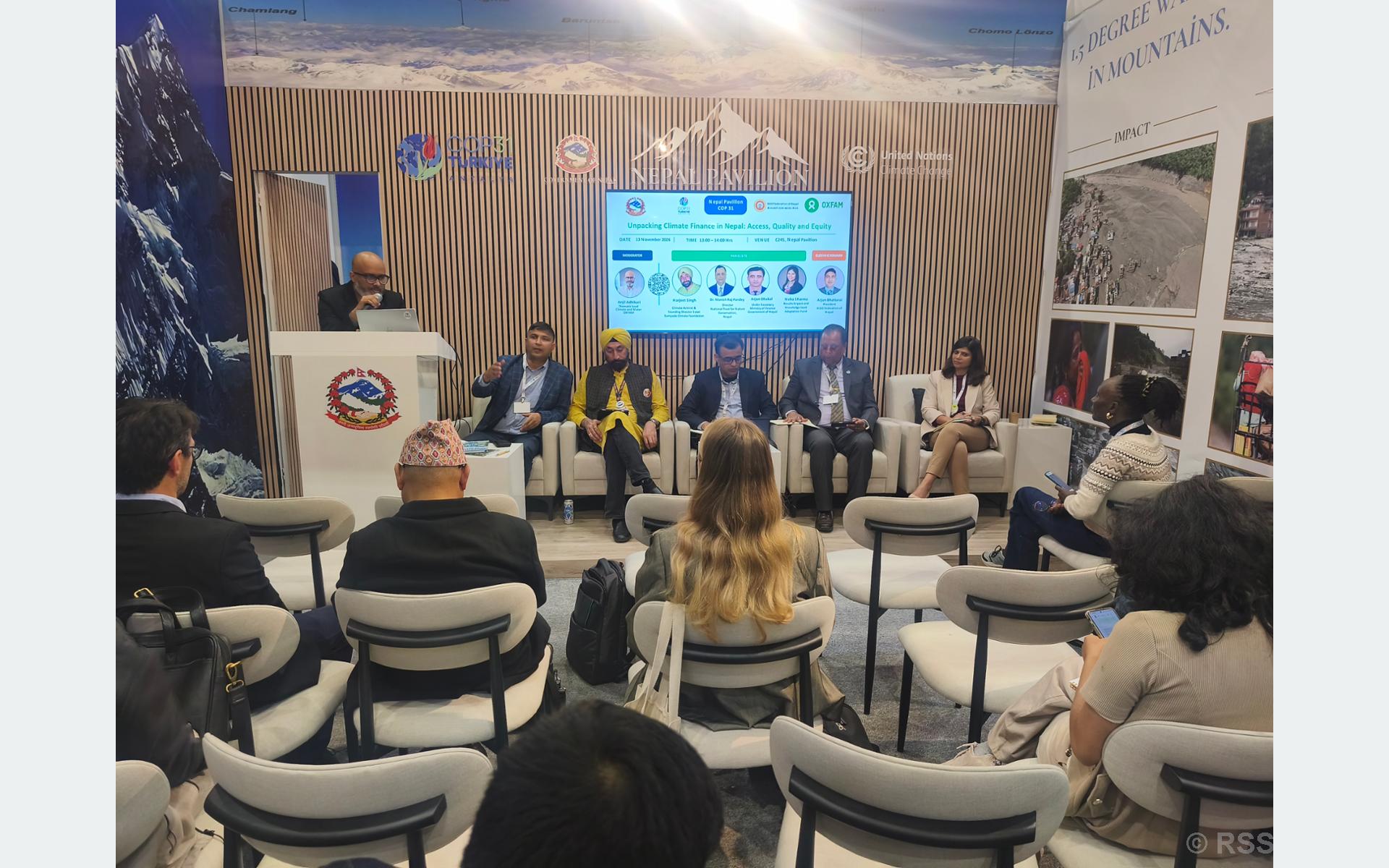
The speakers participating in the discussion on ‘access, quality and equity of climate finance in Nepal’ held today at the Nepal Pavilion under COP-31 opined that it is not fair that a developing country like Nepal, which has contributed little to climate change, should bear the burden of additional debt to face the climate crisis.
According to the data presented in the program organized by the non-governmental organization Federation of Nepal and Oxfam, from 2011 to 2021, Nepal has received five billion 71 million US dollars in climate finance from various sources. Of the financing received from multilateral sources, 61 percent is in the form of loans, 38 percent in the form of grants and one percent in the form of shares and equity.
Out of the three billion three billion US dollars received from multilateral sources, three billion 482 million dollars are loans, two billion 169 million dollars are grants and five hundred seven million dollars are in the form of shares and equity.
In the group discussion, Deputy Secretary of the Ministry of Finance, Arjun Dhakal, said that while mobilizing climate finance, the selection of grants and loans will be made on the basis of the nature of the project, the condition of the need, the availability of financial resources and the financial returns obtained from it. He said that grants should be prioritized in the areas of adaptation for countries that are at risk of climate like Nepal. Deputy Secretary Dhakal mentioned that since most adaptation investments do not give direct financial returns, grants are more suitable than loans for such projects.
But sub-secretary Dhakal said that concessional loans can be mobilized for renewable energy, hydropower and climate infrastructure where economic returns can be obtained. He emphasized on paying attention to the repayment period, grace period, ability to repay the loan and sustainability of the overall loan before accepting the external loan.
Adaptation Fund’s ‘Results, Impact and Knowledge Head’ Neha Sharma said that in order to expand the direct access of national organizations to climate finance, institutional capacity development and necessary standards must be met. She informed that after fulfilling the criteria related to gender equality, environmental and social protection, procurement process and financial management, the national implementing agency can receive direct finance from the International Climate Fund.
Stating that there is a fast track system in the process of getting recognition of Adaptation Fund for organizations recognized by the Green Climate Fund, she said that this will help to expand the capacity of the national organization and the opportunity to mobilize climate finance. He said that the Adaptation Fund preparation program will assist organizations in capacity building from the initial phase of the project to implementation and completion.
Dr. Manishraj Pandey, director of the National Nature Conservation Fund, presented Nepal’s experience regarding access to biological diversity and genetic resources and benefit sharing. According to him, the process started in 2017. It took about three years to prepare the legal framework for access to genetic resources and benefit sharing. During this process, about 13 policies, guidelines and plans have been created and significant progress has been achieved in this field by 2024, he informed.
Harjit Singh, climate activist and founding director of Sustainable Heritage Climate Foundation, said that climate finance should be provided not as a donation or aid, but as the responsibility of developed countries that have contributed more to climate change and the rights of affected countries. He commented that while the developed countries are spending huge amounts of money on the fossil fuel industry and other sectors, they are not providing enough finance to the developing countries affected by the climate crisis.
Pointing out that even though Nepal has made a negligible contribution to climate change, it has to face the challenges of melting glaciers, increasing disasters and adapting, Director Singh claimed that Nepal’s glaciers are melting 65 percent faster than in the previous decade. He said that there is a lack of sufficient funds for adaptation along with losses and damages. Director Singh said that it is unfair that countries that are not responsible for climate change have to take loans for their own security.
Emphasizing that multilateral financial institutions such as the World Bank should give grants instead of providing loans for climate adaptation and post-disaster rehabilitation, Director Singh said that Nepal should raise a clear voice on the international stage to end the use of fossil fuels such as oil, gas and coal and climate justice.