Look around. Usually at home, parents teach their children new things, but a few days ago, a different scene was seen at the house of Sapna Dhungana of Hetauda sub-metropolis-18 Harnamadi in Makwanpur. Daughter Adhisree Dahal, studying in class 4, taught her mother how to make new paper from old paper.
Dhungana was happy when her daughter taught her the skills she had learned in school. It was a new experience for her to learn from her daughter that waste paper can be recycled and made into new paper. “My daughter has learned to make new paper from waste paper in school. She also taught me how to make paper,” said Dhungana.
Adhisree is studying at Makwanpur Bal Vidya Sadan School in Harnamadi. By participating in the ‘skill camp’ conducted by the school, she learned the skill of paper recycling. Class 4 students not only made new paper from old paper, but also showed it by printing on the paper they prepared.
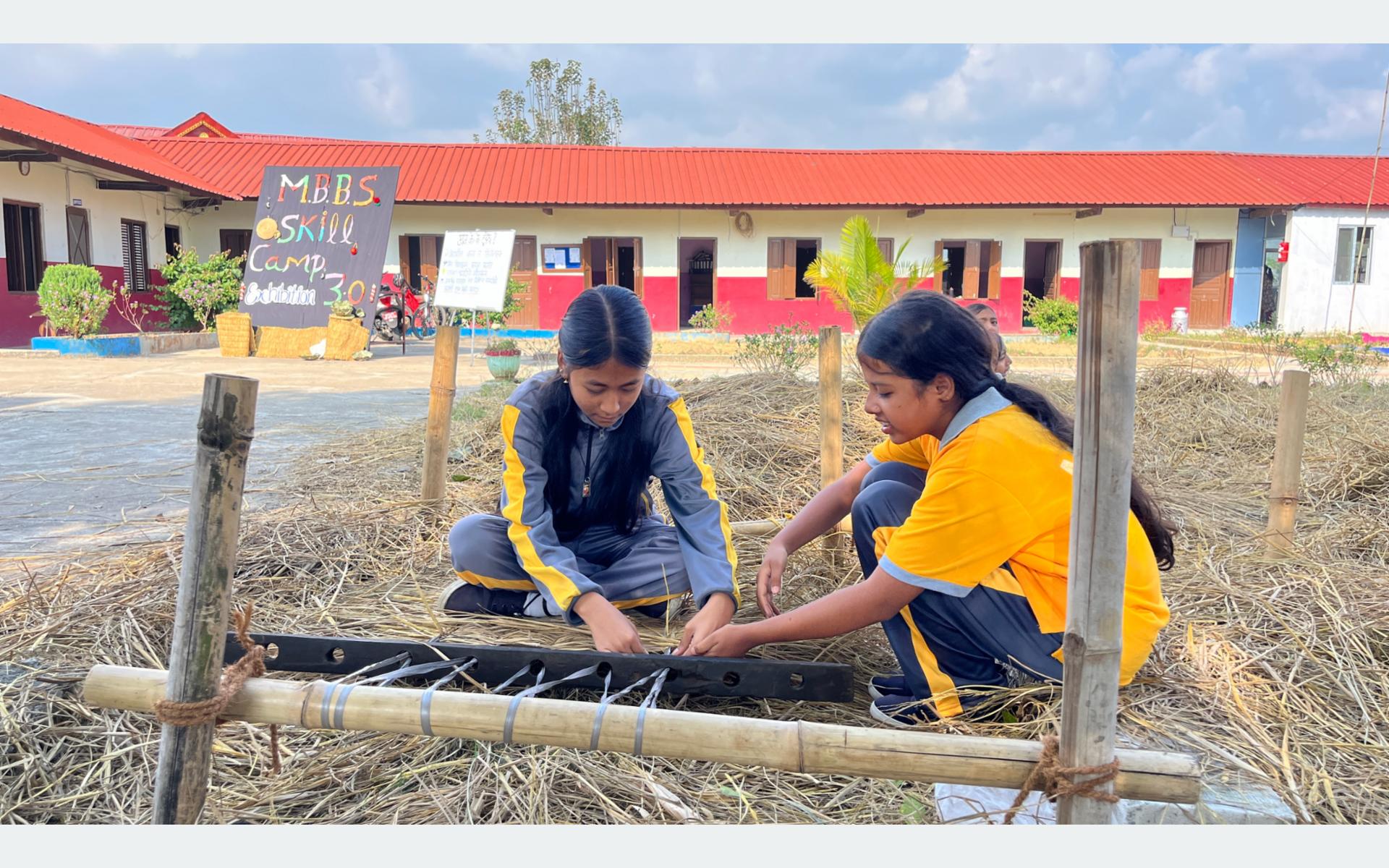
When we reached the school premises, in some places the work of weaving gundri from straw was going on, while in some places the tools made by the students were being displayed. Some students were busy making traditional materials. Some were giving information about how modern technology based devices work. This scene is of the school’s ‘skill camp’ where students are learning by working on their own, going beyond the text books and classroom teaching.
According to the ‘One Class, One Skill’ concept, the school aims to teach students at least 10 practical skills by the time they pass class 10. The third edition of the camp, which has been running for three years with the aim of developing creativity, self-reliance and entrepreneurship among students, was completed on Friday.
According to the principal of the school, Sudipraj Giri, after the Dasain-Tihar holidays, the students have been taught various life skills in the first week of the school opening. He informed that the program was conducted with the aim of connecting the students who returned to school after the long festival holiday to participate in creative activities with regular studies.
The school has determined different skills according to the age and class of the students. Students up to class 3 have practiced health and personal hygiene. Paper recycling was conducted in class 4, knitting in class 5 and art in class 6. Class 7 students have learned to weave traditional gundri from straw. The necessary materials were arranged in the school premises and they were made to practice preparing Gundri.
Sayastha Pariyar, a student of Class 7, also participated in the gundri weaving exercise. She said that she was happy to learn skills that she did not know before at school. He says that he gained new experience while practicing from preparing straw to weaving to make Gundri.
The students have learned by practicing with their own hands how materials such as Gundri, which are used daily in the household, are prepared. As the use of modern materials increases, the school has also tried to familiarize the new generation with traditional skills.
Next to the students who were learning traditional skills, the practice of modern technology was also going on. Class 8 students built models of devices based on robotics and electrical technology. They put the prepared equipment in the exhibition and informed about its use and usefulness.
Class 10 students helped as volunteers in running the camp. According to Principal Giri, the school has also included the ‘STEAM’ teaching concept, which combines science, technology, engineering, art and mathematics with practical practice, in the program. He said that priority has been given to skill-based education with the aim of making the students able to do the necessary work in daily life without limiting them to the knowledge of textbooks.
Dhungana, a parent, shared her experience of increasing the enthusiasm of children to learn new things after participating in the camp. According to him, children are excited to go to school after the festive holidays. Students have the opportunity to enjoy learning by participating in a variety of activities before returning to the regular classroom. “Once you learn a skill, you develop the habit of learning something else by yourself”, Dhungana said.
She said there has been a positive change in children’s creativity and interest in practical work. He suggests that students’ learning will be more effective if such activities can be linked more systematically with the school curriculum. In the school, students are learning not only traditional skills and techniques, but also how to sell the products they produce.
Sonu Adhikari, studying in Class 9, practiced candle production and marketing this year targeting Tihar. The students of the class formed groups and worked from candle production to sales. Some were responsible for collecting materials, some for production and some for marketing.
According to Sonu’s father Purushottam Adhikari, his daughter was given the responsibility of marketing. After the daughter told home about the work done at school, she was interested in the production cost, selling price and profit of the candle.
According to him, the students decided the selling price of the candles by keeping about 40 percent profit on the production cost.
The officer is happy when the daughter comes home to discuss what she has learned in school with business. He said that the students have acquired the knowledge that it is not enough to produce a material, but also to calculate its cost, market value and potential profit.
“It is a good thing that students get the knowledge of how much to sell their products and how to proceed according to the market price,” said the official. He believes that it is important to learn skills that are useful in everyday life, not just reading, writing and taking exams in school.
He said that the learning of the school has also started to be seen in the family. Children apply what they have learned about hygiene and environmental protection at home. He said that sometimes when he does not pay attention to waste management, the children alert him.
The official said that the participation of parents in skill-based education is also necessary. He suggested that an environment should be created to observe the exhibition of materials prepared by the students, encourage them and practice what they have learned at school at home.
Earlier, the school also made students participate in agricultural practice. The students learned how to plant, harvest, chop and bring in rice in the school premises. In the same way, practice was also carried out, including making compost from organic waste.
Principal Giri said that along with preservation of traditional knowledge, skill-based education has been continued with the aim of familiarizing students with modern technology. According to him, the goal of the school is that the students can use the knowledge acquired in the classroom in their daily life.