

Kathmandu. The damage caused by the devastating flood in Bhotekoshi river on August 10 has caused deep pain to Nepal. It will take a long time to forget the pain. More than 1,450 people died in the flood and more than 5,000 people went missing, reflecting the terrible picture of the disaster. Due to this, Nepal has to suffer billions of material losses. Before this wound could be healed, the flood that came in the Budhigandaki river of Gorkha on October 25 added another pain.
Last year also there was a flood in the Lende river due to the bursting of Himtal. It also caused loss of people’s wealth. After a year, the flood in Bhotekoshi has suffered unimaginable damage. Two years ago, there was a sudden flood in Thame in Solukhumbu’s Khumbu Pasanglhamu Rural Municipality. The locals did not imagine that such a disaster would happen. Even there, the settlement turned into a slum in a moment. Remembering the scenes of Bhotekoshi, Budhigandaki and Thame made desolate by floods makes anyone’s heart break.
These events are only a representative scene of the unbearable suffering of the Himalayan region and the people there who are suffering from climate change. The snow is melting in the mountains, the risk of avalanches is increasing and the community living in the arms of the mountains is paying the price.
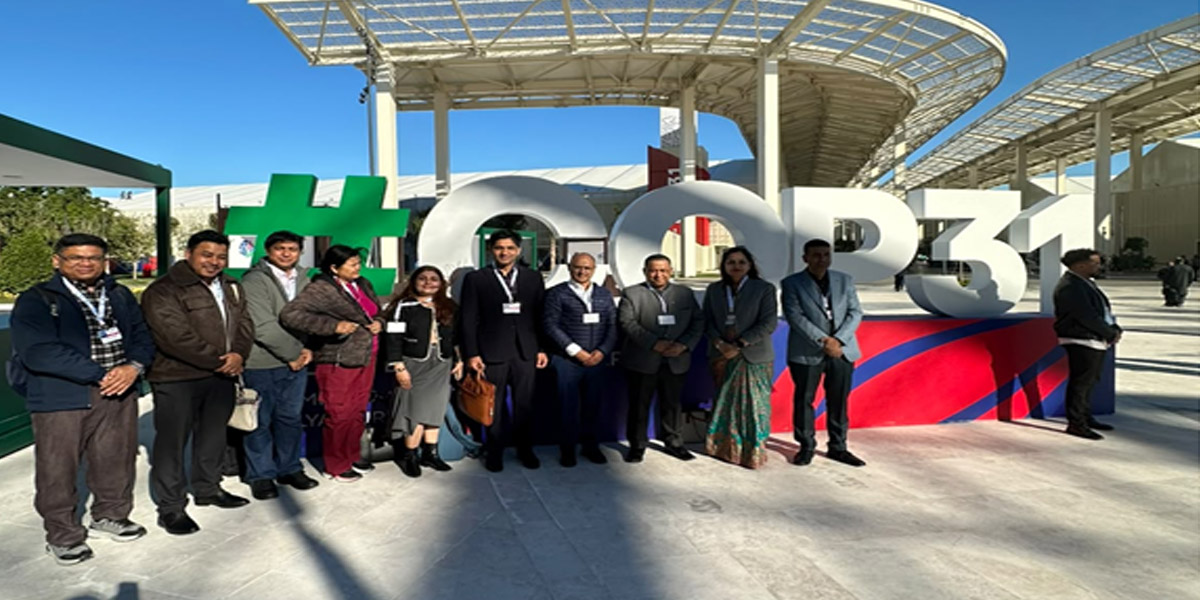
Carrying the voice of these pains and climate-related risks, Nepal has participated in the 31st Conference of the Parties to the United Nations Framework Convention on Climate Change (COP-31) which started today in Antalya, Turkey. Nepal is demanding climate justice from the international community by presenting incidents like Bhotekoshi, Budhigandaki, Lende Khola and Thame as examples.
A team including Foreign Minister Shishir Khanal and Health and Food Hygiene Minister Nisha Mehta has left for Turkey to address COP-31. Agriculture, Forest and Environment Minister Geeta Chaudhary will leave Turkey only on Tuesday. The opening session and the technical session will be conducted in the coop. In the first week of COP, i.e., the opening session, the heads of state, heads of government and high-ranking political leaders of the 192 parties to the United Nations Framework Convention will address.
On behalf of Nepal, Minister Khanal will address the opening session. Minister Chaudhary will lead the technical session. Similarly, Minister Mehta will give her views on the impact of the climate crisis on the health sector.
Dr. Secretary of the Ministry of Agriculture, Forestry and Environment who participated in the COP on behalf of Nepal. Dr. Rajendra Prasad Mishra and Head of Climate Change Management Division under the Ministry. The team including Maheshwar Dhakal will participate in various side events, participate in technical sessions, address the program in Nepal’s pavilion and advocate for the interests of Nepal on climate issues.
Similarly, the executive head of the National Disaster Risk Reduction and Management Authority, Dr. Dharmaraj Upreti will present examples of climatic disasters such as Rasuwa Bhotekoshi flood on August 10th and Budhigandaki flood on October 25th. Climatologist Manjit Dhakal, Raju Pandit Chhetri, Yugan Manandhar and other experts participating in the COP will advocate in favor of Nepal.
Similarly, it is believed that leaders of various political parties, parliamentarians, employees, representatives of civil society, governmental and non-governmental organizations and stakeholders present at the conference on behalf of Nepal will also help to make the climate issue raised by Nepal more effective.
Before the coup, Nepal had also published its position paper. In the position paper, as in the previous COPs, in COP-31, the risk faced by the Himalayan region due to climate change and the agenda of climate finance have been continued. Nepal will insist on taking ambitious steps to achieve the goal of limiting global temperature rise to 1.5 degrees Celsius compared to the pre-industrial era.
Agriculture, Forestry and Environment Minister Geeta Chaudhary has said that Nepal will raise climate justice, mountain issues, damage and loss and climate finance as major priorities in the COP-31 which started today.
“Nepal’s national priorities and the reality of the climate crisis will be strongly presented to the international community,” she said, “For COP-31, Nepal has prepared a national position paper on climate change.” This time, Nepal has given special priority to the common issues of mountain nations. In addition, Nepal and Bhutan have jointly advanced the agenda of ‘1.5 degree Celsius temperature rise and mountainous areas’.
Mentioning that due to global temperature increase, the mountains, glaciers, glaciers and the Himalayan ecosystems have been seriously affected, Minister Chaudhary said that its effects are extending to agriculture, hydropower, food security, river system and human life. According to him, sufficient financial resources, technology transfer and capacity development are necessary for adaptation in mountainous areas.
She said that Nepal will also raise the issue of climate justice with priority. Minister Chaudhary mentioned that although Nepal’s contribution to greenhouse gas emissions is low, it has to bear the effects of climate change disproportionately. She informed that the issue of human, economic and non-economic damage caused by the devastating floods and landslides in the Bhotekoshi-Rasuwa area will be presented to the international community.
Countries affected by climate change should get fair support. Minister Chowdhury said that Nepal will insist that countries affected by the Fund for Responding to Loss and Damage should receive easy, adequate and predictable financial resources.
This time at COP-31, Nepal is preparing to establish its own national pavilion and organize more than 40 side events from it. The Ministry is preparing to develop the Nepal Pavilion at Kop as a common platform to convey Nepal’s climate reality, local community experiences, voices of youth, women, civil society, private sector and other stakeholders to the international community.
In order to expand international cooperation on mountain issues, Nepal is going to organize a high-level program titled ‘Advancing the Mountain Agenda: Glaciers, Cryosphere and Resilience under Overshoot, Shared Responsibility and Sustainable Financing’ in collaboration with Tajikistan, Kyrgyzstan, Bhutan and Pakistan on November 12.
Similarly, a side event on ‘Strengthening Mountain Resilience through Adaptation Finance’ will be organized in collaboration with Nepal, Bhutan, Kyrgyzstan and ISIMOD. Minister Choudhary said that it is expected to make the international debate on glaciers, cryosphere, mountain resilience and adaptation finance more effective through these programs.
She informed that there is a program to sign a bilateral memorandum of understanding (MOU) on carbon trade between the governments of Nepal and Korea. Minister Choudhary expressed her belief that this will create new opportunities for cooperation between the two countries in the fields of carbon market development and climate mitigation.
She said that the participation of Nepal was not limited to the government delegation but the participation of civil society, local community, youth, women, private sector, experts and media was also given priority.
He said that COP-31 is not only an opportunity for Nepal to participate in the international conference, but it is also an important opportunity to present the reality of the climate crisis to the world, establish the common concerns of mountain nations, strengthen the demand for climate justice and expand international cooperation and cooperation. Minister Choudhary said that the cooperation and constructive suggestions of all political parties, civil society, private sector, development partners, expert community and media are necessary to effectively present Nepal’s national interests and climate priorities.
Head of Climate Change Management Division under the Ministry. Dhakal informed that Nepal will raise issues such as adaptation, loss and damage, agriculture and food security, health, climate finance and technology transfer. According to him, the delegation of Nepal has participated in the conference to highlight temperature rise in mountainous areas, climate justice, international cooperation, emission reduction, carbon market, capacity development and equitable transformation.
Similarly, gender equality, impact of climate change on children, youth, people with disabilities, tribal tribes and minority communities and climate justice are included with priority in Nepal’s position paper.
Executive Head of National Disaster Risk Reduction and Management Authority Dr. Upreti said that the details of the human and material damage caused by the climatic disaster, including the devastating flood in Rasuwa Bhotekoshi, will be presented to the international community and the affected countries will receive adequate compensation, support and climate justice. Rasas



