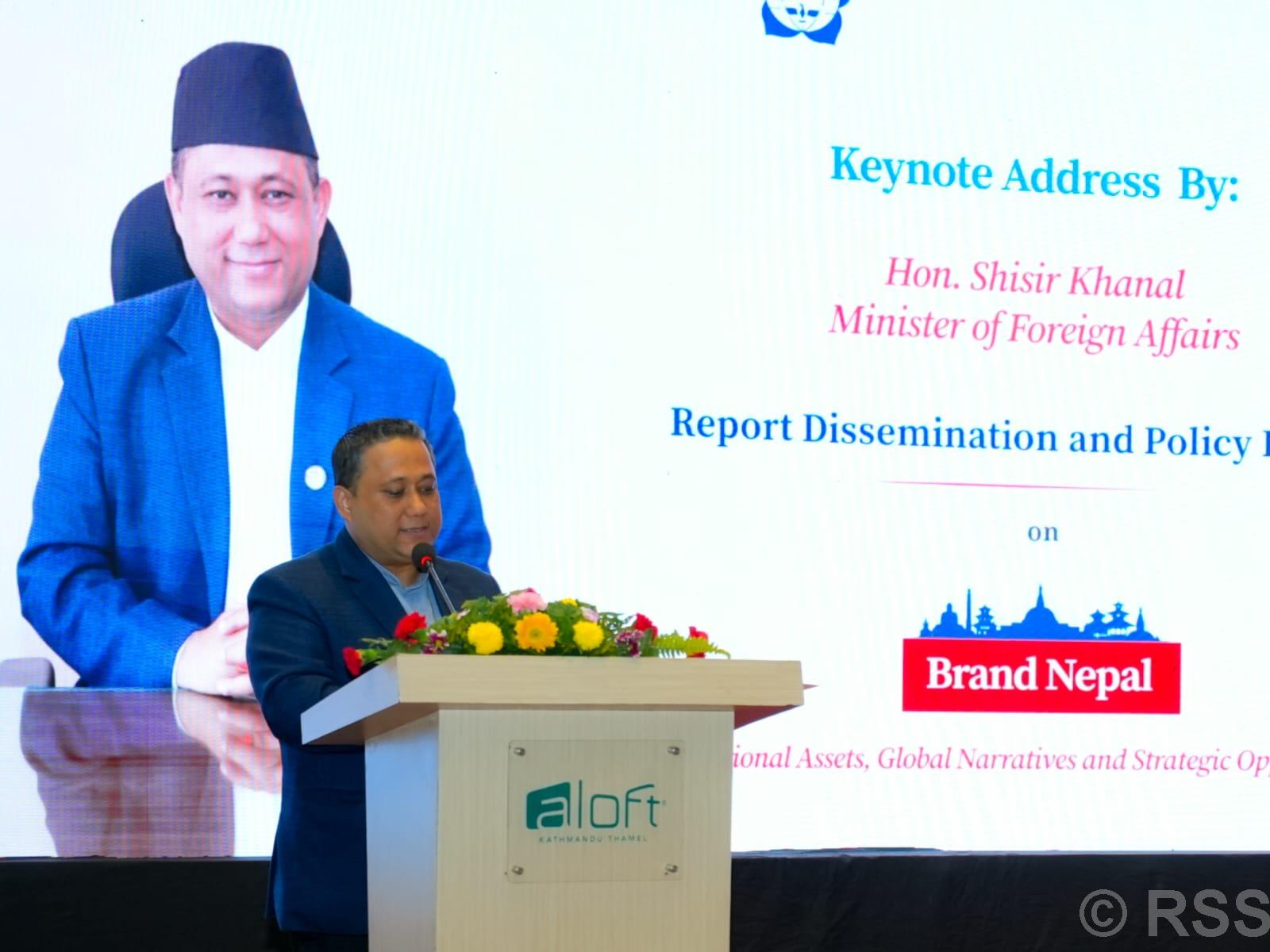
Kathmandu. Foreign Minister Shishir Khanal has said that the government is committed to further establish Nepal’s unique national identity, cultural diversity, natural heritage and contemporary achievements in the world.
Speaking as the chief guest at the public and policy dialogue program on the project report on ‘Brand Nepal: National Asset, Global Narratives and Strategic Opportunities’ organized by the Institute of Foreign Affairs (IFA), Foreign Minister Khanal explained Nepal’s international image and reputation as an important strategic asset of the country’s development aspirations and foreign policy.
A nation’s reputation plays an important role in determining investment decisions, diplomatic relations, consumer confidence and the country’s position in the international world. Therefore, Brand Nepal is an integral part of our development aspirations and foreign policy,” he said.
Foreign Minister Khanal mentioned that Nepal’s global identity is linked to Himalayas, Lumbini and rich cultural heritage and said that Nepal’s identity is not limited to these established identities.
According to Foreign Minister Khanal, the traditional handicrafts of Kathmandu Valley, weaving tradition of Himalayan community, art and environmental knowledge of Tharu community, literary expressions of Maithili, Bhojpuri and other languages and Kirat traditions of eastern hills are important bases of Nepal’s collective identity.
He said that the entrepreneurship of the Nepali community, the creativity of artists, the achievements of young innovators and the contribution of Nepali professionals around the world have further enriched Nepal’s international identity.
We want to enrich the established identity of Nepal and present its contemporary achievements and emerging capabilities clearly to the world. Our vision is to establish Nepal as a nation that is confident about its heritage, dynamic in outlook and contributing to the progress of the world,” he said.
Foreign Minister Khanal emphasized three priorities for the promotion of Brand Nepal. Firstly, to identify, protect and enhance the value of various national heritages of Nepal. Second, to build a comprehensive and effective national identity of Nepal through public diplomacy. And, thirdly, it is necessary to connect national identity with emerging strategic opportunities, he said.
Mentioning the cultural and economic potential of Nepal’s traditional handicrafts, agricultural practices, knowledge of traditional medicine, regional dishes and artistic expression, Foreign Minister Khanal said that protection of intellectual property rights, geographical indication (GI), certification system and quality standards are necessary to enhance the international recognition and competitiveness of such original products.
He mentioned that it is equally important to ensure that the relevant producers and local communities get proper benefits from the price increase of such products.
“We should aim to establish ‘Made in Nepal’ as a trusted brand in the world market based on originality, quality and responsible production,” he said.
Stating that public diplomacy is an important means to present Nepal’s international achievements and contributions more effectively to the world, Foreign Minister Khanal said that Nepal’s participation in United Nations peacekeeping operations, successful practice of community forestry, creative industry, the ability of Nepali youth in the digital sector and the tradition of cultural coexistence should be presented as Nepal’s contemporary identity.
He said that public diplomacy will help to directly convey Nepal’s capabilities and achievements to the international society, organizations and communities. Foreign Minister Khanal said that the Public Diplomacy Division of the Ministry of Foreign Affairs and Nepali Missions abroad are expanding Nepal’s international reach through cultural exchange, educational partnership, diaspora mobilization and strategic communication.
He mentioned that the ‘Sagarmatha Dialogue’, which was organized in 2025 and is preparing to be organized again in 2027, has facilitated dialogue on common global challenges such as climate change and sustainable development, and helped establish Nepal’s creative role on the international stage.
The national identity and narrative that we present to the world should also be confirmed by the experience of creating it in practice. From that, effective public diplomacy is developed,” he said.
Emphasizing on the need to connect Nepal’s national identity with strategic opportunities, Foreign Minister Khanal said that Nepal has potential in hydropower, tourism, digital services, innovation and creative industries.
He said that Nepal’s hydropower resources provide opportunities for regional energy cooperation, natural and cultural heritage can promote diverse and high-value tourism, and young professionals and entrepreneurs are connecting Nepal with the international market through digital services, innovation and creative industries.
Similarly, he said, Nepal’s experience regarding the Himalayan ecosystem and climate risk has made Nepal’s voice more relevant in global environmental diplomacy.
Mentioning that a visionary strategy, competent institutional structure, reliable infrastructure and continuous partnership are necessary to utilize these possibilities, he informed that the Economic Diplomacy Division of the Ministry of Foreign Affairs and Nepali Missions abroad are working to connect Nepal’s potential with foreign investment, markets, technology and knowledge networks.