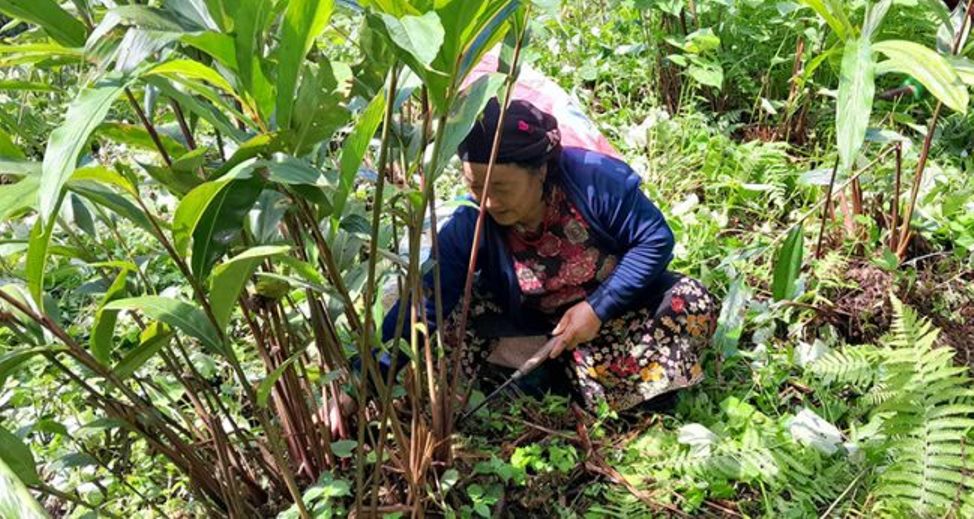
Panchthar Cardamom farming has been done right up to the yard of the house of Suk Bahadur Begha of Yangwarak Rural Municipality Ward No. 1 Thingepur. Begha, who used to grow cardamom up to Ghuryan, stopped cultivating paddy and corn in recent days.
Suk Bahadur’s neighbor Dhanmaya Begha also has a cardamom farm in Karesabari. Dhanmaya says that she wears cardamom everywhere. Balnand Begha of the plant of the same ward also has cardamom farming right up to his yard. Farmers in remote rural areas are expanding cardamom as their main crop by getting better prices in the market.
Suk Bahadur Begha, who expanded the cultivation of cardamom by massaging rice, corn and millet fields, says that cardamom is loved more in the family. This is what sustains and saves us. Cardamom is the only way for us to get cash’, Begha said, ‘Sahu also believes only by growing cardamom. Begha says that the farmer who grows cardamom gets the rest of the material from the local rural market throughout the year.
Farmers have given priority to making a living from cardamom. Suk Bahadur says that cardamom is the honor of farmers. ‘Cardamom has become our honor’, Purna Bahadur said, ‘We have planted cardamom in all places where Ghuryan and paddy are cultivated.’
The good price of cardamom is also the main reason why farmers are attracted to cardamom cultivation. Since last year, Cardamom Pratiman (per 40 kg) is being sold at a price of more than Rs 80,000. It would be good if the statue can be found up to Rs 80,000. In that case, it will be equal to Rs 2,000 per kg. That amount is not available from any food crop’, Suk Bahadur said, ‘If cardamom gets a good price, it will be beneficial for us.’
Dhanmaya Begha has also expanded the cardamom plantations. The price of cardamom is also good. This is the way to connect hands and mouths,” she said.
After incessant rain, a landslide swept away the main cardamom plantation in Dhanmaya’s Kholakholsi on May 8. So far, there has never been such a big damage”, Dhanmaya said, “The cardamom that was harvested by the farmers was left. Could you make some income from that?’
Many farmers have been attracted to cardamom because the plant’s full-fledged bigha rice, corn, and paddy cultivation do not raise the cost. Ramkumar Rai of Chamlingdanda of the same ward had a landslide in June 2080 and last May and washed away nearly 30 cardamom fields. Rai says that there will be no other source of income after there is no production of cardamom. The residents here are stuck in the village because of cardamom. Otherwise, we would have been unable to walk because we would not even have enough to eat,” Rai said, “Our daily life is based on cardamom. Cardamom is produced not only in Yangwarak-1, but also in more than 40 wards of the district.
In Panchthar, in the financial year 2082/83, the total area of cardamom cultivation is three thousand 326 hectares, according to the statistics of Agricultural Knowledge Center. Similarly, Pradeep Nepali, Agricultural Extension Officer of Panchthar Agricultural Knowledge Center informed that a total of 1 thousand 396.92 metric tons of cardamom was produced. -Rasus