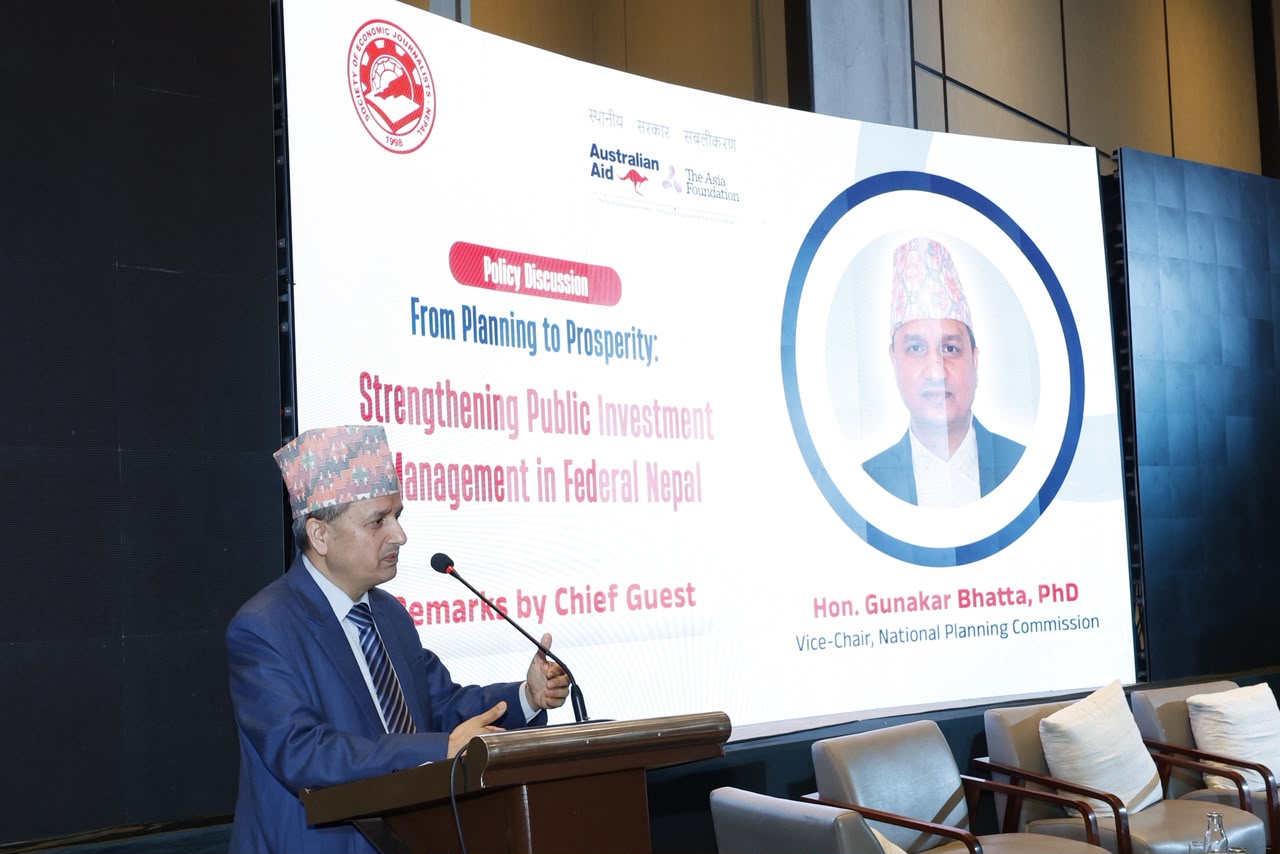
Kathmandu. Vice President of National Planning Commission Dr. Gunakar Bhatt has said that the old style of focusing development and investment in one area has put the country at great financial and physical risk. He said that investment and development programs should be decentralized nationwide.
Speaking at the program organized by the Nepal Economic Journalists Association (SEJAN) in the capital on Tuesday, Vice President Dr. Bhatt informed that the Planning Commission is doing its homework to formulate a ‘Nepal Development Approach’ for the next 25 years. Reminding that in the past 7-8 percent economic growth was achieved, he emphasized that continuous dialogue between the private sector, academia and the government is necessary for high growth.
He mentioned that the recent floods and landslides have caused the most damage to the hydropower sector while investing in one place. “When 13-14 hydropower plants are built in the same river, when a disaster occurs, all the projects will be swept away and cause great damage,” he said.
According to him, when investing in any project, environmental risk, social return and economic return must be considered. There should be cooperation between the private sector and the government, not competition. Bhatt’s opinion. Emphasizing the effectiveness of public investment, he said that the government should intervene only when the market fails.
According to him, Nepal is facing three major challenges due to geo-political tension, petroleum price fluctuations, climate change and artificial intelligence (AI). Pointing to the regional inequality, he informed that while the per capita income of Bagmati province is around 2,600 dollars, it is only 1,000 to 1,100 dollars in Karnali, Madhes and Far West. He emphasized that private investment should be extended to Mofsal to bridge this gap.
Presenting a working paper on ‘public investment in Nepal, strategic priorities, financial choices and development results’, Dr. Baikunth Aryal, the former Chief Secretary of the Government of Nepal, said that the government should draw a clear line of demarcation between building roads and driving vehicles by the private sector. Roads are built by the government, but vehicles are dug by the private sector. “The government will only look at traffic, regulation and security,” he said. He said that when the government started doing business by itself, the basic infrastructure was not built, nor was the private sector able to work confidently.
Former Chief Secretary Dr. According to Aryal, in a country with weak infrastructure like Nepal, at least 8 to 12 percent of the gross domestic product (GDP) should be invested in infrastructure, but currently only 4 to 5 percent is being spent. Presenting the data of the past 51 years, he said that Nepal has been stuck in a vicious cycle of low economic growth for a long time.
He mentioned that the average growth rate during this period was only 4.27 percent and only one year saw a double digit growth. He said that after the open market policy, the contribution of the industry to the GDP has reached 21 percent, but now the share of the manufacturing industry has fallen below 5 percent. Although the service sector is above 60 percent, he presented the statistics that the productivity is weak.
Out of 45 public institutions in the country, 16 are in loss. He said that even after 11 years have passed since Janakpur cigarette factory was closed, the liability remains and Nepal Metal Company, which opened in 2021, is only carrying the liability without producing yet. As soon as Dasai comes, the Ministry of Finance is flooded with people asking for loans to pay the salaries and expenses of the institute’s employees. This practice should be stopped,” he said. He argued that there is no justification for the government to continue running sick institutions of a commercial nature apart from strategic, security and basic services.
He suggested four points to make the policy and regulation tighter without the government interfering in business. Government presence is low but strong regulation is the first requirement. Secondly, instead of putting all the projects in one bucket, sectoral priorities should be set and once set, they should stick to it for 5 years.
Third, improvement in investment-friendly thinking is necessary. “When making laws, we should give up the mindset of hurting 99 good investors to catch one wrong person,” he said. Fourth, the duality seen in federalism must be ended immediately. He emphasized on the need to remove the duplication of separate offices and conditional grants for the same nature of work between the union, state and local levels.
Industrialist Shashikant Agarwal, who participated in the group discussion on mandatory restructuring program before running the closed government industries, said that sick government industries such as Hetauda cloth, Butwal thread and Birgunj sugar should be restructured before they are started again. He says that the current government’s announcement to operate closed industries is only a ‘political stunt’. In the discussion on ‘Effectiveness of Public Investment: Project Selection, Operational Feasibility and Accountability of the Institute’, other participants also emphasized that restructuring is mandatory.
Shashikant Agarwal, who is also the director of Reliance Spinning Mills, said that more government investment in old machines is like a crime. “The old machines of Hetauda textile industry run at 160 rpm, today the modern machines of the private sector run at 2,000 rpm,” he said. He informed that the daily capacity of Birgunj sugar mill is only 6 tons whereas the capacity of modern mill is 5000 tons. He said that the government should not compete in sectors such as textiles, yarn and sugar as the private sector has been enabled. He suggested to convert the land of closed industries into a park or a useful public structure.
Arpita Nepal, co-founder and research director of Samriddhi Foundation, who participated in the group discussion, said that there is no clear legal definition of public investment. She said, “When the institutions were opened, the government should leave when the private sector came in.”
He suggested that a sick company like in Indonesia can be disinvested by setting up an asset management company and giving shares to the employees. She said that the reform of the institute should start with transparent election funding of political parties. He emphasized that Nepal should be managed according to the reality without copying the models from outside.
Kailash Kumar Paneru, the former general manager of Nepal Aushadhi Limited, said that when the procurement and regulation of the institute under the Ministry of Industry was linked with the Ministry of Health, it took 7 months to reach an agreement. He recalled that although private companies would take the market by giving gifts and commissions to doctors, it was Aushadhi Limited that came forward to prevent the shortage of cetamol and vital water during the times of Covid and dengue.
“We broke the syndicate by giving the hemodialysis fluid that cost Rs 390 at Veer Hospital for Rs 350,” he said. He suggested that the institute should be freed from the interference of the ministry and given professional autonomy for the protection of public health.